
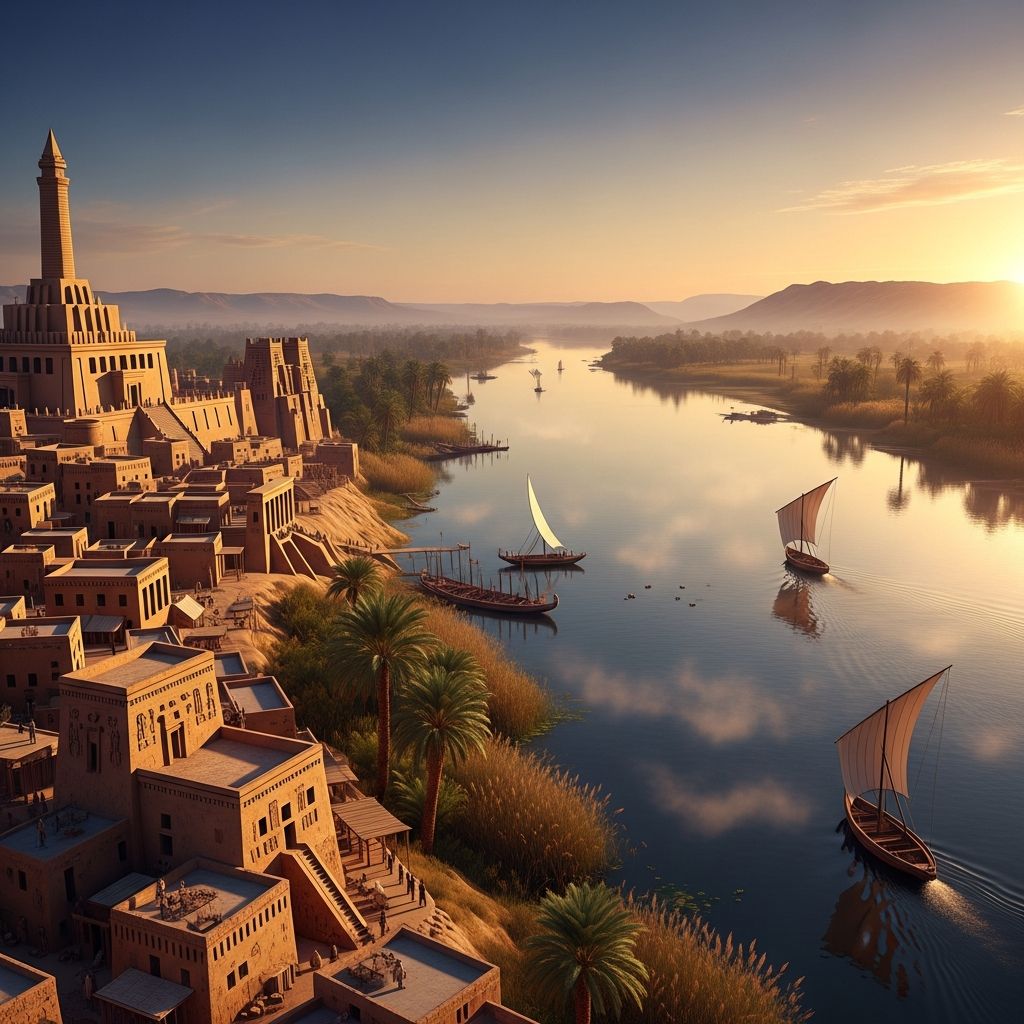
Ancient rivers served as the lifeblood of humanity’s earliest societies, providing essential resources that transformed nomadic groups into thriving urban centers. These waterways delivered water for sustenance, enriched soils for farming, and created pathways for commerce and cultural exchange, laying the foundations for some of the world’s most enduring civilizations.
The Foundations of River-Based Societies
Humanity’s shift from hunter-gatherer lifestyles to settled communities began around 12,000 years ago in regions blessed by reliable river systems. These areas offered predictable water supplies and nutrient-rich sediments from floods, enabling surplus food production. This agricultural revolution supported population growth, specialization of labor, and the emergence of cities, governments, and writing systems.
In the **Fertile Crescent**, a crescent-shaped region spanning modern Iraq, Syria, Turkey, and beyond, rivers turned arid lands into paradises of productivity. Here, early innovators domesticated crops like wheat and barley, alongside animals such as goats and sheep, fostering the first complex societies.
Mesopotamia: Between the Twin Rivers
The Tigris and Euphrates rivers, often called the cradle of civilization, flowed through Mesopotamia, nourishing Sumerian, Akkadian, and Babylonian cultures. Their annual floods deposited silt, creating fertile plains ideal for intensive farming. Farmers developed irrigation canals and plows, boosting yields and allowing cities like Ur and Babylon to flourish.
- Irrigation Mastery: Extensive canal networks distributed water, preventing famine and enabling year-round cultivation.
- Urban Centers: Populations swelled, leading to innovations in governance, law (e.g., Hammurabi’s Code), and literature (e.g., Epic of Gilgamesh).
- Trade Highways: Rivers linked city-states, facilitating exchanges of timber, metals, and gems from distant lands.
These rivers not only sustained life but symbolized prosperity, with deities embodying their floods and flows in religious practices.
The Nile: Egypt’s Eternal Gift
Stretching over 4,000 miles through Africa, the Nile River was indispensable to ancient Egypt, sustaining society for over 5,000 years. Its predictable annual inundation, driven by monsoon rains, flooded banks with black silt, transforming deserts into arable fields. Egyptians timed planting around this cycle, growing wheat, barley, and flax with minimal effort.
| Aspect | Nile’s Contribution |
|---|---|
| Agriculture | Fertile silt from floods; basin irrigation. |
| Transportation | Northward flow aided goods and people movement to Mediterranean and Red Sea. |
| Monuments | Quarried stones floated to pyramid sites via canals. |
| Religion | God Hapi represented life-giving floods. |
The Nile unified Upper and Lower Egypt, enabling pharaonic rule and monumental architecture like the pyramids at Giza. It was revered as a deity, central to myths and rituals.
Indus Valley: Engineering Marvels by the River
The Indus River, originating in the Himalayas and flowing to the Arabian Sea, supported the Indus Valley Civilization (c. 7000–1900 BCE) in present-day Pakistan and India. Cities like Harappa and Mohenjo-Daro boasted advanced urban planning, with baked-brick homes, grid streets, and sophisticated drainage systems.
- Hydraulic Expertise: Reservoirs and wells managed seasonal floods for irrigation.
- Maritime Links: River access to the sea spurred trade with Mesopotamia, evidenced by seals found in Sumerian sites.
- Cultural Uniformity: Standardized weights, measures, and script indicate a cohesive society.
Though its script remains undeciphered, the Indus legacy highlights rivers’ role in fostering equality and technological prowess.
Yellow River: China’s Sorrow and Joy
Known as the “Mother River,” the Yellow River (Huang He) birthed Chinese civilization in its loess-rich valley. Early dynasties like the Xia and Shang thrived on its fertile soils, developing rice and millet farming, bronze work, and oracle bone writing.
Its yellow hue from silt made it a double-edged sword: bountiful harvests alternated with devastating floods, earning its moniker “China’s Sorrow.” Yet, this duality spurred hydraulic engineering, including dikes and canals that defined imperial China.
Other Waterways of Influence
Beyond these core rivers, others shaped history. The Ebro River in Spain marked boundaries in the Punic Wars, separating Roman and Carthaginian territories and influencing Mediterranean power dynamics. In the Roman world, rivers like the Tiber, Rhine, and Danube facilitated military conquests, trade, and cultural integration across Europe and beyond.
These waterways were more than physical features; they embodied divinity, health, and imperial might in Roman lore.
Rivers in Culture, Religion, and Daily Life
Rivers permeated ancient worldviews. In Egypt, the Nile was divine; in Mesopotamia, floods were godly decrees; in India, the Indus hinted at sacred crossings (tirthas). They inspired art, myths, and rituals, serving as metaphors for life’s flow and renewal.
Daily, rivers provided drinking water, fish, and transport, while floods fertilized fields. Legal systems governed water rights, and economies boomed via riverine trade routes connecting distant realms.
Challenges and Innovations
Rivers brought peril—unpredictable floods ravaged crops and cities. Mesopotamians built levees; Egyptians tracked stars for flood predictions; Chinese engineered grand canals. These adaptations highlight human ingenuity in harnessing nature.
Climate shifts eventually strained some systems, contributing to declines, yet their legacies endure in modern infrastructure.
Frequently Asked Questions
What made rivers crucial for ancient civilizations?
Rivers supplied water, fertile silt for farming, and routes for trade and transport, enabling population growth and societal complexity.
Which river is called the ‘Cradle of Civilization’?
The Tigris and Euphrates in Mesopotamia, where the first cities and writing emerged around 12,000 years ago.
How did the Nile influence Egyptian society?
Its floods provided fertile soil and a calendar for agriculture, while facilitating unity, trade, and pyramid construction.
Why is the Yellow River known as ‘China’s Sorrow’?
Frequent floods caused massive destruction, despite its vital role in agriculture and early dynasties.
Did ancient rivers support international trade?
Yes, the Indus connected to Mesopotamia via sea, and Nile/Euphrates networks exchanged goods across regions.
These rivers’ stories reveal how geography molded history, with echoes in today’s world. Their management challenges persist, underscoring sustainable stewardship’s timeless importance.
References
- 13 Rivers That Changed The Flow Of History — Ranker. N/A. https://www.ranker.com/list/rivers-flow-history/michael-muir
- The Role of Rivers in Ancient Civilizations — World Rivers. 2025-04-26. https://worldrivers.net/2025/04/26/the-role-of-rivers-in-ancient-civilizations/
- 8 Ancient Rivers Around the World That Are Also Cultural Treasure Troves — Times of India. N/A. https://timesofindia.indiatimes.com/travel/destinations/8-ancient-rivers-around-the-world-that-are-also-cultural-treasure-troves/photostory/116967215.cms
- Now As Then, Rivers Are Crucial to Our Prosperity — Environmental Law Institute. N/A. https://www.eli.org/vibrant-environment-blog/now-then-rivers-are-crucial-our-prosperity
- Rome’s Wondrous Rivers — Origins OSU. N/A. https://origins.osu.edu/review/romes-wondrous-rivers
- World Great Rivers Civilizations Forum — HNFO.gov.cn. N/A. http://www.hnfo.gov.cn/sitesources/hnswswen/page_pc/xwzx/articlee4e3714e65654d64b6f819092558abbf.html

- Integrated M.A. in Applied Linguistics, University of Hyderabad
- 5+ years in editorial, instructional, SEO, and research-based writing
Sneha is a relationships and lifestyle writer with a strong foundation in applied linguistics and certified training in relationship coaching. She brings over five years of writing experience to theskillvault, crafting thoughtful, research-driven content that empowers readers to build healthier relationships, boost emotional well-being, and embrace holistic living. Her writing and insights reflect the belief that beauty, happiness, and wellness…