
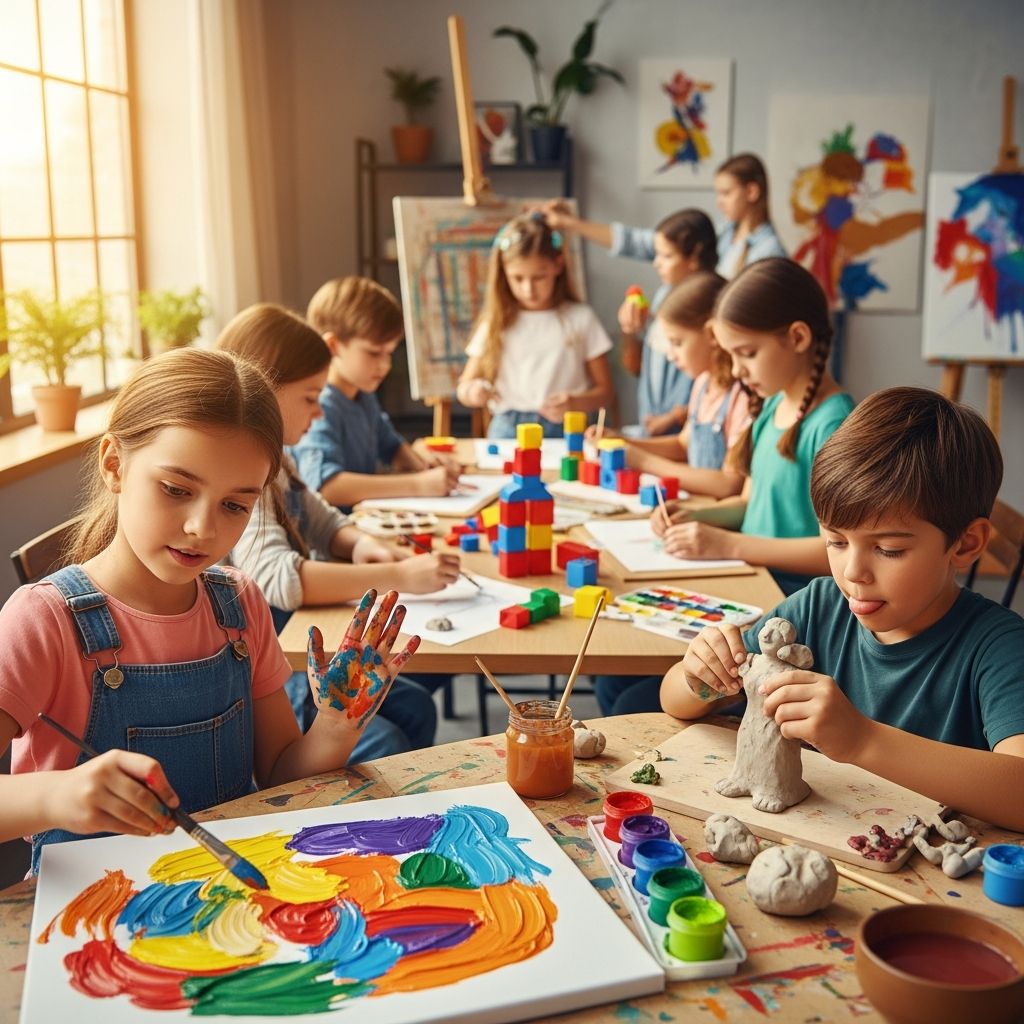
Creative pursuits like drawing, painting, and crafting offer children more than entertainment; they cultivate essential cognitive and emotional skills. In today’s fast-paced, screen-dominated environment, art stands out as a vital tool for improving concentration and emotional understanding.
Navigating Distractions: Art as a Focus Anchor
Modern children face constant interruptions from devices and rapid stimuli, which fragment attention spans. Engaging in artistic endeavors counters this by promoting sustained engagement. When kids immerse themselves in creating, they experience a profound state of absorption, often termed ‘flow,’ where external distractions diminish.
This immersion trains the brain to maintain focus over extended periods. Unlike digital media that delivers quick rewards, art demands patience and deliberate actions, gradually strengthening neural pathways for attention regulation.
Mechanisms Behind Art’s Concentration Power
- Structured Progression: Art projects typically involve ideation, execution, and reflection, mirroring task completion in academics and daily life. This sequence builds organizational habits and perseverance.
- Sensory Integration: Manipulating materials like clay or brushes engages multiple senses, anchoring attention and reducing mental wanderings.
- Stress Reduction: Creative processes lower cortisol levels, creating a relaxed state conducive to better focus. Research indicates arts participation can decrease stress by up to 25%.
For neurodivergent children, such as those with ADHD, art provides a low-pressure outlet to practice regulation, enhancing working memory and problem-solving.
Cultivating Emotional Intelligence Through Creation
Emotional intelligence (EQ)—encompassing self-awareness, self-regulation, empathy, and social skills—is as crucial as IQ for success. Art uniquely equips children to navigate feelings non-verbally, bridging gaps in verbal expression.
Self-Expression and Awareness
Children often lack words for complex emotions, but art translates them into visuals. Dark hues might represent sadness, while vibrant strokes convey joy. This externalization aids in recognizing and naming feelings, foundational to self-awareness.
Post-creation discussions, like ‘What inspired these colors?’, expand emotional vocabulary. Over time, kids better articulate states like frustration or pride, improving self-regulation.
Fostering Empathy and Social Bonds
Viewing peers’ artwork exposes children to diverse emotional landscapes, prompting questions like ‘What do you think this artist felt?’. Such interactions build perspective-taking, a core empathy component.
Group projects further enhance collaboration, teaching compromise and respect. Studies from arts-rich environments show increased empathy and reduced conflict.
| EQ Component | How Art Supports It | Evidence |
|---|---|---|
| Self-Awareness | Reflection on personal creations | Recognizing hard-to-verbalize emotions |
| Self-Regulation | Mindful process embraces mistakes | Reduces stress by 25% |
| Empathy | Interpreting others’ work | Stronger in collaborative settings |
| Social Skills | Group sharing and feedback | Improved relationships |
Scientific Backing: Research on Art and Development
Empirical evidence underscores art’s benefits. A National Endowment for the Arts study found 70% of arts-program participants reported enhanced emotional expression. Peer-reviewed research links regular creative practice to lower stress, better regulation, and heightened empathy in classrooms.
Early childhood experts from Michigan State University emphasize art’s role in stress relief and emotional processing, recommending it for holistic development. For ADHD, art therapy boosts attention and memory, per CHADD guidelines.
Implementing Art for Maximum Impact
Parents and educators can harness art without specialized tools. Consistency is key—short, daily sessions yield cumulative gains.
Setting Up Success
- Dedicate a distraction-free zone with basics: paper, crayons, paints.
- Start with guided prompts, e.g., ‘Draw your mood as weather’.
- Incorporate reflection: Discuss feelings evoked by the work.
Age-Tailored Activities
Ages 3-5: Finger painting for free expression, building motor skills alongside emotions.
Ages 6-8: Storytelling through drawings to sequence ideas and feelings.
Ages 9+: Collaborative murals for empathy and team dynamics.
Incorporate mindfulness: Pair art with breathing exercises for amplified calm.
Real-World Transformations
Educators report shy children gaining confidence via shared artwork, while high-energy kids learn patience. Parents note improved focus at homework and calmer emotional responses post-art routines. Long-term, these skills predict better academic performance, relationships, and resilience.
Frequently Asked Questions
Does art really improve focus in screen-addicted kids?
Yes, by fostering flow states and reducing stress, art rebuilds attention spans fragmented by digital media.
Can art help children with anxiety or ADHD?
Absolutely; it offers non-verbal outlets and regulation tools, with studies showing memory and attention gains.
How often should kids do art for EQ benefits?
20-30 minutes, 3-5 times weekly, for noticeable improvements in awareness and empathy.
What if my child says their art is ‘bad’?
Emphasize process over product; praise effort to build confidence without perfectionism.
Are structured classes better than free play?
Both work; classes add social elements for empathy, while free art boosts self-directed focus.
Sustaining Lifelong Habits
Integrate art into routines: family craft nights or school clubs. Track progress via journals of creations and feelings. As children mature, art evolves into tools for stress management and innovation.
Ultimately, art equips kids for a world demanding adaptability. By prioritizing creativity, we nurture focused, emotionally savvy individuals ready for challenges.
References
- The Art of Creating: Why Art is Important for Early Childhood Development — Michigan State University Extension. 2023-06-15. https://www.canr.msu.edu/news/the_art_of_creating_why_art_is_important_for_early_childhood_development
- Build Social and Emotional Regulation Skills Through Art — CHADD. 2024-02-20. https://chadd.org/adhd-news/adhd-news-caregivers/adhd-weekly-build-social-and-emotional-regulation-skills-through-art/
- How The Arts Promote Social-Emotional Learning (SEL) In Students — Kidsmart.org. 2023-11-10. https://www.kidsmart.org/the-joy-journal-2/how-the-arts-promote-social-emotional-learning-sel-in-students
- The Power of Art in Building Emotionally Intelligent Classrooms — Maine College of Art & Design. 2025-08-29. https://online.meca.edu/news-events/2025-08-29/the-power-of-art-in-building-emotionally-intelligent-classrooms
- Unleashing the Power of Creativity: How Art Ignites Emotional Resilience in Children — Playday.com. 2024-05-12. https://www.playday.com/post/unleashing-the-power-of-creativity-how-art-ignites-emotional-resilience-in-children

Medha Deb is an editor with a master's degree in Applied Linguistics from the University of Hyderabad. She believes that her qualification has helped her develop a deep understanding of language and its application in various contexts. Medha specializes in the areas of beauty, health, sports, and wellness and is committed to ensuring that the content on the website is…