
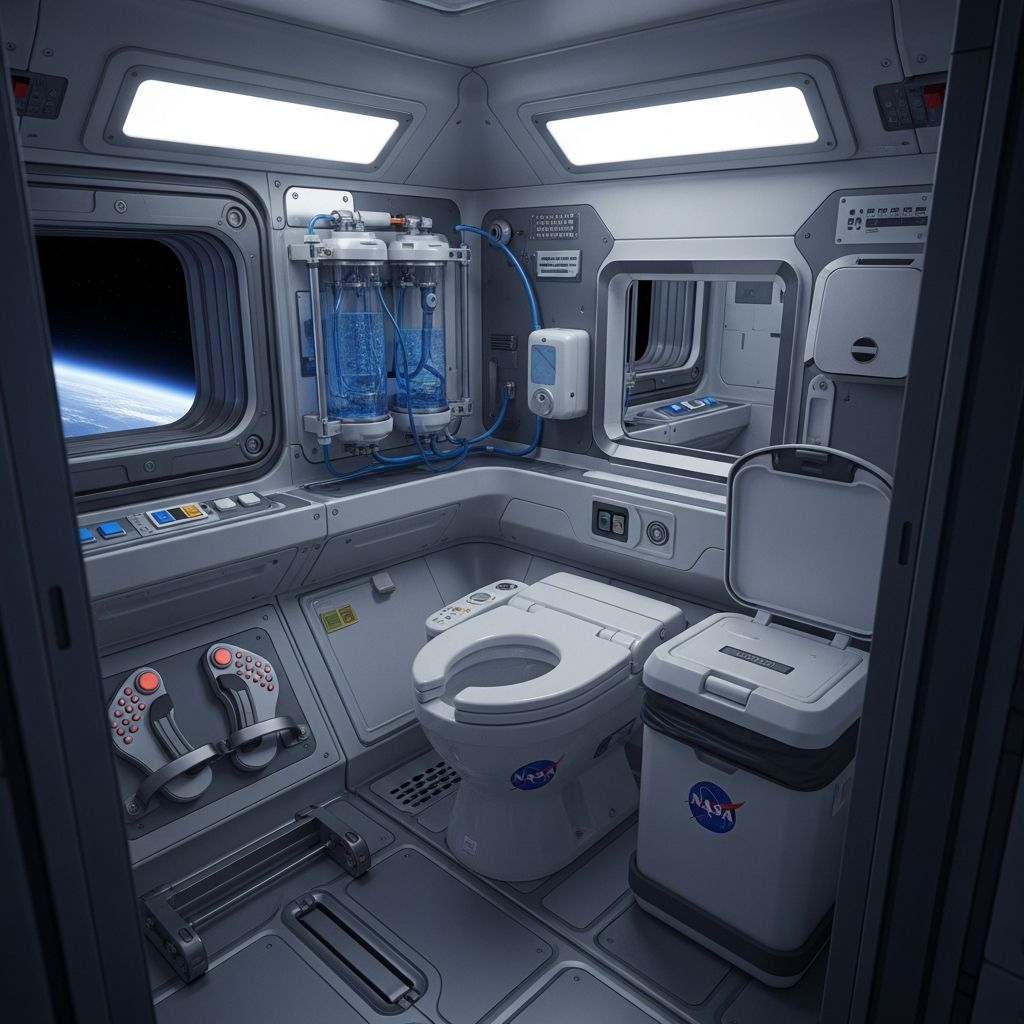
In the vast expanse of space, where gravity’s pull is absent, even the most basic human needs like using the bathroom become complex engineering puzzles. Astronauts aboard the International Space Station (ISS) and future deep-space missions rely on sophisticated systems to handle waste management, ensuring hygiene, health, and mission success. These innovations transform everyday necessities into feats of technology.
The Physics of Zero-Gravity Sanitation
Without gravity to guide waste downward, traditional toilets fail. Instead, space bathrooms employ powerful airflow systems that suck urine and feces away from the body into separate collection chambers. This vacuum-like mechanism prevents floating particles, a hazard that could damage equipment or spread bacteria.
Airflow is precisely controlled to mimic gravity’s role. Fans generate suction strong enough to overcome microgravity’s tendency to let matter drift freely. For urine, a funnel directs the stream into a hose, while the seat handles solids. These components operate simultaneously, accommodating varied user needs.
NASA’s Universal Waste Management System (UWMS)
NASA’s latest advancement, the Universal Waste Management System (UWMS), represents a leap in space sanitation. Launched to the ISS via Northrop Grumman’s 14th resupply mission and slated for Orion in Artemis II, this toilet prioritizes comfort, efficiency, and adaptability.
The ‘universal’ aspect allows seamless integration across spacecraft. On the ISS, it preprocesses urine for water recycling, reclaiming up to 90% of liquids—including sweat and urine—for drinking after purification. Astronaut Jessica Meir notes, ‘Today’s coffee is tomorrow’s coffee,’ highlighting the closed-loop water cycle mimicking Earth’s natural processes.
Key Features Enhancing Usability
- Automatic Activation: Lifting the lid triggers airflow, improving odor control and user convenience.
- Ergonomic Design: A compact, pointed seat ensures precise body contact in microgravity, reducing mishaps and cleanup time.
- Gender-Inclusive Funnel: Allows simultaneous use by multiple users, addressing feedback from female astronauts.
- Restraints and Holds: Foot pedals and hand grips replace cumbersome thigh straps, stabilizing users without hassle.
- Durable Materials: Corrosion-resistant parts minimize maintenance, freeing crew for scientific tasks.
These enhancements stem from direct astronaut input, making the UWMS more intuitive and reliable than predecessors.
Historical Evolution of Space Toilets
Space sanitation has evolved dramatically since the early days. Mercury and Gemini missions used rudimentary bags and tubes, often leading to leaks and discomfort. Apollo astronauts contended with fecal collection bags strapped to their buttocks, plagued by odors and detachment issues.
Skylab introduced the first seated toilet with airflow, a major upgrade. The Space Shuttle refined this with separate urine and fecal systems, including waterless urine collection. The ISS’s early toilets built on these, but clunky designs prompted the UWMS development.
| Era/Mission | Technology | Challenges Overcome |
|---|---|---|
| Mercury/Gemini | Roll-on bags, tubes | Leaks, hygiene |
| Apollo | Fecal bags | Odor, adhesion |
| Skylab/Shuttle | Airflow seats, funnels | Floating waste |
| ISS/UWMS | Universal system, recycling | Comfort, efficiency |
Daily Routines for Astronauts
Astronauts follow strict protocols. For urination, men align with the funnel; women use it or the seat. Bowel movements require positioning with restraints. Post-use, wipes and gloves go into sealed bags, while solids compact into canisters.
Privacy is limited—doors have small windows for safety. Schedules align with sleep cycles to minimize disruptions. Urine preprocesses with chemicals before recycling; feces store for Earth return or atmospheric disposal via cargo ships.
Health and Hygiene Protocols
- Rigorous handwashing with no-rinse sanitizers.
- Daily equipment checks to prevent clogs.
- Microbial monitoring to curb infections.
- Exercise to regulate bodily functions amid fluid shifts.
Water Recycling: From Waste to Resource
Water scarcity drives innovation. ISS systems distill urine, sweat, and humidity into potable water via filtration and oxidation. The UWMS boosts this efficiency, integrating directly with life support.
Future plans explore fecal water recovery, though current tech focuses on liquids. This closed-loop approach sustains long missions, vital for Mars voyages where resupply is impossible.
Challenges for Deep-Space Missions
Beyond low-Earth orbit, radiation, distance, and duration amplify issues. Orion’s UWMS variant stores waste without pretreatment for shorter trips like Artemis II. For Mars, compact, zero-water systems are essential, potentially incorporating microbial breakdown.
Psychological factors matter too—familiar routines combat isolation stress. Engineers tackle bone loss and fluid redistribution affecting elimination.
Future Innovations on the Horizon
Emerging tech includes self-cleaning surfaces, AI-monitored usage for health data, and bio-reactors converting waste to fertilizer for space farming. NASA’s research promises sustainable hygiene for lunar bases and Martian habitats.
Frequently Asked Questions (FAQs)
Do astronauts drink their own recycled urine?
Yes, after advanced purification, up to 90% of water—including urine—is reclaimed and safe to drink on the ISS.
How is solid waste handled in space?
Feces are sealed in canisters, stored, and either returned to Earth or incinerated during cargo re-entry.
Is the space toilet comfortable?
The UWMS features ergonomic designs based on astronaut feedback, with restraints for stability and minimal cleanup.
Can men and women use the same setup?
Yes, the dual funnel-seat system supports simultaneous or individual use by all genders.
What happens to toilet paper in space?
It’s disposed in airtight bags with other hygiene items and processed as waste.
References
- Boldly Go! NASA’s New Space Toilet Offers More Comfort, Improved Efficiency for Deep Space Missions — NASA. 2021-09-01. https://www.nasa.gov/humans-in-space/boldly-go-nasas-new-space-toilet-offers-more-comfort-improved-efficiency-for-deep-space-missions/
- How Do Astronauts Go to the Bathroom? — Nerd Nite / WMFE. Accessed 2026. https://nerdnite.com/videos/how-do-astronauts-go-to-the-bathroom/
- How do astronauts go to the bathroom in space? — ABC News. 2026-04-02. https://abcnews.com/video/131663718/
- Space Station Conditions and Environments — NASA. 2024-05-15. https://www.nasa.gov/mission_pages/station/expeditions/current/living-in-space.html

- Integrated M.A. in Applied Linguistics, University of Hyderabad
- 5+ years in editorial, instructional, SEO, and research-based writing
Sneha is a relationships and lifestyle writer with a strong foundation in applied linguistics and certified training in relationship coaching. She brings over five years of writing experience to theskillvault, crafting thoughtful, research-driven content that empowers readers to build healthier relationships, boost emotional well-being, and embrace holistic living. Her writing and insights reflect the belief that beauty, happiness, and wellness…