
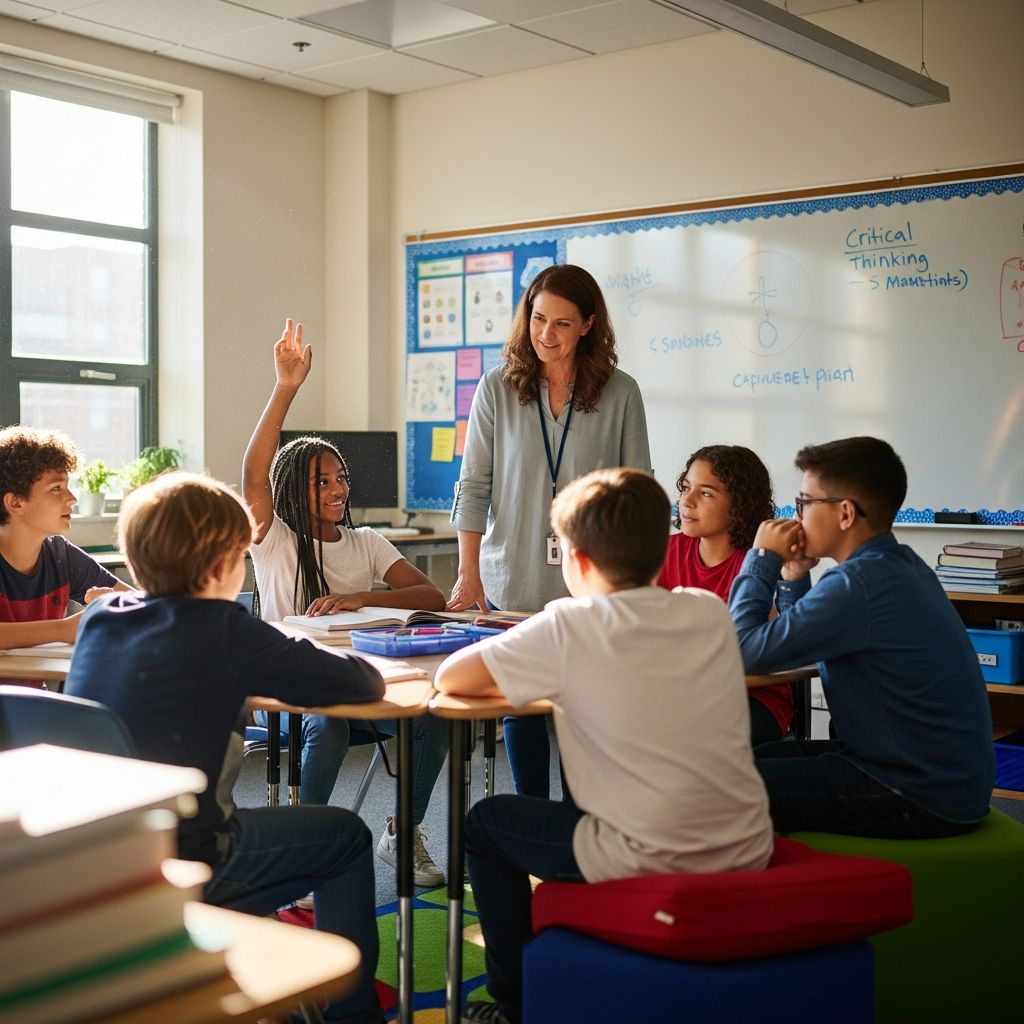
Strategic classroom conversations transform passive learning into active engagement, driving significant improvements in academic outcomes and personal development. Research shows that when students articulate ideas and respond to peers, they achieve deeper comprehension and retention of complex concepts.
The Science Behind Student-Led Discussions
Student talk is not mere chatter; it is a powerful catalyst for cognitive growth. Experimental studies reveal that discussions emphasizing open-ended questions and student-initiated contributions lead to superior performance on content assessments compared to traditional lecture formats. For instance, participants in dialogue-rich lessons produced essays demonstrating nuanced understanding and integrated prior knowledge more effectively.
These interactions promote higher-order thinking skills, such as analysis and synthesis, which are essential for long-term academic success. Even silent observers benefit by exposure to diverse viewpoints, expanding their background knowledge without verbal participation. This inclusive dynamic ensures equitable learning opportunities across proficiency levels, including English learners who thrive when verbalizing concepts.
Academic Gains from Purposeful Peer Exchanges
Regular peer dialogues sharpen literacy and content mastery. When students explain math strategies, debate historical events, or explore scientific inquiries aloud, they refine their reasoning and identify knowledge gaps. Listening to classmates introduces novel problem-solving approaches, enriching individual perspectives.
Moreover, oral expression precedes and enhances writing proficiency. Pre-writing discussions allow students to organize thoughts, receive peer feedback, and clarify ideas, resulting in more coherent compositions. Teachers report that pair activities outperform whole-class presentations in sustaining attention and promoting genuine interaction.
| Conversation Type | Key Benefits | Evidence-Based Impact |
|---|---|---|
| Think-Pair-Share | Processes ideas aloud; reveals misconceptions | Deeper engagement; improved articulation |
| Whole-Group Debate | Exposes multiple viewpoints; builds arguments | Enhanced comprehension; nuanced essays |
| Small-Group Jigsaw | Collaborative expertise sharing | Broadened knowledge; social awareness |
Building Social-Emotional Skills Through Talk
Beyond academics, conversations cultivate essential interpersonal competencies. Participants practice self-regulation by balancing speaking turns and active listening, fostering empathy and respect for differing opinions. Structured dialogues encourage perspective-taking, vital for social awareness in diverse settings.
Teachers can explicitly highlight these growth areas, reinforcing emotional intelligence alongside content goals. For example, prompting students to paraphrase a peer’s idea before responding models thoughtful communication. Over time, these habits reduce conflicts and build classroom community.
Practical Techniques for Effective Discussions
To maximize impact, educators must scaffold conversations deliberately. Begin with direct instruction on core content via readings, videos, or reviews, equipping students for substantive exchanges. Progress from paired talks to larger groups, escalating complexity to sustain momentum.
- Model Explicitly: Demonstrate ideal interactions, including clarifying questions and restatements, using volunteers or recordings.
- Provide Stems: Offer sentence starters like “I agree because…” or “Can you explain how…” to build confidence.
- Incorporate Tools: Use polls, temperature checks, or reflective pauses to gauge understanding and refocus.
- Assess Actively: Evaluate participation for accountability, valuing quality over quantity to encourage ownership.
For challenging topics, pre-discussion reflections on values and goals align participants, minimizing reactivity. Prompting questions like “What perspectives exist on this?” shift focus to analysis over emotion.
Overcoming Common Dialogue Challenges
Unstructured talk risks off-topic digressions or dominant voices overshadowing quieter ones. Counter this by teaching norms upfront: equal airtime, evidence-based claims, and respectful disagreement. Technology aids equity; apps track talk ratios, offering data-driven feedback on inclusivity.
Differentiate for language learners or those with delays through visual aids, repeated modeling, and small-group practice. Speech-language specialists can collaborate to embed advanced conversational skills systematically.
Integrating Conversations Across Subjects
Dialogue transcends disciplines, amplifying learning universally. In science, students hypothesize and critique experiments; in history, they role-play viewpoints; in math, they justify solutions collaboratively. This versatility simplifies planning while addressing multiple standards simultaneously.
Short bursts like 2-minute turn-and-talks fit any lesson, yielding outsized returns on time invested. Surveys indicate students prioritize speaking and listening as top skills, validating these methods’ relevance.
Measuring and Sustaining Progress
Track dialogue efficacy via pre/post assessments, observation rubrics, and student self-reflections. Improvements in essay quality, participation rates, and social metrics signal success. Professional development, including coaching with analytics tools, empowers teachers to refine techniques continuously.
Longitudinally, schools embedding these practices see holistic gains: higher achievement, stronger relationships, and resilient learners prepared for real-world discourse.
Frequently Asked Questions
What makes classroom conversations more effective than lectures?
Conversations require active processing and peer feedback, leading to better retention and critical thinking than passive listening.
How can teachers ensure all students participate?
Use structured formats like think-pair-share, talk ratios via tech, and accountability assessments to promote equity.
Do these strategies work for English learners?
Yes, they accelerate achievement by building language through guided, content-focused talk.
How much time should be dedicated to discussions?
Even brief 2-5 minute exchanges yield benefits; integrate daily for cumulative impact.
Can conversations improve writing skills?
Absolutely; verbalizing ideas first organizes thoughts and incorporates peer insights for clearer writing.
This comprehensive approach to classroom dialogue equips educators with tools to foster thriving learners. By prioritizing student voice, teachers unlock untapped potential across cognitive, social, and emotional domains.
References
- How to generate deeper learning with instructional conversations — TeachFX. 2023. https://teachfx.com/blog/deeper-learning-with-instructional-conversations
- Building Literacy Through Classroom Conversations — ASCD. 2023. https://www.ascd.org/el/articles/building-literacy-through-classroom-conversations
- Talking to Learn: Harnessing the Power of Student Conversation — Edutopia. 2023. https://www.edutopia.org/discussion/talking-learn-harnessing-power-student-conversation
- Crafting Classroom Conversations: Maximizing Meaningful Peer Talk — Let’s Quit Teaching. 2023. https://letsquitteaching.com/crafting-classroom-conversations-maximizing-meaningful-peer-talk/
- Preparing for and Facilitating Difficult Conversations — University of Illinois Chicago (UIC). 2023. https://teaching.uic.edu/cate-teaching-guides/engaged-teaching-strategies/preparing-for-and-facilitating-difficult-conversations/
- Using a Collaborative Academic Conversation Approach to Improve… — American Speech-Language-Hearing Association (ASHA). 2021-10-04. https://pubs.asha.org/doi/10.1044/2021_PERSP-21-00068

Medha Deb is an editor with a master's degree in Applied Linguistics from the University of Hyderabad. She believes that her qualification has helped her develop a deep understanding of language and its application in various contexts. Medha specializes in the areas of beauty, health, sports, and wellness and is committed to ensuring that the content on the website is…