
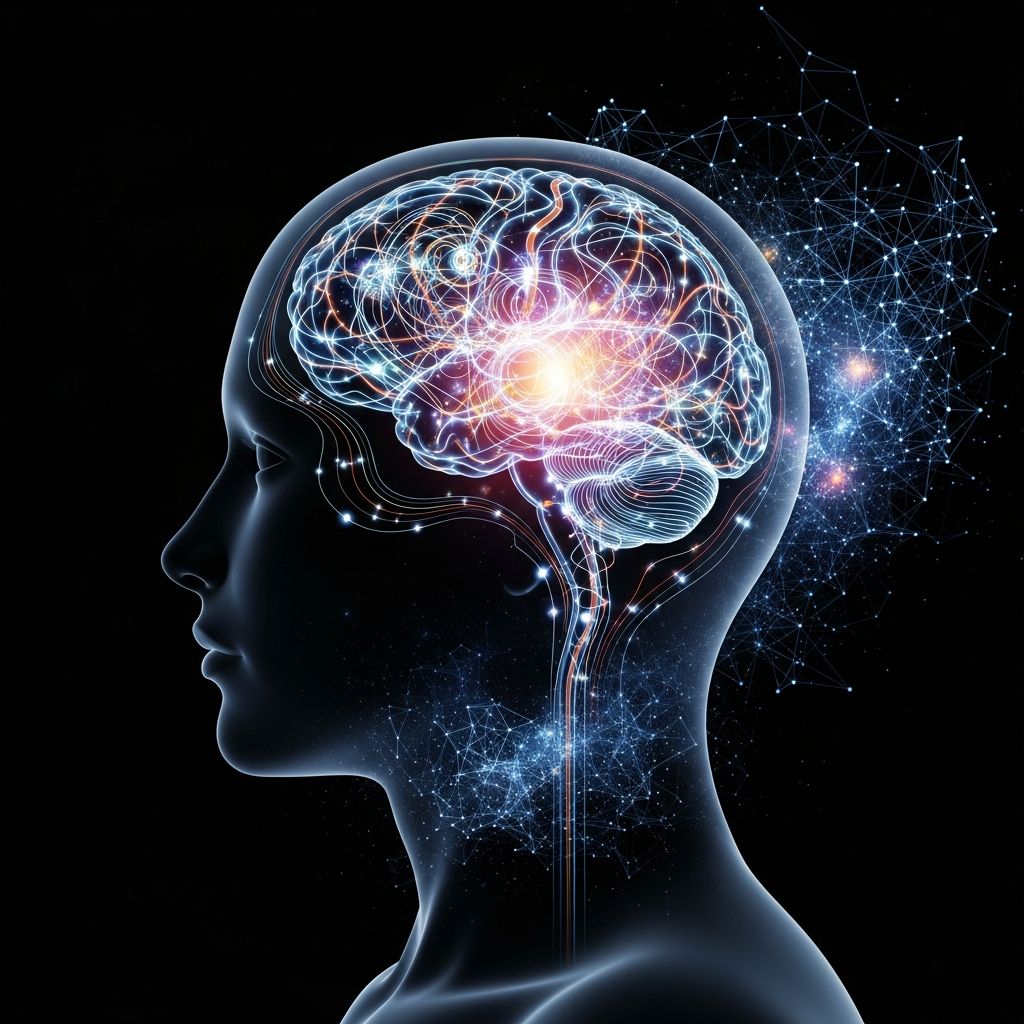
Understanding the Creative Mind: Cognitive Distinctions
Creative individuals possess fundamentally different approaches to processing information, solving problems, and generating ideas. These differences extend beyond simple personality traits—they represent distinct neurological pathways and cognitive strategies that enable extraordinary innovation. The creative mind operates through interconnected systems that allow for fluid thinking, unconventional associations, and the ability to perceive possibilities where others see constraints. Understanding these differences provides valuable insights into how creativity functions and how individuals can cultivate more creative thinking patterns in their own cognitive processes.
The Role of Multiple Brain Networks in Creative Processing
Modern neuroscience has identified that creative thinking relies on the coordinated activity of multiple brain networks working in concert. The default mode network (DMN), which activates during relaxation and daydreaming, serves as the foundation for spontaneous idea generation and memory integration. This network is particularly strong in creative individuals, allowing them to access a vast repository of experiences and concepts without deliberate effort.
Equally important is the executive control network (ECN), which manages focused attention and analytical thinking. Unlike the common misconception that creativity requires abandoning logic, the most creative minds excel at leveraging both networks. The critical distinction lies in network switching—the brain’s ability to transition seamlessly between the DMN’s expansive, associative mode and the ECN’s focused, analytical mode. This cognitive flexibility enables creative individuals to generate numerous possibilities while simultaneously evaluating their feasibility and merit.
Divergent Thinking as a Hallmark of Creative Cognition
Divergent thinking represents one of the most distinctive cognitive patterns in creative individuals. Unlike convergent thinking, which focuses on finding a single correct solution, divergent thinking explores multiple pathways to solve a problem or generate ideas. Research has identified specific characteristics that define this pattern:
- Originality: Creative thinkers produce ideas that are uncommon and distinct from conventional approaches, often combining familiar concepts in novel ways.
- Flexibility: The ability to shift between different types of solutions and adapt thinking strategies based on changing circumstances or new information.
- Elaboration: Creative minds develop ideas with rich detail, expanding initial concepts into more comprehensive and refined solutions.
- Fluency: The capacity to generate multiple ideas rapidly within a given timeframe, demonstrating a continuous stream of creative output.
These components work together to distinguish how creative minds approach challenges. Where conventional thinkers might identify one or two solutions, creative individuals generate numerous possibilities, evaluate them through various lenses, and develop the most promising ones with intricate detail.
Imaginative Thinking and Metaphorical Language Processing
Creative minds demonstrate a distinctive capacity for imaginative thinking that transforms raw experience into metaphorical understanding. Rather than processing information literally, creative thinkers naturally construct symbolic connections and abstract representations of concrete concepts. This facility with metaphorical thinking enables them to communicate complex ideas accessibly and to perceive hidden similarities between disparate domains.
The use of metaphorical language in creative expression serves multiple functions. It compresses complex meaning into memorable phrases, creates emotional resonance, and bridges the gap between the abstract and the concrete. Creative individuals instinctively recognize that human understanding relies heavily on metaphor, and they leverage this insight to make their ideas more persuasive and memorable.
Lateral Thinking: Challenging Assumptions and Conventions
While vertical thinking digs deeper into an established framework, lateral thinking approaches problems from unexpected angles by deliberately questioning long-held assumptions. Creative minds naturally engage in lateral thinking, treating conventional wisdom as a starting point for questioning rather than a destination for acceptance.
This cognitive pattern manifests in several ways within creative problem-solving. Individuals who think laterally refuse to accept that current constraints are permanent—they generate ideas by imagining alternative scenarios and working backward from desired outcomes. They challenge terminology, redefine problems, and explore the consequences of deliberately violating established rules. This willingness to operate outside conventional boundaries enables creative thinkers to identify solutions that others overlook because they remain trapped within existing frameworks.
Attention Patterns: Flexibility Versus Permeability
An unexpected distinction in creative minds involves how they manage attention. Research reveals that creative achievement is associated with what researchers term “leaky attention”—a tendency to allow peripherally relevant information to enter awareness even when focusing narrowly on a task. This contrasts with the selective attention typical in high performers on laboratory divergent thinking tests.
The mechanism operates as follows: while conventional thinkers excel at filtering distracting information to maintain focus, creative individuals benefit from allowing tangential information to influence their thinking. This openness enables creative minds to make unexpected associations between ideas that typically remain compartmentalized. A creative architect might notice how light plays across a building surface and apply that observation to solve a completely unrelated design challenge. This “leaky” quality allows ambient information to percolate into conscious awareness, generating the distinctive associations that characterize creative breakthroughs.
Associative Thinking: Building Bridges Between Concepts
Creative minds excel at associative thinking, the cognitive process of linking concepts together to form new combinations and insights. While most people maintain relatively stable conceptual categories, creative individuals continuously forge unexpected connections between ideas, experiences, and observations. This continuous pattern of association-building generates the raw material for innovation.
Associative thinking differs fundamentally from logical reasoning. Rather than following established rules of inference, associative thinking pursues intuitive connections based on similarity, contrast, temporal proximity, or emotional resonance. A creative entrepreneur might hear a conversation about fish migration patterns and suddenly perceive an application for supply chain logistics. The connection arises not through formal analysis but through the brain’s tendency to detect patterns and forge associations across domains.
Pattern Recognition: From Observations to Innovation
Creative individuals demonstrate exceptional pattern recognition capabilities. They perceive subtle regularities, recurring themes, and underlying structures that others miss. This facility with pattern detection combines sensory observation with memory retrieval, allowing creative minds to recognize meaningful trends hidden within apparent randomness or complexity.
Pattern recognition serves creativity in multiple ways. It enables creative thinkers to identify problems before they become obvious, recognize opportunities within apparent constraints, and transfer solutions from one domain to another. A designer trained in pattern recognition might observe behavioral patterns in social media and translate those patterns into intuitive interface design principles. This capacity transforms observation into actionable insight, enabling creative individuals to lead rather than follow in their fields.
Cognitive Flexibility and the Problem of Functional Fixedness
A significant cognitive difference between creative and conventional thinkers involves their vulnerability to functional fixedness—the tendency to perceive objects only in terms of their conventional functions. Remarkably, creative individuals are less susceptible to this limitation. When asked to generate novel uses for everyday objects, they more readily escape the mental constraints that bind conventional thinkers to established functions.
This difference becomes particularly pronounced when the task requires genuine innovation. Research demonstrates that creative thinkers employ bottom-up cognitive strategies, mentally disassembling objects into component properties and considering novel combinations. In contrast, conventional thinkers rely more heavily on top-down retrieval of already-known uses stored in long-term memory. This fundamental difference in cognitive strategy explains why creative minds consistently generate more original solutions to open-ended problems.
Emotional Engagement and Intuitive Processing
Creative minds characteristically engage emotions as integral components of their cognitive processes rather than treating emotions as separate from rational thinking. This integration enables creative thinkers to leverage intuitive knowing—rapid pattern recognition processed outside conscious awareness—as a source of creative insight.
The emotional dimension of creativity manifests in several ways. Creative individuals often describe experiencing emotional reactions to problems before consciously understanding them intellectually. They trust their intuitive responses and investigate the foundations of these intuitions. Additionally, they recognize that emotional engagement sustains motivation and focus during extended creative work, making the integration of feeling and thinking essential to creative productivity.
Memory Integration and Creative Synthesis
Creative minds demonstrate distinctive patterns in how they integrate memories and experiences into novel combinations. Rather than storing memories in rigid categories, creative thinkers maintain flexible, overlapping conceptual networks that enable unexpected cross-domain retrieval. When working on creative problems, they access their accumulated experience in less filtered, more associative ways.
This distinctive memory integration explains why creative individuals often draw seemingly obscure references into their work. They maintain unusually permeable boundaries between cognitive domains, allowing memories from one context to inform thinking in entirely different contexts. A musician might draw inspiration from architecture, a scientist from poetry, a business strategist from biological systems. These unexpected syntheses emerge naturally from how creative minds organize and retrieve their knowledge.
Structured Creativity: The Balance of Method and Spontaneity
Contrary to the stereotype of creativity as chaotic spontaneity, research reveals that highly creative individuals often employ structured methodologies that scaffold their creative thinking. Many creative thinking tools operate through consistent patterns and frameworks that guide exploration while maintaining openness to unexpected directions. This balance of structure and flexibility distinguishes professional creative practice from undisciplined imagination.
Creative professionals develop reliable processes for generating ideas, evaluating them, and developing promising ones into complete solutions. These processes provide sufficient structure to prevent aimless wandering while maintaining sufficient flexibility to permit genuine innovation. The structure enables sustained focus while the flexibility prevents premature commitment to inadequate solutions.
Key Differences at a Glance
| Cognitive Dimension | Creative Minds | Conventional Thinkers |
|---|---|---|
| Attention Focus | Permeable, allowing tangential information to influence thinking | Selective, filtering distracting information |
| Problem Approach | Generates multiple solutions through divergent exploration | Identifies single optimal solution through convergent analysis |
| Functional Perception | Escapes functional fixedness through bottom-up analysis | Bound by conventional object functions and uses |
| Memory Retrieval | Associative and cross-domain, enabling unexpected connections | Categorical and domain-specific, maintaining separation |
| Assumption Treatment | Deliberately questions and challenges established assumptions | Accepts conventional frameworks as given constraints |
Training and Developing Creative Cognitive Patterns
Research indicates that creative thinking represents a learnable skillset rather than an innate talent. While individuals may demonstrate different baseline levels of creative capacity, sustained practice in creative thinking develops and strengthens these distinctive cognitive patterns. Several evidence-based approaches accelerate this development:
- Analogical thinking exercises: Regularly practice identifying similarities between conceptually distant domains, training the mind to forge unexpected connections.
- Lateral thinking challenges: Deliberately approach familiar problems from unconventional angles, questioning why current solutions exist and imagining alternatives.
- Observation practices: Cultivate pattern recognition through sustained attention to detail in everyday phenomena, building the habit of noticing subtle regularities.
- Cross-domain exploration: Intentionally study and engage with fields outside your primary expertise, building the knowledge networks that enable creative synthesis.
- Assumption documentation: Explicitly identify the assumptions underlying current approaches, then systematically challenge each assumption’s validity.
Frequently Asked Questions
Q: Can people become more creative, or is creativity an inborn trait?
A: Research demonstrates that creative thinking represents a learnable skillset that develops through sustained practice and deliberate engagement with creative thinking tools and exercises. While individuals may possess different baseline capacities, everyone can substantially strengthen their creative cognitive patterns.
Q: Does excessive attention to detail hinder creative thinking?
A: While laser-focused attention can sometimes promote functional fixedness, the combination of flexible attention (permitting tangential information) with periodic focused analysis creates optimal conditions for creativity. The key is developing the capacity to shift between these modes appropriately.
Q: How do emotions influence creative thinking processes?
A: Emotions serve multiple creative functions, including sustaining motivation, enabling intuitive pattern recognition, and providing evaluative signals about emerging ideas. Integrating emotional responses rather than suppressing them enhances creative capacity.
Q: Can structured methodologies actually enhance creativity rather than constrain it?
A: Yes, appropriate structure provides scaffolding that enables sustained creative exploration without aimlessness. The structure removes decision fatigue about process, freeing cognitive resources for the actual creative work of idea generation and development.
Q: What is the relationship between memory and creative thinking?
A: Creative thinking depends fundamentally on memory integration. Creative minds maintain flexible, overlapping memory networks that enable unexpected cross-domain retrieval, allowing experiences from diverse contexts to inform novel combinations and insights.
References
- Creative Thinking Patterns in Student’s Scientific Works — ERIC (Education Resources Information Center), Educational research database. https://eric.ed.gov/?id=EJ1217283
- Functional Fixedness in Creative Thinking Tasks Depends on Stimulus Modality — National Center for Biotechnology Information (NIH), peer-reviewed research. https://pmc.ncbi.nlm.nih.gov/articles/PMC5365093/
- The Science of Creativity: How to Train Your Brain for Innovative Thinking — University of Pennsylvania, Positive Psychology Center. https://lpsonline.sas.upenn.edu/features/science-creativity-how-train-your-brain-innovative-thinking
- Making Connections: Psychologist Explores the Neuroscience of Creativity — Penn State University Research, neuroscience research findings. https://www.psu.edu/news/research/story/making-connections-psychologist-explores-neuroscience-creativity
- Flexible or Leaky Attention in Creative People: Distinct Patterns of Selective Attention — Northwestern University Psychology Faculty, peer-reviewed research. https://psychology.northwestern.edu/people/faculty/core/profiles/zabelina-saporta-beeman-2015-flexible-or-leaky-attention-in-creative-people-preprint.pdf
- Patterns for Creative Thinking — The Hillside Group, design patterns and creative methodology documentation. https://hillside.net/plop/2012/papers/proceedings/papers/03-kohls.pdf

Medha Deb is an editor with a master's degree in Applied Linguistics from the University of Hyderabad. She believes that her qualification has helped her develop a deep understanding of language and its application in various contexts. Medha specializes in the areas of beauty, health, sports, and wellness and is committed to ensuring that the content on the website is…