
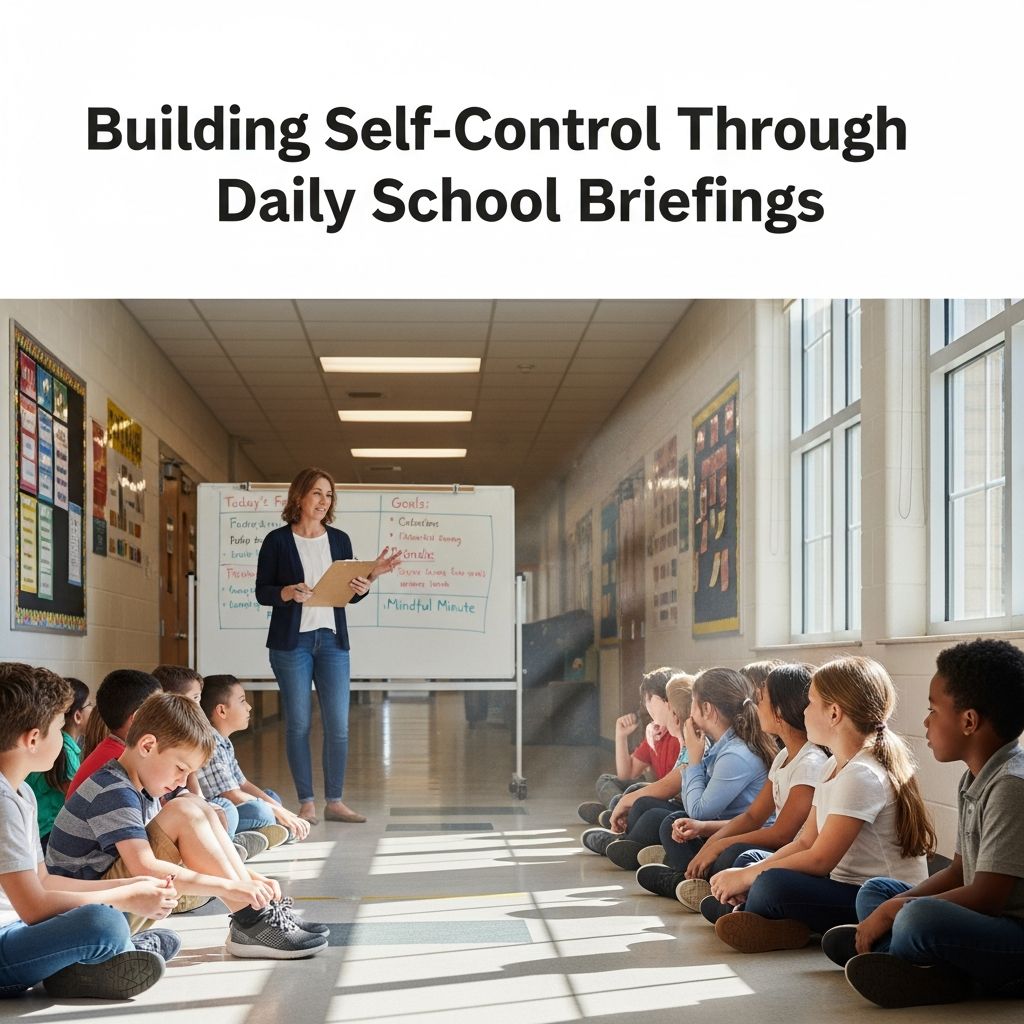
Daily school briefings offer a powerful opportunity to cultivate self-regulation among students. These short sessions can introduce concepts like emotional awareness, impulse management, and calm decision-making, setting a positive tone for the entire day. By weaving these elements into routine announcements, educators create a foundation for lifelong skills that enhance academic success and social interactions.
Understanding Self-Regulation in Educational Settings
Self-regulation refers to the ability to manage one’s emotions, thoughts, and behaviors in pursuit of long-term goals. In schools, it manifests as students pausing before reacting, focusing during lessons, and recovering from setbacks. Research shows that early development of these skills correlates with improved educational outcomes, as children learn to navigate frustrations without disrupting learning.
Educators play a pivotal role by modeling these behaviors. Starting the day with intentional practices helps students internalize them. For instance, consistent routines during briefings reinforce neural pathways for self-control, making it a habit rather than an effort.
Designing Effective Daily Briefing Routines
Crafting briefings that promote self-regulation begins with structure. A typical session might include a greeting, pledge, skill spotlight, and closing action. This format ensures predictability, which reduces anxiety and supports focus.
- Greet warmly: Address the school community to build connection.
- Recite a pledge: Use affirmations like “I choose calm responses” to prime mindset.
- Highlight a skill: Share a brief tip on managing impulses.
- End with action: Assign a simple daily challenge.
These elements, drawn from established programs, foster a sense of belonging and purpose. Schools incorporating such routines report fewer behavioral issues and higher engagement.
Key Strategies for Emotional Awareness
Emotional awareness is the cornerstone of self-regulation. During briefings, introduce prompts that encourage students to identify feelings. For example, ask, “What emotion are you carrying today, and how can you handle it?”
Visual aids like emotion charts can be referenced school-wide. Teachers might say, “If you’re feeling overwhelmed, like a storm cloud, take three deep breaths.” This normalizes emotions and provides tools.
| Emotion | Briefing Prompt | Quick Strategy |
|---|---|---|
| Frustration | “Notice your tight fists?” | Breathe deeply for 10 counts. |
| Excitement | “Energy bubbling up?” | Channel it into focused movement. |
| Anxiety | “Heart racing?” | Visualize a safe, quiet place. |
| Anger | “Heat rising?” | Count to five before speaking. |
Such tables can be displayed in classrooms, referenced in announcements for reinforcement.
Impulse Control Techniques for Young Learners
Impulse control prevents hasty reactions. Briefings can feature “stop and think” scenarios. Narrate: “Your friend takes your pencil. Pause, breathe, then ask nicely.”
Incorporate quotes from role models: “Between stimulus and response, there is a space. In that space lies our power to choose.” Pair with actions like practicing a “pause button” hand signal.
Over time, students self-apply these, reducing disruptions. Programs like those emphasizing daily pledges tie this to school values, enhancing buy-in.
Fostering Community and Shared Responsibility
Self-regulation thrives in supportive communities. Use briefings for shout-outs: “Shout-out to the class that lined up calmly today!” This models positive behavior.
Guest spots rotate staff sharing personal regulation stories, humanizing the process. “Today, our counselor shares how she uses walks to reset.” Builds trust and relatability.
Practical Implementation Steps
- Train student anchors: Select responsible students, rehearse scripts focusing on clear, calm delivery.
- Rotate themes: Week 1: Awareness; Week 2: Control; Week 3: Recovery.
- Track progress: Use simple charts to note improvements in transitions or focus.
- Adapt for ages: Simplify for younger grades, add depth for older ones.
- Integrate tech: Record sessions for absent students, review for feedback.
These steps ensure sustainability. Schools see gains in just weeks with consistency.
Advanced Tools: Breaks and Reset Zones
Beyond announcements, teach self-initiated breaks. Introduce “calm corners” where students go voluntarily to regroup. Briefing demo: “If focus fades, visit the reset zone—no questions asked.”
Model procedures: Enter quietly, use breathing cards, return when ready. This shifts from teacher-directed to student-led regulation, empowering independence.
Measuring Impact on School Culture
Assess through observations: Fewer interruptions? Better transitions? Surveys ask students, “Do announcements help you stay calm?” Data guides refinements.
Long-term, links to higher achievement emerge, as regulated students engage deeply. Collaborate with specialists for tailored support.
Overcoming Common Challenges
Resistance may arise; counter with student input on themes. Time constraints? Keep under 5 minutes. Tech issues? Have backups.
For diverse needs, offer multilingual prompts or sensory-friendly options like soft chimes for transitions.
Frequently Asked Questions (FAQs)
Q: How long should morning briefings last?
A: Aim for 3-5 minutes to maintain attention while covering essentials.
Q: What if students ignore the messages?
A: Reinforce through classroom follow-ups and visual reminders; consistency builds habit.
Q: Can this work in larger schools?
A: Yes, via PA systems or video feeds, with grade-specific adaptations.
Q: How to involve parents?
A: Share weekly scripts via newsletters, encourage home practice.
Q: Are there resources for scripts?
A: Adapt from SEL programs; create originals based on school needs.
Creating Lasting Change
Integrating self-regulation into briefings transforms schools into hubs of emotional resilience. Students gain tools for life, from playgrounds to careers. Educators, by prioritizing this, invest in futures where calm prevails over chaos.
Expand by linking to curriculum: Math problems requiring patient solving, or group projects practicing shared regulation. The ripple effect strengthens entire communities.
References
- Self-Regulation Practices for Teachers and Students — Edutopia. 2023. https://www.edutopia.org/article/self-regulation-strategies-teachers-students/
- Time-Out & Teaching Self-Regulation — Responsive Classroom. 2022-10-15. https://www.responsiveclassroom.org/time-out-teaching-self-regulation/
- Skills for Growing Morning Announcements — Lions Quest. 2016-09. https://www.lions-quest.org/wp-content/uploads/2016/09/SFG-morningannouncements.pdf
- Use Morning Announcements to Build a Sense of Community — Education World. 2000-03-01. https://www.educationworld.com/a_admin/takefive/takefive003.shtml
- Early self-regulation boosts children’s educational success — Newswise. 2023. https://www.newswise.com/articles/early-self-regulation-boosts-children-s-educational-success

Medha Deb is an editor with a master's degree in Applied Linguistics from the University of Hyderabad. She believes that her qualification has helped her develop a deep understanding of language and its application in various contexts. Medha specializes in the areas of beauty, health, sports, and wellness and is committed to ensuring that the content on the website is…