
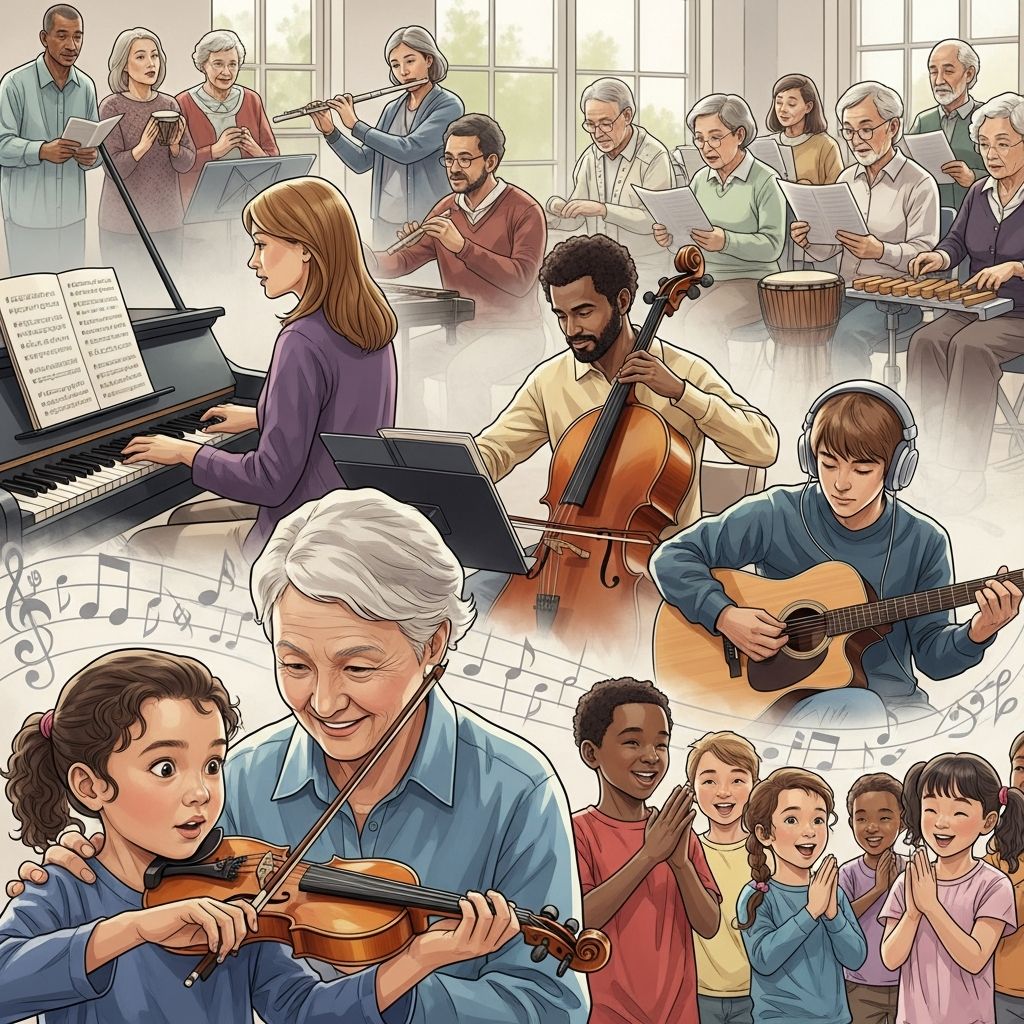
The Neuroscience Behind Musical Training and Lifelong Brain Health
The relationship between early musical education and long-term cognitive health represents one of the most compelling discoveries in neuroscience and educational psychology. Research increasingly demonstrates that children who engage in musical training before age 14 develop robust neural pathways that offer protective effects against cognitive decline and language loss in later life. This phenomenon extends far beyond simple entertainment value—it reflects fundamental changes in brain architecture and function that can persist throughout an individual’s entire lifespan.
When children learn to play instruments or engage in formal musical training, they are not simply acquiring a new skill. Instead, they are fundamentally restructuring their brain’s organization, particularly in regions responsible for language processing, auditory perception, and memory formation. The developing brain during childhood and early adolescence possesses remarkable neuroplasticity, meaning its structure and function can be shaped by experience and learning in ways that become increasingly difficult to achieve in adulthood.
Understanding How Music Shapes Language Processing Capabilities
The connection between musical training and language skills operates through several interconnected neural mechanisms. First, musical education enhances pitch discrimination abilities, which directly translates to improved phonological awareness—the ability to identify and manipulate the sounds within words. This heightened sensitivity to acoustic distinctions means that children with musical training develop superior auditory processing capabilities that directly support language comprehension and production.
Research from cognitive neuroscience laboratories has revealed that musicians demonstrate stronger neural responses when listening to different pitches and tones compared to non-musicians. This enhanced neural sensitivity extends to speech processing, meaning that individuals with early musical training can better distinguish subtle differences between spoken words, particularly consonant sounds. This advantage becomes increasingly valuable as people age, when natural hearing decline might otherwise compromise language understanding.
The precise auditory timing hypothesis explains another crucial mechanism by which music training protects language abilities. Both music and language depend critically on perceiving extremely subtle timing differences in acoustic signals. Musical training strengthens the brain’s capacity for precise temporal perception, and this same ability facilitates accurate speech sound recognition. By developing this neural skill early, children create cognitive reserves that help maintain language abilities despite the inevitable neurological changes that accompany aging.
The Critical Window: Why Age 14 Matters for Musical Development
The significance of the age 14 threshold reflects the developmental trajectory of the adolescent brain. During childhood and early adolescence, the brain undergoes dramatic organizational changes, with synaptic pruning and myelination processes that optimize neural circuits for efficient functioning. Musical training during this sensitive period takes advantage of these natural developmental processes, creating more efficiently organized and robustly connected neural networks.
After age 14, while the brain retains some capacity for learning and change, the window of maximal neuroplasticity begins to narrow. The neural systems that support language processing and auditory perception become increasingly consolidated. This does not mean that adolescents or adults cannot benefit from musical training—research confirms they can—but the protective effects appear strongest when training occurs during this critical developmental window.
Furthermore, the adolescent years represent a period when myelin—the insulating substance around nerve fibers—is still actively developing in language and auditory processing regions. Musical training during this time enhances myelination in these networks, resulting in faster, more efficient neural communication that provides advantages observable decades later.
Mechanisms of Protection Against Age-Related Language Decline
As individuals age, natural neurological changes occur that can compromise language abilities. Hearing becomes less acute, processing speed diminishes, and neural efficiency declines. However, individuals who received musical training in childhood appear to show significantly greater resilience against these typical age-related changes. Several mechanisms explain this protective effect:
- Enhanced Cognitive Reserve: Musical training builds what neuroscientists call cognitive reserve—essentially a surplus of neural processing capacity that buffers against age-related decline. Individuals with greater cognitive reserve can lose more neural function before experiencing noticeable cognitive impairment.
- Improved Auditory Processing: The heightened pitch discrimination and timing perception developed through musical training creates an auditory processing advantage that persists throughout life, helping compensate for age-related hearing changes.
- Stronger Neural Connectivity: Musical training strengthens connections between language regions and auditory processing areas, creating multiple pathways for language understanding that provide redundancy if one pathway becomes compromised.
- Enhanced Memory Systems: Musical training improves both working memory and long-term memory systems, abilities that are crucial for maintaining language comprehension and production in older age.
Research Evidence on Musical Training and Linguistic Development
Scientific investigation has produced compelling evidence that musical education directly enhances language skills across diverse populations and linguistic contexts. Studies conducted in different countries and cultural contexts consistently demonstrate that musical training provides measurable benefits for language learning and linguistic competence.
Research with adolescents in South Korea revealed that those receiving music training demonstrated significantly enhanced linguistic skills, including superior vocabulary acquisition and syntactic comprehension compared to peers without musical instruction. These improvements were not limited to passive understanding but extended to active language production, suggesting that musical training influences the entire language system.
Studies specifically examining the relationship between musical aptitude and foreign language learning have found statistically significant correlations between musical ability and success in acquiring new languages. This correlation held even when controlling for general intelligence and other cognitive factors, suggesting a specific connection between musical and linguistic capabilities rather than a general intelligence effect.
Longitudinal educational interventions provide particularly strong evidence for music training’s language benefits. A two-year music program in kindergarten involving singing, instrument playing, and rhythmic movement contributed significantly to children’s phoneme processing and vocabulary learning compared to control groups. These effects persisted beyond the formal training period, suggesting lasting neural changes.
Phonological Skills as the Gateway to Language Preservation
Phonological awareness—the ability to recognize and manipulate the sound structure of language—emerges as the primary mechanism through which musical training protects language abilities. Multiple meta-analyses of research literature have confirmed that musical training effectively promotes phonological skills in children. This foundation becomes increasingly important in later life as it provides a strong basis for maintaining language understanding despite hearing changes and neurological aging.
The connection operates bidirectionally: children with stronger phonological skills learn music more readily, while children receiving musical training develop superior phonological awareness. This reciprocal relationship means that early musical education effectively teaches the foundational auditory and linguistic skills most vulnerable to age-related decline.
Adults and older individuals with strong phonological skills maintain better speech comprehension in noisy environments, more effective verbal communication, and greater resilience against speech understanding problems associated with aging and hearing loss. By developing these skills through musical training in childhood, individuals essentially invest in their future linguistic health.
Beyond Music: The Broader Implications for Cognitive Health
While the focus here has been specifically on language preservation, the cognitive benefits of early musical training extend more broadly. Musical training engages virtually every major brain system—auditory, visual, motor, and cognitive processing regions all activate during musical learning. This comprehensive brain engagement during the formative years creates broadly enhanced neural organization that supports many cognitive functions.
The improvements in attention, working memory, and processing efficiency associated with musical training benefit numerous cognitive domains. Language preservation represents just one facet of the broader cognitive health benefits that early musicians enjoy throughout their lives. This suggests that musical education should be understood not as a peripheral enrichment activity but as a core educational priority with profound implications for lifelong health and functioning.
Practical Implications and Educational Recommendations
The evidence that musical training before age 14 provides lasting protective effects against language loss should influence educational policy and family decisions about childhood enrichment. Several practical implications emerge from the research:
- Priority in School Curricula: Schools should prioritize music education as a core component of the curriculum rather than treating it as an optional enrichment activity, recognizing that music provides documented cognitive health benefits comparable to or exceeding other educational interventions.
- Early Access: Music education should begin in early childhood, as research suggests that longer exposure to musical training produces greater protective effects. Waiting until secondary school represents a missed opportunity for optimal neural development.
- Variety of Musical Experiences: Both instrumental instruction and participatory musical activities like singing and ensemble performance provide cognitive benefits. Schools should offer diverse musical experiences rather than limiting music education to passive listening or a single instrument.
- Family Engagement: Families should understand music education as an investment in their children’s cognitive health that extends decades into the future, potentially protecting against language and cognitive problems in older age.
Frequently Asked Questions
Q: Does it matter what type of musical training a child receives?
A: Research indicates that various types of musical training—including instrumental instruction, singing, and ensemble participation—provide benefits for language development and cognitive function. The most important factor appears to be regular, sustained engagement with musical learning rather than the specific instrument or musical genre.
Q: Can adults benefit from starting music lessons?
A: Yes, adults can improve their language skills and cognitive function through musical training. However, the protective effects against age-related language decline appear strongest when training occurs during childhood and adolescence. Adults should still pursue musical learning for its immediate cognitive and health benefits.
Q: How long does a child need to study music for lasting benefits?
A: Research suggests that approximately three or more years of musical training produces measurable language and cognitive benefits. However, even shorter periods of consistent musical engagement can provide positive effects. The quality and consistency of instruction appear more important than an absolute minimum duration.
Q: Does musical training specifically help prevent Alzheimer’s disease or dementia?
A: While research has not yet directly proven that childhood musical training prevents Alzheimer’s disease, the cognitive reserve and protective factors associated with musical training do support overall brain health and may reduce dementia risk. Musical engagement throughout life, including in older age, has shown associations with better cognitive outcomes.
Q: Are there any downsides to children receiving musical training?
A: Research has not identified significant downsides to early musical training. Potential concerns about time investment are offset by the broad cognitive benefits demonstrated across numerous studies. The key is ensuring that musical instruction remains enjoyable rather than becoming a source of excessive stress.
References
- The Influence of Music Training on Language Processing Skills in Adolescents — International Journal of Languages, 2024. https://iprjb.org/journals/IJL/article/view/2721
- How music lessons can improve language skills — MIT News, McGovern Institute for Brain Research. 2018-06-25. https://news.mit.edu/2018/how-music-lessons-can-improve-language-skills-0625
- Embodied music training can help improve speech imitation and pronunciation skills — Cambridge University Press, Language Teaching Journal. 2024. https://www.cambridge.org/core/journals/language-teaching/article/embodied-music-training-can-help-improve-speech-imitation-and-pronunciation-skills/0F8F0FE69D97463B8B407C7251102521
- Correlation between musical aptitude and learning foreign languages — PubMed Central, National Institutes of Health. 2018. https://pmc.ncbi.nlm.nih.gov/articles/PMC5952984/
- The Effects of Training in Music and Phonological Skills — Frontiers in Psychology. 2016. https://www.frontiersin.org/journals/psychology/articles/10.3389/fpsyg.2016.01647/full

Medha Deb is an editor with a master's degree in Applied Linguistics from the University of Hyderabad. She believes that her qualification has helped her develop a deep understanding of language and its application in various contexts. Medha specializes in the areas of beauty, health, sports, and wellness and is committed to ensuring that the content on the website is…