
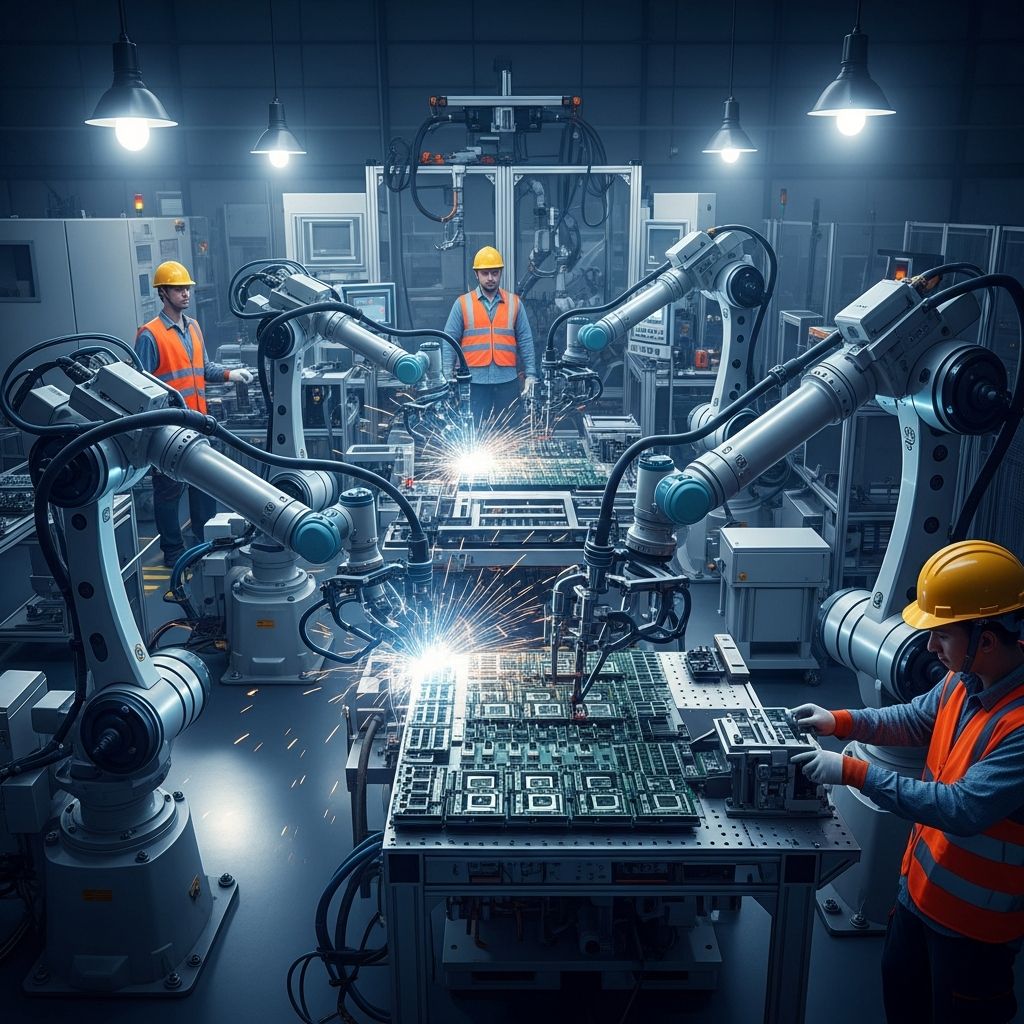
Robots have moved from industrial curiosities to core components of modern production lines, logistics networks, and even some service jobs. The crucial question is no longer whether robots will scale, but how quickly they could move from millions of units today to tens or even hundreds of millions, and what that pace of adoption would mean for the economy, workers, and policy.
This article explores the potential speed of robot scale-up, drawing on current deployment data, market forecasts, and the physical and economic limits that could either accelerate or slow this transformation.
1. The Starting Point: How Many Robots Are in Use Today?
To understand how quickly robots could scale, it helps to know where we are now. Industrial and commercial robotics are already big business and growing rapidly.
- According to the International Federation of Robotics, there were about 4.66 million industrial robots in operation worldwide in 2024, up 9% from the previous year.
- Global robot installations in factories are expected to reach 575,000 units per year in 2025 and surpass 700,000 by 2028.
- Across commercial and industrial segments, one major market analysis puts the global robotics market at roughly $50 billion in 2025, projected to grow to about $111 billion by 2030.
While these numbers are large, they are still small compared with the global workforce. Billions of people are engaged in labor; robots, even counting all types, are still measured in the low millions. The gap between those two figures helps frame how much growth would be needed for robots to become a central pillar of the world’s production capacity.
2. Current Growth Trajectories: What Do Markets Expect?
Market forecasts provide one baseline view of how quickly robots could scale if current trends continue without radical disruption.
- The overall robotics market is projected to grow at around a 13–16% compound annual growth rate (CAGR) through 2030, more than doubling in size.
- Industrial robotics is expected to remain a major segment, with strong adoption in automotive and electronics manufacturing.
- Mobile robots (for warehouses, logistics, and other applications) are already the largest revenue segment in some forecasts and are expected to generate 50–60% of robotics revenue by 2030.
- North American firms alone ordered over 17,600 robots in the first half of 2025, valued at more than $1 billion, with automotive manufacturers leading the demand.
At these growth rates, the number of robots in use could plausibly double over the next decade. That would be a significant change, but still far from a world where robots replace a substantial fraction of all human labor. To get to that point, growth would need to accelerate or stay high for much longer than one decade.
3. What Would Rapid Scale-Up Look Like in Practice?
To think concretely about speed, imagine different scale-up regimes. Below is a simplified view of how robot stocks could evolve under different annual growth rates, starting from a rough base of 5 million units across industrial and advanced commercial robots.
| Scenario | Annual growth in installed base | Robots after 10 years (approx.) | Implication |
|---|---|---|---|
| Conservative | 8% | ~10.8 million | Measured expansion; robots still niche relative to global labor |
| Market baseline | 12–15% | ~15–20 million | Robots become standard in large firms and logistics |
| Aggressive | 25–30% | ~47–69 million | Robots penetrate many mid-sized firms and new sectors |
| Hyper-growth | 40%+ | 100M+ (if sustained) | Transformational impact; many tasks automated across sectors |
Hyper-growth scenarios would likely require breakthroughs in cost, general-purpose capabilities, and supply chains, as well as strong economic incentives for rapid adoption. Nonetheless, some specific subsegments, such as humanoid robots or collaborative robots, already have projections involving extremely high CAGRs starting from small bases.
4. Technical Constraints on How Fast Robots Can Scale
Even if demand is high, there are physical and engineering bottlenecks that limit how quickly robot fleets can expand.
4.1 Hardware production and supply chains
Robot manufacturing depends on complex supply chains for precision actuators, sensors, power electronics, and computing chips. Recent global disruptions in semiconductors and logistics show how vulnerable such networks can be.
- Scaling from millions to tens of millions of robots would require major expansion of component production and assembly capacity.
- Competition from electric vehicles, consumer electronics, and data centers for advanced chips and batteries could slow robot deployment if supply remains tight.
- New manufacturing approaches, such as modular designs and standardized components, could ease some of these bottlenecks but take time to diffuse.
4.2 Software, AI, and reliability
Robots become far more economically attractive when paired with advanced AI for perception, planning, and control. In 2025, AI-equipped robots can already perform complex tasks in semi-structured environments, but reliability and robustness still limit their use in many settings.
- Developing and validating robust autonomy for new tasks is labor-intensive; scaling quickly means reusing platforms and software across many deployments.
- Safety certification, cybersecurity hardening, and compliance with industry standards all add friction to rapid rollouts, particularly in high-risk sectors like healthcare or transportation.
4.3 Energy and infrastructure
Large fleets of robots require sustained access to electricity, charging or swapping infrastructure, and often high-bandwidth, low-latency connectivity.
- Industrial robots typically draw power from existing facility infrastructure, but rapid expansion might demand electrical upgrades.
- Mobile robots and emerging humanoids depend on batteries and chargers; their scale-up intersects with broader energy and grid planning challenges.
5. Economic Forces Accelerating Robot Adoption
While technical constraints matter, the speed of adoption is ultimately driven by economics: where robots are cheaper, more reliable, or more scalable than human labor, they will spread faster.
- Labor shortages and demographic shifts: Many advanced economies face aging populations and tightening labor markets, especially in manufacturing, logistics, and care work. Robots offer a partial substitute for scarce labor, providing a strong incentive to invest.
- Productivity and cost pressure: Firms adopt robots to increase throughput, reduce defects, and cut costs per unit. The more global competition squeezes margins, the stronger the case for automation.
- Falling hardware and software costs: As production scales and technologies mature, unit costs tend to fall, accelerating adoption further—a classic technology S-curve dynamic.
- New business models: Robots-as-a-service and leasing schemes lower upfront costs, enabling small and medium enterprises to adopt automation that previously required large capital expenditures.
Major analyses of the future of work indicate that AI and robotics are among the most influential technologies reshaping jobs and skills by the mid-2020s, reflecting their growing economic centrality.
6. Barriers That Could Slow Down Robot Scaling
Despite strong drivers, several factors could keep robot deployment from reaching hyper-growth speeds.
6.1 Integration and organizational change
Installing robots is not just a matter of buying hardware. It often requires redesigning workflows, retraining workers, and reconfiguring physical spaces.
- Integration projects can be slow, costly, and risky, particularly for smaller firms with less technical capacity.
- Managers may delay automation if they lack in-house expertise or fear interruptions to production during transitions.
6.2 Regulation, safety, and liability
Regulators must balance innovation with protection of workers and the public. Depending on how policies evolve, they could either facilitate or restrain rapid scaling.
- Standards for collaborative robots and autonomous systems require rigorous testing and certification, which takes time.
- Unclear liability for accidents involving autonomous robots may discourage aggressive deployment in public or high-risk environments.
6.3 Social and political resistance
As robots and AI start to affect employment, public and political responses will influence the pace of adoption.
- Analyses by organizations like the World Economic Forum and consulting firms project that a substantial share of jobs will be transformed or exposed to automation over the coming decade.[10]
- If job displacement becomes a major concern, governments may introduce policies that slow or shape automation, such as taxes, stricter safety rules, or incentives for human-centric strategies.
7. Sector-by-Sector Dynamics: Where Could Robots Scale Fastest?
Robots will not scale uniformly across the economy. Some sectors are already on steep adoption curves, while others may remain relatively untouched for years.
7.1 Manufacturing and logistics
Factories and warehouses are the most advanced test beds for large-scale robotics.
- Industrial robot density (robots per 10,000 workers) is already very high in leading manufacturing countries, and still rising.
- Mobile robots for inventory handling, picking, and transport are seeing rapid uptake as e-commerce and just-in-time logistics expand.
- The combination of AI vision, improved grippers, and collaborative robots allows automation of tasks that previously required significant dexterity.
Over the next decade, these sectors are likely to see the fastest and most predictable scaling, driven by clear return-on-investment metrics and relatively controlled environments.
7.2 Healthcare and caregiving
Healthcare robotics is smaller than industrial robotics today but projected to grow steadily. Surgical robots, rehabilitation devices, and assistive systems are already transforming specific procedures and treatments.
- Surgical robots enable minimally invasive procedures with high precision and are expanding into more hospitals worldwide.
- Exoskeletons for rehabilitation and worker assistance are expected to multiply their market size between 2025 and 2030.
However, strict regulation, patient safety requirements, and complex environments may slow the speed of scaling relative to manufacturing, even if long-term potential is large.
7.3 Service and humanoid robots
Humanoid and service robots attract significant attention because they could, in principle, operate in spaces designed for humans. Some speculative forecasts suggest very large potential deployments in countries facing demographic decline.
- Current projections for humanoid robots show tiny absolute numbers but very high percentage growth, moving from tens of millions of dollars in market size to billions by 2030.
- Real-world deployment speed will depend on whether humanoids can reach acceptable levels of robustness, safety, and cost for everyday tasks such as basic facility work, logistics support, or simple customer service.
While humanoids could, in theory, enable faster scaling by fitting into existing human-centric infrastructure, they currently face steeper technical hurdles than task-specific industrial or mobile robots.
8. Labor, Skills, and the Human Side of Rapid Robot Growth
Rapid robot scale-up will not just change how goods and services are produced; it will reshape labor markets and skills requirements.
- Research on the future of work indicates that automation will both displace some tasks and create new roles around designing, managing, and maintaining AI and robotic systems.
- Jobs with a high share of routine, predictable physical tasks are more exposed to automation pressure, while those involving complex social interaction, creativity, or high-stakes judgment are comparatively less exposed in the near term.
- Education and training systems need to pivot toward skills such as systems integration, data analysis, human–robot collaboration, and adaptive problem-solving.
Importantly, robots tend to automate tasks, not entire occupations. Many roles will be reconfigured rather than fully eliminated, especially in mixed environments where humans and robots work together.
9. Policy Choices That Influence the Pace of Robot Scaling
Governments and institutions have significant leverage over how quickly robots diffuse and how their benefits and risks are distributed.
- Investment and incentives: Subsidies, tax credits, and public R&D funding can speed up or slow down robotics innovation and deployment.
- Regulation and standards: Clear, risk-based regulation can reduce uncertainty and encourage investment, whereas ambiguous or inconsistent rules can act as a brake.
- Labor and social policy: Policies on retraining, unemployment insurance, and income support affect how workers and communities adjust to automation pressures.[10]
- Education and skills: Long-term scaling depends on having enough engineers, technicians, and operators who can design, implement, and maintain robotic systems.
Depending on these choices, the same underlying technologies could produce very different adoption curves: gradual and managed, or extremely rapid and disruptive.
10. Frequently Asked Questions (FAQs)
Q1: Could robots double or triple in number within a decade?
Under current market forecasts, the global stock of robots is likely to grow significantly over the next decade, with some analyses suggesting more than a doubling in market size by 2030. Whether the number of robots doubles or triples depends on exact growth rates and average system cost, but expansion on that order is plausible in manufacturing and logistics if existing trends hold.
Q2: What would stop robots from scaling extremely fast?
The major brakes on very rapid expansion include hardware supply constraints, the need for skilled integration, regulatory and safety requirements, and social or political resistance to rapid job displacement. Even if the technology is ready, these frictions can slow real-world deployments.
Q3: Will robots eliminate most jobs?
Evidence so far suggests that robots and AI are more likely to automate specific tasks within jobs rather than eliminating most occupations outright. Some roles will shrink or disappear, but new ones will emerge around designing, maintaining, and governing automated systems. The net impact on total employment depends strongly on economic growth, policy choices, and how quickly education and training adapt.
Q4: Which sectors are likely to see the fastest robot growth?
Manufacturing, logistics, and some parts of healthcare are currently the leading candidates for fast robot scaling, thanks to well-defined tasks, strong economic incentives, and accumulating experience with automation. Service and humanoid robots may follow at a slower but eventually transformative pace if technical challenges are overcome.
Q5: How can workers prepare for a world with more robots?
Workers can focus on developing skills that complement automation—such as complex problem-solving, communication, oversight of AI and robotic systems, and cross-disciplinary understanding of technology and business needs. Lifelong learning and adaptability will be increasingly important as task content evolves.
References
- The Transformative Rise of Global Robotics: A 2025 Market Analysis — Nasdaq. 2025-01-06. https://www.nasdaq.com/articles/transformative-rise-global-robotics-2025-market-analysis
- Global Robot Demand in Factories Doubles Over 10 Years — International Federation of Robotics. 2025-09-26. https://ifr.org/ifr-press-releases/news/global-robot-demand-in-factories-doubles-over-10-years
- The Global Robotics Market Outlook — ABI Research. 2025-09-04. https://www.abiresearch.com/blog/global-robotics-market-outlook
- The Future of Humanoid Robotics — Recorded Future. 2024-06-03. https://www.recordedfuture.com/research/future-humanoid-robotics
- AI, Agents, and Work: Skill Partnerships in the Age of AI — McKinsey Global Institute. 2025-04-18. https://www.mckinsey.com/mgi/our-research/agents-robots-and-us-skill-partnerships-in-the-age-of-ai
- The Future of Jobs Report 2025 — World Economic Forum. 2025-10-15. https://www.weforum.org/publications/the-future-of-jobs-report-2025/digest/
- How Will Artificial Intelligence Affect Jobs 2026–2030? — Nexford University (citing PwC estimates). 2024-11-12. https://www.nexford.edu/insights/how-will-ai-affect-jobs

Medha Deb is an editor with a master's degree in Applied Linguistics from the University of Hyderabad. She believes that her qualification has helped her develop a deep understanding of language and its application in various contexts. Medha specializes in the areas of beauty, health, sports, and wellness and is committed to ensuring that the content on the website is…