
Transforming Everyday Tasks Into Learning Moments
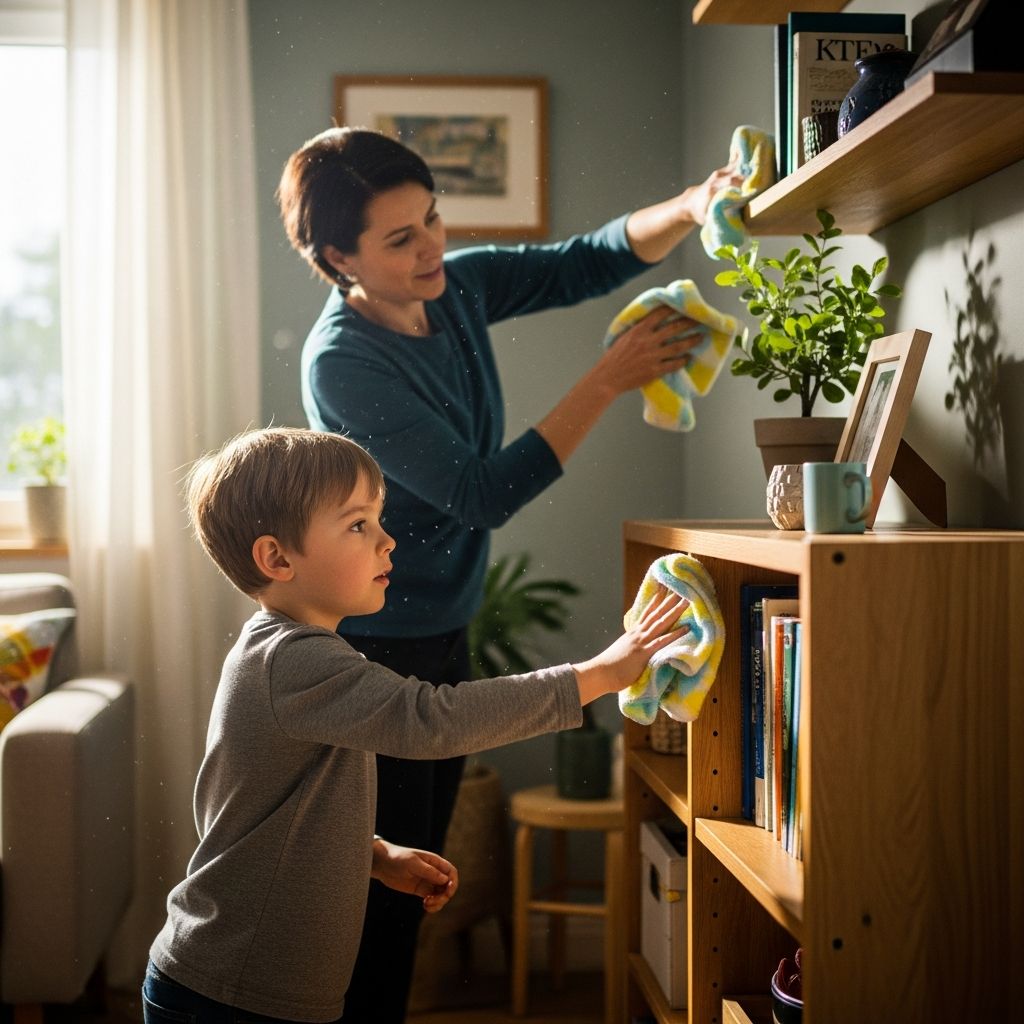
Parents and educators often search for creative ways to teach children essential skills without relying solely on traditional classroom methods. One of the most overlooked opportunities for meaningful learning happens right at home, within the routine activities that families perform together regularly. When children participate in practical household responsibilities, they absorb valuable lessons about organization, numerical reasoning, and personal accountability. These everyday moments provide a natural foundation for developing both academic competencies and essential life capabilities that will serve them throughout their lives.
The beauty of learning through household participation lies in its authenticity. Children understand that they are contributing to real family needs rather than completing artificial exercises designed purely for educational purposes. This sense of purpose strengthens their motivation and deepens their engagement with the learning process itself.
Foundational Concepts: Why Sorting and Categorization Matter
One of the most fundamental mathematical concepts that children need to develop is the ability to recognize similarities and differences among objects. Organizing items into distinct groups based on shared characteristics forms the basis for more complex mathematical thinking later on. When children engage in activities that require them to categorize items, they strengthen their observational skills and develop their ability to think critically about the properties that define different groups.
During household tasks, children encounter multiple systems for organizing items. They learn to consider attributes such as:
- Color groupings and visual patterns
- Type or category of item
- Size variations among similar objects
- Material composition or texture
- Ownership or designated user
By engaging with these different classification systems, children develop mental flexibility and understand that the same collection of items can be organized in multiple valid ways depending on the purpose. This foundational skill transfers directly to more sophisticated mathematical concepts they will encounter in formal education.
Numerical Literacy Through Practical Application
Counting serves as one of the most essential mathematical foundations, but many children struggle with the concept because counting exercises feel disconnected from their everyday experience. When children count objects as they sort them during household activities, the counting serves a genuine purpose that they can understand and appreciate.
Consider the learning opportunities embedded in everyday counting scenarios:
- Counting individual items as they place them into containers
- Recognizing when a count doesn’t match the physical quantity and investigating the discrepancy
- Comparing quantities to determine which group contains more or fewer items
- Understanding one-to-one correspondence between the number said and the object being counted
- Building familiarity with number sequences through repetitive, purposeful counting
When children count with purpose—such as counting socks to ensure they have the correct number for a family member—they internalize that numbers represent real quantities with meaningful applications. This concrete understanding becomes the foundation for abstract mathematical thinking.
Matching and Pattern Recognition Skills
Beyond simple sorting, children benefit greatly from activities that require them to identify matching pairs and recognize patterns. Matching exercises develop visual discrimination abilities and logical reasoning. When children work on pairing similar items together, they practice visual scanning, comparison, and pattern recognition—all skills that support mathematical development and reading readiness.
The concept of pairs holds particular mathematical significance. Children who engage in matching activities develop an intuitive understanding that certain items belong together in groups of two. This foundation supports later learning about even and odd numbers, multiplication by two, and combinatorial thinking.
Beyond pairs, children can explore more complex patterns:
- Identifying and continuing color sequences
- Recognizing design patterns such as stripes or polka dots
- Grouping items by multiple attributes simultaneously
- Creating their own organizational systems and explaining the logic behind them
Measurement and Spatial Reasoning Development
Measurement represents a critical mathematical skill that connects abstract numbers to physical reality. Most children’s first exposure to measurement should be informal and practical rather than abstract. Household tasks provide numerous opportunities for children to encounter and work with measurements in meaningful contexts.
Children develop measurement understanding through activities such as:
- Pouring and measuring cleaning products using standard or non-standard measures
- Observing how much space items occupy in containers
- Understanding volume through the act of filling and emptying
- Recognizing that different quantities require different sized containers
- Comparing sizes and amounts through direct observation
These practical measurements help children understand that quantities can be expressed numerically and that different measurement approaches yield comparable results. This concrete experience with measurement makes later formal instruction in standardized units more comprehensible and relevant.
Building Independence Through Gradual Responsibility
Children develop genuine independence not through sudden assignment of complete tasks but through gradually increasing levels of responsibility and autonomy. When parents introduce household tasks strategically, starting with simple participation and progressing toward independent completion, children build confidence in their abilities while developing practical competence.
Effective progression in household responsibility typically follows this trajectory:
| Development Stage | Typical Activities | Learning Outcomes |
|---|---|---|
| Observation & Assistance | Watching adults perform tasks, handing items when asked | Understanding task sequences, developing awareness |
| Guided Participation | Completing steps with direct supervision and instruction | Learning proper techniques, building competence |
| Supported Practice | Performing most steps independently with occasional guidance | Refining skills, developing responsibility |
| Independent Execution | Completing entire task with minimal or no supervision | Full capability, personal accountability, confidence |
Research indicates that children as young as four or five can begin participating in household tasks, while children around eleven or twelve years old often have the cognitive and physical abilities to manage complete laundry tasks independently. However, the specific age at which children become ready for various responsibilities varies considerably based on individual maturity and physical capability.
Sequencing and Planning Skills
Household tasks require understanding and following a logical sequence of steps. Children who participate in multi-step activities develop their ability to remember and execute steps in the correct order—a skill essential for academic success across all subject areas. Additionally, they learn that different sequences lead to different outcomes and that certain steps must precede others for success.
Children engaged in household tasks naturally encounter sequencing concepts:
- Understanding that dirty clothes must be sorted before washing
- Recognizing that clothes must be washed before they can be dried
- Learning that items must be dry before folding or putting away
- Discovering that certain steps, if skipped, result in poor outcomes
- Planning which tasks need to happen on which days
This experiential understanding of sequence and planning transfers to academic contexts where children must organize their work systematically and understand the importance of proper ordering of steps.
Comparison and Mathematical Vocabulary Expansion
As children engage in household tasks, they naturally encounter opportunities to use and develop mathematical vocabulary. Terms such as “more,” “fewer,” “most,” “least,” “larger,” “smaller,” “matching,” and “similar” become part of their active vocabulary through repeated use in meaningful contexts rather than through rote memorization.
Rich mathematical vocabulary develops when adults narrate activities, ask questions that prompt mathematical thinking, and introduce appropriate terminology during genuine applications. For example, asking a child “Which family member has the most items to fold today?” combines vocabulary development with mathematical thinking in a natural way.
Expanded mathematical vocabulary includes:
- Comparative terms: more, fewer, most, least, equal
- Descriptive terms: matching, similar, different, paired
- Attribute terms: color, size, shape, pattern, texture
- Organizational terms: sort, categorize, organize, arrange
- Quantitative terms: count, number, amount, quantity
Fine Motor Development and Physical Coordination
Beyond mathematical and organizational learning, household tasks provide valuable opportunities for developing fine and gross motor skills. Activities like folding, matching, and carrying build strength, coordination, and hand-eye coordination. Children who engage in these practical tasks often develop the motor control and dexterity that supports their ability to write, draw, and manipulate objects in academic settings.
Creating Engagement Through Game-Based Learning
Children demonstrate increased motivation and enjoyment when household tasks incorporate playful elements. Turning tasks into games, creating friendly competitions, or adding imaginative elements transforms potentially tedious chores into engaging learning experiences that children actually want to participate in.
Game elements that increase engagement include:
- Tossing items into baskets with accuracy challenges
- Racing to complete sorting tasks within time limits
- Making predictions about outcomes and checking accuracy
- Creating point systems based on task completion
- Establishing family competitions with small rewards
When children enjoy the learning process, they demonstrate greater persistence, deeper engagement, and improved retention of skills and concepts. The positive emotions associated with playful learning also create lasting memories and more favorable attitudes toward household responsibility in general.
Responsibility and Accountability Development
When children complete household tasks, they learn that their actions have real consequences for the family unit. This understanding builds a sense of responsibility that extends beyond the immediate task. Children begin to understand that they contribute meaningfully to their family’s functioning and that others depend on them to fulfill their commitments.
This sense of contribution to something larger than themselves strengthens children’s motivation and develops intrinsic rather than extrinsic motivation. Children who complete tasks because the family genuinely needs their help develop stronger responsibility and accountability than those who complete tasks purely for external rewards or consequences.
Frequently Asked Questions
Q: At what age should children start participating in household tasks?
A: Children as young as three or four can begin simple participation, such as handing items or watching alongside adults. By age five or six, many children can help with sorting and basic organizing. Children around age eleven or twelve often have the capability for more independent task management, though individual readiness varies significantly.
Q: How can I make household tasks feel less like punishment and more like learning?
A: Frame tasks as family contributions rather than chores, use game elements and friendly challenges, ask mathematical and organizational questions during the activity, celebrate successes, and allow children genuine autonomy in how they approach the tasks. Your positive attitude toward these activities strongly influences how children perceive them.
Q: What mathematical concepts can children learn through household participation?
A: Children develop understanding of sorting and categorization, counting and number sense, comparing quantities, pattern recognition, matching and pairs, measurement and volume, sequencing and ordering, and expand their mathematical vocabulary through practical applications.
Q: How long does it take children to become independent with household tasks?
A: The timeline varies considerably based on the child’s age, maturity, physical ability, and the complexity of the task. Simple sorting might take a few weeks to master, while complete independent task management often requires several months of guided practice and instruction.
Q: Can household task participation replace formal math instruction?
A: No, household task participation provides valuable concrete experiences that support and enhance formal math instruction, but it should complement rather than replace structured math education. The combination of practical application and formal instruction creates the most comprehensive learning experience.
References
- Teaching Math With Laundry — Ready Child. https://readychild.org/activity/teaching-math-with-laundry/
- Laundry Day Lessons: Sorting, Matching, and Life-Skill Independence — Axis Therapy Centers. 2025-05-18. https://axistherapycenters.com/2025/05/18/laundry-day-lessons-sorting-matching-and-life-skill-independence/
- Learn through laundry: Everyday chores develop early math skills — Oakland Family Services. 2020-08-25. https://www.oaklandfamilyservices.org/blog/2020/8/25/laundry-headline
- Let’s Wash that Math Right Into Laundry Day — Erikson Institute. https://www.erikson.edu/?post_type=idea&p=74536%2F
- Teaching Life Skills: Kids Can Do Their Own Laundry — Encouraging Moms at Home. https://encouragingmomsathome.com/teaching-life-skills-kids-can-do-their-own-laundry/

- Integrated M.A. in Applied Linguistics, University of Hyderabad
- 5+ years in editorial, instructional, SEO, and research-based writing
Sneha is a relationships and lifestyle writer with a strong foundation in applied linguistics and certified training in relationship coaching. She brings over five years of writing experience to theskillvault, crafting thoughtful, research-driven content that empowers readers to build healthier relationships, boost emotional well-being, and embrace holistic living. Her writing and insights reflect the belief that beauty, happiness, and wellness…