
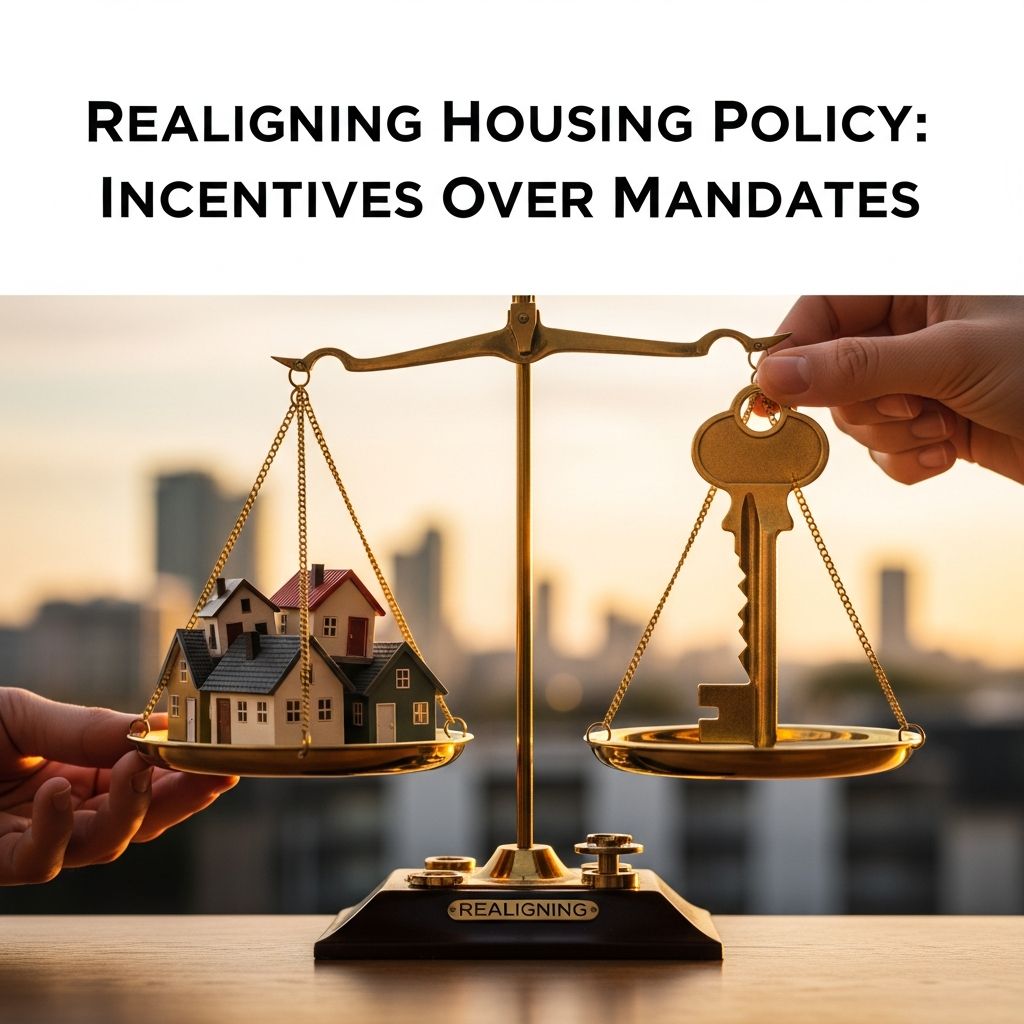
The Fundamental Challenge of Urban Housing Development
Housing development faces a persistent paradox across developed nations. While policymakers recognize critical shortages affecting affordability, workforce mobility, and economic dynamism, communities consistently resist new construction projects in their neighborhoods. This resistance stems not from simple prejudice but from rational economic self-interest: residents bear the costs of increased density, congestion, and change while capturing none of the financial benefits generated by property value appreciation. Understanding this incentive structure reveals why conventional policy approaches have repeatedly failed and points toward more durable solutions.
The housing crisis manifests across multiple dimensions of economic and social life. Restricted housing supply constrains labor mobility, preventing workers from relocating to higher-productivity regions where employment opportunities cluster. This geographic immobility dampens economic growth, perpetuates regional inequality, and concentrates opportunity in already-advantaged areas. The policy debate has long focused on supply constraints, yet implementation consistently stumbles when attempting to impose development over community opposition.
Why Traditional Top-Down Approaches Underdeliver
Conventional housing policy attempts to overcome local resistance through regulatory mandates. Central governments establish construction targets, streamline approval processes, or eliminate local veto power over development decisions. While theoretically sound, these approaches generate predictable problems in practice.
When authorities impose housing targets without restructuring underlying incentives, local planners typically locate new housing in the least desirable locations—distant from commercial districts, transportation networks, and established amenities. This geographic misdirection produces housing that fails to address genuine demand and serves existing residents poorly. More critically, mandated approaches create political backlash that undermines implementation sustainability. Residents who bear development costs without receiving corresponding benefits naturally organize opposition, ultimately constraining the policy’s effectiveness regardless of its initial legal authority.
The fundamental flaw in top-down strategies lies in their failure to align the interests of affected residents with development objectives. Government coercion may temporarily overcome resistance, but absent underlying incentive alignment, communities find creative ways to obstruct, delay, or undermine projects. This political resistance has repeatedly defeated even well-intentioned policy initiatives, suggesting that sustainable housing policy must operate through interest alignment rather than against it.
Restructuring Property Tax Distribution as Economic Incentive
One of the most overlooked policy levers involves how jurisdictions distribute tax revenue from real estate development. Historically, communities that permitted industrial or commercial development retained the resulting property tax revenue, creating natural incentives to welcome such projects. This decentralized approach generated competition between localities to attract investment and development.
The postwar period saw a significant shift, particularly in countries pursuing equity-focused fiscal policies. Property tax revenue collection became increasingly centralized, with local authorities required to contribute revenue to regional or national redistribution systems. While motivated by fairness principles—ensuring poorer communities received adequate funding—this centralization inadvertently eliminated the financial incentive for communities to permit new development.
When property tax increments generated by new construction benefit a distant central government rather than the local area, communities rationally resist development that increases density without improving local services or reducing tax burdens. Reversing this dynamic—ensuring that communities retain property tax revenue generated by new development—directly addresses the incentive problem. Communities facing concentrated development costs would simultaneously capture concentrated financial benefits, fundamentally altering cost-benefit calculations regarding new housing projects.
This approach extends beyond simple revenue retention. Policies could mandate that new residents pay higher tax rates for specified periods, ensuring that development generates immediate fiscal benefits for existing populations. Such mechanisms transform housing development from a zero-sum imposition into a fiscal opportunity for communities.
Empowering Residents Through Participatory Decision-Making
Beyond financial incentives, participatory mechanisms can align resident interests with housing development. Rather than imposing decisions through centralized authority, policies can grant residents genuine decision-making power over development proposals affecting their communities.
Street-level voting represents one innovative participatory approach, enabling residents of specific neighborhoods to collectively determine whether their area permits increased density housing. This mechanism grants communities genuine veto power while requiring developers to demonstrate benefits sufficiently compelling to gain resident support. When coupled with financial incentives—ensuring that residents capture property value appreciation or tax benefits—participatory voting transforms from a constraint on development into a mechanism for resident-aligned growth.
The London estate redevelopment program provides compelling evidence of this approach’s effectiveness. When housing authorities transferred decision-making authority to residents, rather than housing administrators, regarding major regeneration projects, participation rates reached 91%, with 93% voting in favor of redevelopment proposals. These projects collectively replaced aging council housing with mixed-tenure developments, providing residents with substantially improved accommodations while generating development activity that would have faced fierce resistance under traditional planning approaches.
This pattern repeats across policy contexts: when residents exercise genuine decision-making authority and capture benefits from their approval, development proceeds with broad support rather than entrenched opposition. The mechanism requires careful institutional design, particularly regarding who retains decision-making authority and how benefits distribute among affected populations.
Defining Authority Before Specific Proposals Emerge
Successful resident-participation policies require clarity regarding decision-making authority established in advance of specific development proposals. Without predetermined rules, affected parties attempt to redefine participation parameters when concrete projects emerge, returning policy to the problematic status quo of contested authority and political maneuvering.
Effective policy frameworks establish clear, predetermined answers to crucial questions: Which residents retain decision-making authority regarding specific development areas? What threshold of support triggers approval? What financial benefits accrue to decision-making populations? How long do participation requirements apply? These parameters must be established through general policy frameworks rather than negotiated separately for each development, preventing interested parties from optimizing rules to support their preferred outcomes.
This institutional clarity serves multiple purposes simultaneously. It reduces administrative complexity and transaction costs associated with development. It prevents strategic behavior by developers or residents attempting to manipulate decision-making processes. Most importantly, it establishes predictability that encourages both development investment and resident participation, knowing that rules remain stable across projects and time periods.
International Evidence and Policy Innovation
Beyond London’s estate redevelopment program, international jurisdictions have experimented with incentive-realignment approaches. Israel has implemented policies that grant existing residents shares of property value appreciation generated by new construction, directly aligning resident financial interests with development. These mechanisms demonstrate that housing development and resident satisfaction need not conflict when policy structures align their underlying incentives.
Various UK and US jurisdictions have begun experimenting with modified property tax distribution or resident benefit-sharing mechanisms. While these initiatives remain early-stage, their expansion reflects growing recognition that sustainable housing policy requires fundamentally restructuring how communities relate to development in their neighborhoods.
Beyond Housing: Broader Economic Implications
The housing policy challenge extends beyond real estate development to encompass broader economic constraints. Housing supply restrictions prevent labor market efficiency by reducing geographic mobility. Skilled workers cannot easily relocate to regions with superior employment opportunities, reducing productivity gains from labor specialization and agglomeration effects. This immobility contributes to regional inequality as opportunity concentrates in already-advantaged regions with less restrictive housing policies.
Addressing housing through incentive-realignment rather than mandate approaches may unlock broader economic benefits beyond housing itself. By enabling free labor mobility and efficient geographic specialization, housing policy reform could contribute to renewed productivity growth and more balanced regional development.
Implementing Systemic Change
Translating these insights into effective policy requires sustained attention to institutional design and political implementation. Property tax distribution changes face resistance from national governments accustomed to centralized revenue control. Participatory mechanisms require significant administrative capacity and genuine commitment to resident authority rather than symbolic consultation.
Successful implementation depends on framing housing policy as creating win-win opportunities rather than imposing losses on either residents or developers. When residents recognize that development generates tangible financial benefits or meaningful improvements to their neighborhoods, opposition transforms into potential support. This requires transparent communication regarding how benefit-sharing mechanisms operate and genuine commitment to resident decision-making authority.
Comparative Policy Framework
| Policy Approach | Primary Mechanism | Resident Incentives | Implementation Challenges |
|---|---|---|---|
| Centralized Mandates | Government authority overrides local opposition | Minimal or negative | Political backlash, poor project location |
| Property Tax Distribution | Local revenue retention from development | Fiscal benefits for existing residents | Requires central government revenue sacrifice |
| Participatory Voting | Resident decision-making authority | Control over neighborhood transformation | Requires institutional capacity and genuine authority |
| Value-Sharing Mechanisms | Residents capture property appreciation benefits | Direct financial participation in development gains | Complex administrative implementation |
Frequently Asked Questions
Q: How do property tax distribution changes actually increase housing development?
When communities retain tax revenue generated by new development, decision-makers face incentives favoring housing construction rather than opposing it. Rather than bearing development costs while benefits accrue to distant governments, local authorities recognize that approving housing generates fiscal resources that can improve local services or reduce tax burdens. This financial incentive fundamentally shifts political calculations regarding development approval.
Q: Don’t participatory voting mechanisms simply delay development further?
Evidence suggests otherwise. When residents exercise genuine decision-making authority and capture development benefits, participation increases and approval rates rise substantially. London’s estate program demonstrates that participatory mechanisms with proper incentive alignment produce faster development than traditional planning processes mired in conflict. The key distinction involves whether participation reflects genuine authority with aligned incentives or symbolic consultation without meaningful decision-making power.
Q: How can these approaches address housing affordability directly?
By removing supply constraints, incentive-realignment policies reduce housing cost pressures while increasing availability. Additionally, participatory mechanisms can mandate affordability components as conditions for development approval, ensuring that new housing serves mixed-income populations. Value-sharing approaches can direct development benefits toward affordable housing creation or tenant protection.
Q: What prevents communities from using these mechanisms to indefinitely block development?
Predetermined decision-making rules established before specific proposals emerge constrain such behavior. Additionally, when communities recognize tangible financial or service benefits from development approval, political incentives shift toward accommodation rather than obstruction. The policy design ensures that voting power cannot be weaponized indefinitely without forgoing corresponding benefits.
Q: Could smaller communities be systematically disadvantaged by these approaches?
Policy design can include equalization provisions ensuring that smaller communities retain proportionate benefits from development while larger metropolitan areas cannot monopolize tax revenue concentration. Regional coordination mechanisms can balance local autonomy with broader development needs across jurisdictions.
References
- Sam Bowman on Why Housing Still Isn’t Fixed and What Would Actually Work — 80,000 Hours Podcast. https://80000hours.org/podcast/episodes/sam-bowman-overcoming-nimbys-housing-policy-proposals/
- Britain’s 15-Years of Stagnation & What to Do — Institute of Economic Affairs. https://www.youtube.com/watch?v=g4qQ4eZKwT4
- The Housing Theory of Everything — Works in Progress. https://worksinprogress.co/our-authors/sam-bowman/
- Sam Bowman on Economic Growth and Policy Innovation — Adam Smith Institute. https://www.adamsmith.org/patrons-senior-fellows-fellows/sambowman
- The Housing Theory of Everything: Long-Term Economic Stagnation — Narratives Podcast. https://narrativespodcast.com/2022/09/05/110-sam-bowman-the-housing-theory-of-everything/

Medha Deb is an editor with a master's degree in Applied Linguistics from the University of Hyderabad. She believes that her qualification has helped her develop a deep understanding of language and its application in various contexts. Medha specializes in the areas of beauty, health, sports, and wellness and is committed to ensuring that the content on the website is…