
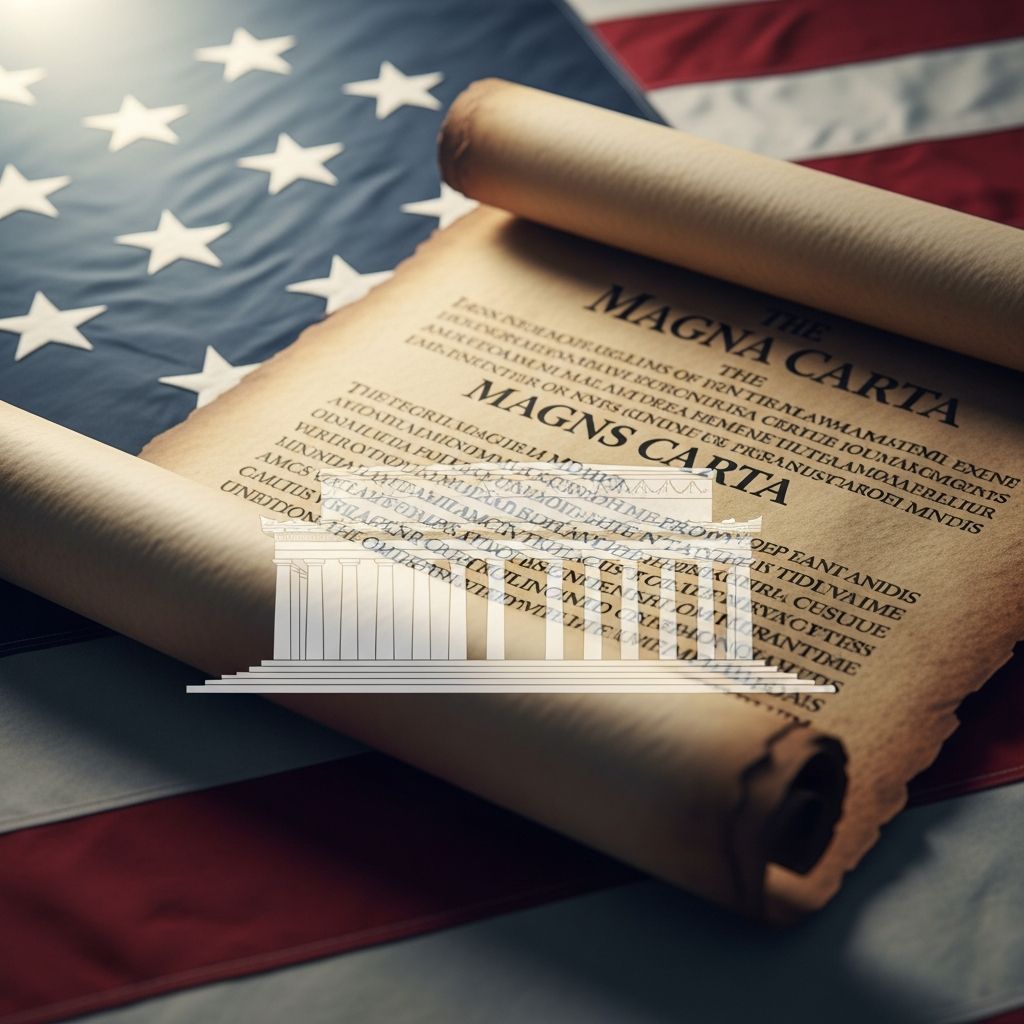
A medieval agreement forged in crisis between English barons and King John in 1215, Magna Carta laid foundational stones for modern governance. Its principles of limited authority, legal protections, and accountability resonated across centuries, profoundly influencing the American constitutional framework. This document, often called the Great Charter, transitioned from a feudal pact to a universal symbol of liberty, embedding ideas like due process and the rule of law into the U.S. legal system.
Origins of a Revolutionary Document
In the early 13th century, England faced turmoil under King John’s rule. Heavy taxation to fund unsuccessful wars, coupled with arbitrary seizures of property and denial of fair trials, sparked rebellion among powerful barons. On June 15, 1215, at Runnymede meadow, they compelled the king to seal Magna Carta, a 63-clause charter addressing grievances such as unlawful imprisonment, excessive fines, and unapproved taxes.
Though initially annulled by Pope Innocent III and reissued multiple times, the charter evolved. By the 17th century, it symbolized resistance to absolutism, inspiring figures like Sir Edward Coke, whose writings carried its ideas to the American colonies. Colonists viewed it as ancient proof that even monarchs were bound by law, a concept pivotal during tensions with Britain.
From English Charter to Colonial Foundation
American colonists invoked Magna Carta frequently in charters and legal disputes. The 1606 Virginia Charter referenced its protections, ensuring settlers rights akin to those in England. Massachusetts Bay Colony leaders cited it in resisting crown overreach, while the 1689 English Bill of Rights, influenced by Magna Carta, shaped colonial assemblies.
During the revolutionary era, pamphlets and declarations quoted the charter to justify independence. It represented the people’s right to constrain tyrannical power, mirroring grievances against King George III. This period marked Magna Carta’s shift from elite privilege to broader assertions of natural rights.
Shaping the Declaration of Independence
Thomas Jefferson and fellow framers drew on Magna Carta’s legacy when drafting the Declaration of Independence in 1776. The charter’s premise that government exists to protect rights—and can be altered if it fails—echoed in phrases like “whenever any Form of Government becomes destructive of these ends, it is the Right of the People to alter or to abolish it.” This idea stemmed from the barons’ bold limitation of royal power, establishing a moral basis for revolution against oppression.
- Limited Government: Magna Carta curbed the king’s absolute claims, prefiguring the Declaration’s rejection of unchecked authority.
- Individual Liberties: Protections for “free men” evolved into universal rights to life, liberty, and pursuit of happiness.
- Right to Resist: The charter validated baronial action, inspiring American resolve to form a new government.
Influence on the U.S. Constitution
At the 1787 Constitutional Convention, delegates like James Madison referenced Magna Carta indirectly through English common law traditions. The resulting document embodied its spirit by creating checks and balances, separating powers, and vesting authority in the people rather than a single ruler. Article I, Section 9’s habeas corpus guarantee directly traces to Clause 39 of Magna Carta, preventing detention without lawful judgment.
The Constitution’s taxation clause, requiring revenue bills to originate in the House of Representatives, reflects Clause 12’s demand for “common counsel” before imposing scutage or aid. This ensured the people’s representatives controlled the purse, preventing executive overreach seen in King John’s era.
| Magna Carta Clause | Key Principle | U.S. Constitution Parallel |
|---|---|---|
| Clause 12 | No taxation without consent | Article I, Section 7 (Origination Clause) |
| Clause 39 | No imprisonment without judgment | Article I, Section 9 (Habeas Corpus) |
| Clause 40 | Justice neither delayed nor denied | Article III (Judicial Power) |
The Bill of Rights: Direct Echoes of the Great Charter
Ratified in 1791, the Bill of Rights crystallized Magna Carta’s legal safeguards. James Madison’s proposals, influenced by state declarations like Virginia’s 1776 document, incorporated charter principles. The Fifth Amendment’s due process clause mirrors Clause 39: “No person shall… be deprived of life, liberty, or property, without due process of law.” This ensures government actions must follow established legal procedures.
Other amendments reflect the charter:
- Sixth Amendment: Speedy and public trial by jury, echoing protections against arbitrary justice.
- Fourth Amendment: Safeguards against unreasonable searches and seizures, akin to limits on royal sheriffs.
- Eighth Amendment: Bans excessive bail, fines, and cruel punishments, paralleling Clause 20.
These provisions transformed Magna Carta’s feudal guarantees into universal rights, applicable to all persons under U.S. jurisdiction.
State Constitutions and Early Legal Precedents
Before the federal Constitution, state charters embedded Magna Carta. Pennsylvania’s 1776 frame referenced it explicitly, while others adopted habeas corpus and due process. Courts invoked the charter in cases like Entick v. Carrington (1765), reinforcing limits on executive searches—a precedent carried to America.
In the U.S., Chief Justice John Marshall cited Magna Carta in early Supreme Court rulings, affirming its role in common law heritage. This continuity ensured the charter’s principles permeated American jurisprudence.
Symbolic Power in American Culture
Beyond text, Magna Carta symbolized liberty. Abraham Lincoln called it a “rebuke to tyranny” during the Civil War. The Lincoln Memorial displays its 1297 version, underscoring its revered status. Internationally, U.S. presidents have gifted copies to promote democracy, linking American ideals to this ancient document.
In education, it’s taught as the origin of constitutionalism, inspiring generations to value rule of law over arbitrary power.
Modern Relevance and Legal Applications
Today, Magna Carta influences Supreme Court decisions on due process and equal protection. Cases like Gideon v. Wainwright (1963) expanded Sixth Amendment rights, building on charter foundations. The Fourteenth Amendment applies Bill of Rights protections to states via due process, extending Magna Carta’s reach nationwide.
Challenges persist: debates over executive detention (e.g., Guantanamo) test habeas corpus. Yet, the charter reminds that no one—not even the president—is above the law.
Frequently Asked Questions (FAQs)
What was the main purpose of Magna Carta?
It primarily aimed to limit King John’s powers by guaranteeing baronial rights, fair trials, and limits on taxation, establishing that law binds the sovereign.
How many clauses did Magna Carta originally have?
The 1215 version contained 63 clauses, many addressing feudal disputes, but key legal principles endure.
Did Magna Carta apply to everyone in 1215?
No, it protected “free men” like barons and clergy, but its ideas expanded to universal rights over time.
Which U.S. amendment is most directly from Magna Carta?
The Fifth Amendment’s due process clause directly descends from Clause 39.
Is Magna Carta still law in England?
Parts remain in UK statute, influencing common law worldwide, including the U.S.
Key Principles Compared: Magna Carta vs. U.S. Constitution
| Principle | Magna Carta (1215) | U.S. Constitution/Bill of Rights |
|---|---|---|
| Rule of Law | King subject to law (Preamble) | Supreme Law of the Land (Art. VI) |
| Due Process | Clause 39: Lawful judgment | 5th & 14th Amendments |
| Habeas Corpus | No arbitrary detention | Art. I, Sec. 9 |
| Taxation | Common counsel required (Cl. 12) | Art. I, Sec. 7 |
| Trials | By peers (Cl. 39) | 6th Amendment |
Magna Carta’s journey from a baronial bargain to a cornerstone of American democracy illustrates the enduring power of principled resistance. Its emphasis on accountability, justice, and rights continues to guide the world’s oldest constitutional republic.
References
- How Did the Magna Carta Influence the American Constitution? — Encyclopaedia Britannica. 2023-10-15. https://www.britannica.com/topic/How-Did-the-Magna-Carta-Influence-the-American-Constitution
- Magna Carta’s Influence on the Declaration of Independence & U.S. Constitution — Constituting America. 2012-04-15. https://constitutingamerica.org/90day-dcin-magna-carta-influence-on-declaration-of-independence-and-us-constitution-guest-essayist-george-landrith/
- Magna Carta, the Rule of Law, and the U.S. Constitution — IAALS, University of Denver. 2015-06-15. https://iaals.du.edu/news/magna-carta-rule-law-and-us-constitution
- Magna Carta and the US Constitution — Library of Congress. N/A. https://www.loc.gov/exhibits/magna-carta-muse-and-mentor/magna-carta-and-the-us-constitution.html
- Magna Carta and Its American Legacy — National Archives. N/A. https://www.archives.gov/files/exhibits/featured-documents/magna-carta/legacy.html
- Magna Carta — Legal Information Institute, Cornell Law School. 2023-01-10. https://www.law.cornell.edu/wex/magna_carta

Medha Deb is an editor with a master's degree in Applied Linguistics from the University of Hyderabad. She believes that her qualification has helped her develop a deep understanding of language and its application in various contexts. Medha specializes in the areas of beauty, health, sports, and wellness and is committed to ensuring that the content on the website is…