
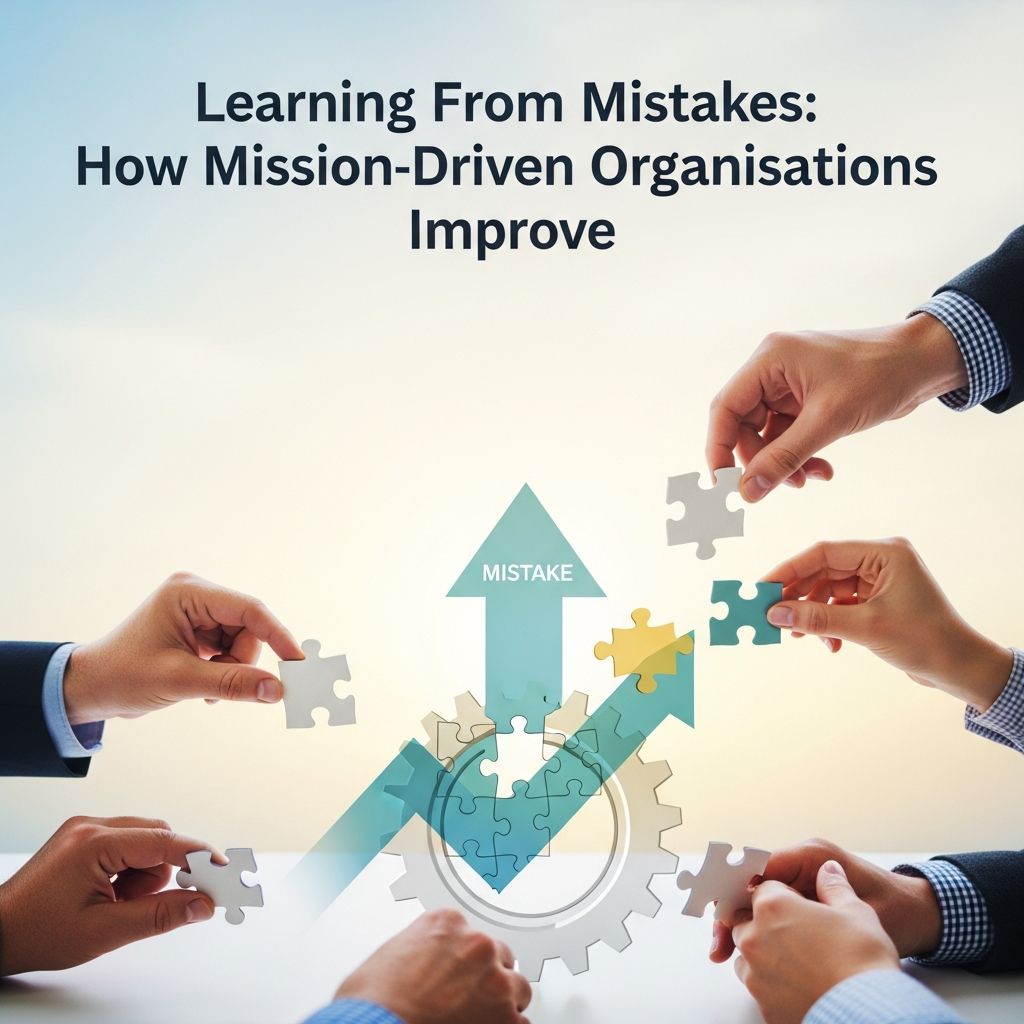
Mission-driven organisations attempt to change the world under deep uncertainty, limited data, and strong time pressure. Mistakes are therefore unavoidable — but leaving them unexamined is optional. This article explores how organisations that advise on careers and social impact can systematically recognise, analyse, and learn from their biggest errors, turning missteps into long-term strength.
Why Publicly Admitting Mistakes Matters
For organisations that influence people’s careers, donations, or policy decisions, the consequences of error are unusually high. When your advice can shape thousands of life trajectories, the way you handle mistakes becomes a central part of your ethical responsibility.
Several strands of research and practice support the idea that openly acknowledging and learning from mistakes improves long-run performance and trust:
- Psychological safety and learning: Teams that feel safe to acknowledge errors innovate more and make fewer serious mistakes over time, according to organisational behaviour research on psychological safety.
- After-action reviews and debriefs: Structured post-project reviews, widely used in the military and healthcare, have been shown to improve performance by systematically surfacing what went wrong and why.
- Transparency and trust: Empirical work on public institutions finds that transparency and accountability mechanisms can support higher public trust when paired with real corrective action.
For organisations in the effective altruism ecosystem or similar communities, this implies that a public record of mistakes is not a sign of failure but evidence of a functioning learning process.
Typical Categories of Strategic Mistakes
When examining reviews and retrospectives from impact-focused organisations, certain patterns of mistake recur. Below is a high-level taxonomy that can help structure reflection.
| Category | Core Description | Typical Consequences |
|---|---|---|
| Impact Evaluation Errors | Overstating or understating the organisation’s counterfactual impact due to weak methods or optimistic assumptions. | Misallocated resources, misleading external stakeholders, and poor strategic priorities. |
| Community & Culture Neglect | Focusing on direct outputs (e.g., career changes) while ignoring broader effects on community norms and diversity. | Alienation of potential contributors, cultural fragility, and reputational risk. |
| Communication Misalignment | Public materials unintentionally conveying a narrower or more extreme focus than the organisation’s actual views. | Misguided decisions by readers, distorted perceptions, and reduced trust when views shift. |
| Operational & Hiring Mistakes | Underinvesting in capacity, overhiring, or mis-hiring; failing to delegate effectively. | Bottlenecks, burnout, slow progress, and missed opportunities. |
| Content Drift & Outdated Advice | Old publicly available content no longer reflects current best-guess views or evidence. | Users act on outdated guidance, reducing impact and increasing risk of harm. |
Learning From Overconfident Impact Evaluation
One of the most consequential mistakes a high-impact organisation can make is to overestimate its own impact. This is especially salient for groups whose core product is advice: career recommendations, funding decisions, or strategic priorities.
Common Failure Modes in Impact Evaluation
- Naïve attribution: Crediting the organisation with nearly all change reported by a user, without carefully probing what would have happened otherwise.
- Selection bias: Relying primarily on enthusiastic success stories, which systematically overrepresent positive outcomes.
- Weak counterfactual reasoning: Underusing methods like comparison groups, longitudinal follow-up, or structured counterfactual questions.
- Metrics that track outputs, not outcomes: Counting signups, clicks, or reported shifts in intent, instead of downstream real-world results.
In the evaluation literature, similar issues are well known: even sophisticated organisations can systematically overstate program effectiveness when relying on self-reported outcomes and weak counterfactual analysis.
Better Practices for Measuring Counterfactual Impact
Organisations can improve by building a more sceptical and structured approach to impact evaluation:
- Ask detailed counterfactual questions: When someone reports a change, probe what they would likely have done without your work, and what else influenced them.
- Use multiple evidence streams: Combine surveys, interviews, external data, and qualitative case studies instead of relying on one metric.
- Invite independent checks: External analysts or advisors can review case studies, suggest alternative interpretations, and highlight blind spots.
- Document uncertainty explicitly: Where impact estimates depend on strong assumptions, state these clearly and quantify ranges rather than point estimates where possible.
These steps resemble the principles of theory-based evaluation and contribution analysis, commonly used in complex social programs where randomised trials are infeasible.
Understanding Your Effect on Community Culture
Some organisations in the effective altruism ecosystem have become primary entry points for new people. This gives them substantial influence over community values, priorities, and norms — whether or not this was their explicit goal.
How Culture-Level Mistakes Arise
- Overemphasis on a narrow problem area: Highlighting one cause (for example, advanced AI risk) without sufficiently conveying uncertainty can create the impression that other pressing problems barely matter.
- Implicit signals in hiring and leadership: If leadership and full-time teams are demographically homogeneous, this can shape who sees the community as “for people like me.”
- Lack of attention to norms: Underinvesting in codes of conduct, feedback channels, and community health mechanisms can allow poor behaviour or unhealthy dynamics to compound.
Research on social movements and volunteer organisations suggests that culture, inclusion, and governance practices significantly affect long-term resilience and growth.
Balancing Direct Impact and Community Health
To avoid undervaluing community-level effects, organisations can:
- Allocate explicit staff time to thinking about community norms, diversity, and inclusion, rather than treating them as side projects.
- Establish clear values and safeguards, such as anti-harassment policies, conflict-of-interest guidelines, and independent ombudsperson channels.
- Collaborate with specialist groups (for example, community health, DEI, or safeguarding teams in related organisations) to share best practices and coordinate responses to problems.
- Measure community effects via surveys, focus groups, and qualitative feedback to detect harms or misperceptions early.
When Communication Creates the Wrong Impression
Even when an organisation’s internal views are nuanced, its public content can unintentionally convey something quite different. This mismatch is particularly likely in areas with fast-moving research, technical uncertainty, and emotionally salient risks.
Sources of Misalignment
- Emphasising exciting or urgent topics: Articles and podcasts on high-stakes issues like AI safety or pandemic risks may crowd out material on other problems, even if leadership internally thinks several causes are similarly important.
- Legacy content: Older pages that remain highly ranked in search results may no longer match current views but still guide many readers.
- Headline and framing choices: Catchy or simplified messaging can trade accuracy for memorability, leaving stronger impressions than the careful caveats buried in the text.
Improving External Accuracy
Practical steps include:
- Content lifecycle management: Maintain a list of high-traffic pages, review them regularly, and either update, redirect, or clearly label them as outdated.
- Prominent uncertainty and scope notes: At the top of major advice pages, clarify that recommendations may not apply to everyone and briefly summarise key uncertainties.
- Balanced topic portfolios: Ensure newsletters, podcasts, and featured articles collectively reflect the organisation’s overall priorities rather than only its most extreme or newsworthy views.
- Feedback loops on perception: Periodically survey readers to ask what they believe your priorities and views are, and compare that to your actual stance.
Operational and Hiring Lessons
Strategic clarity is only as useful as an organisation’s capacity to act on it. Internal retrospective documents from many nonprofits highlight recurring operational and HR-related mistakes:
- Underinvestment in capacity building: Delaying key hires can leave crucial functions understaffed for years.
- Overcentralisation: Senior leaders personally handling too many tasks, leading to bottlenecks and burnout.
- Ad hoc HR practices: Informal performance management and unclear compensation structures, which can contribute to inequity and dissatisfaction.
Research on high-performing organisations underscores the importance of robust HR systems, including clear job design, performance management, and fair compensation processes.
Healthier HR and Management Practices
Impact-focused organisations can adapt widely studied best practices:
- Standardised performance reviews: Structured reviews reduce bias, align expectations, and give staff clearer guidance on growth.
- Transparent salary bands: Open compensation frameworks can reduce inequity and perceptions of unfairness.
- Flexible work arrangements: Options for remote and asynchronous work can broaden the hiring pool and improve retention, when compatible with the role.
- Robust HR policies: Written procedures for addressing discrimination, harassment, and grievances protect both staff and the organisation.
Managing Legacy Content and Outdated Advice
Organisations with hundreds of articles, tools, and reports inevitably face content drift: what they once endorsed may no longer represent their best thinking.
Risks of Outdated Content
- Readers making life-changing decisions based on guidance that current staff now view as suboptimal.
- Hidden inconsistencies between newer and older materials undermining trust in the organisation’s coherence.
- Search engines continuing to highlight pages that staff rarely review.
To mitigate these risks:
- Track canonical views: Maintain internal documents summarising your current best-guess positions on each major topic.
- Label out-of-date resources: Prominent banners can direct readers to newer material or flag uncertainty.
- Retire harmful tools: If an old quiz, framework, or article consistently misleads, taking it down may be better than preserving it for historical interest.
Building a Repeatable Mistake-Review Process
Isolated admissions of error are helpful but insufficient. Organisations benefit most when they institutionalise reflection. A repeatable process might include:
- Regular review cadence: Conduct annual or biennial reviews that explicitly include a “biggest mistakes” section.
- Cross-functional input: Involve research, operations, community, and leadership teams so that operational and cultural issues are as visible as strategic ones.
- External perspectives: Invite advisors, partner organisations, or engaged critics to comment on drafts of major reviews.
- Concrete follow-up plans: For each identified mistake, specify what will change: policies, staffing, evaluation methods, or content strategy.
- Public documentation: Where feasible, publish summaries of major mistakes and updates, so that stakeholders can track progress and hold you accountable.
Frequently Asked Questions (FAQs)
Q: Doesn’t publicly documenting mistakes damage an organisation’s reputation?
In the short term, highlighting serious errors can feel risky. But research on transparency and trust suggests that institutions seen as honest and self-correcting often gain credibility over time, provided they demonstrate real improvements rather than excuses. For organisations whose impact depends on being trusted as advisors, long-run credibility is usually more important than short-run image management.
Q: How can small organisations afford rigorous impact evaluation?
Smaller groups rarely have the resources for full-scale experimental evaluations. However, they can still adopt cost-effective principles from evaluation research: collecting structured feedback, asking counterfactual questions, documenting case studies, and inviting independent reviewers to assess a sample of outcomes. Even simple, well-designed surveys and interviews are significantly better than relying on anecdote alone.
Q: What should an organisation do if it realises old advice may have harmed some users?
Ethically, the first step is to prevent further harm: update, label, or remove the problematic material. Next, inform your audience about the change and explain the reasons in plain language, including what you have learned and how your processes will improve. Where feasible, you can also invite affected users to share their experiences to guide further corrections. This aligns with broader principles of accountability used in fields like medicine and public health when guidance changes.
Q: How can organisations reduce overconfidence without becoming paralysed by uncertainty?
The goal is calibrated confidence. Techniques such as structured forecasting, explicit confidence intervals, and pre-mortem analyses can highlight where the team is most uncertain while still enabling action. Many high-stakes fields — from aviation to epidemiology — operate under uncertainty by pairing modesty about predictions with strong procedures for monitoring outcomes and adjusting rapidly when evidence changes.
Q: Is focusing on community culture a distraction from maximising direct impact?
Evidence from social movements and volunteer-based organisations indicates that unhealthy culture and weak governance can eventually undermine even highly effective programs. Investing in inclusion, safety, and sound norms is best seen as maintaining the infrastructure that makes long-term impact possible, rather than a competing goal.
References
- Psychological Safety and Learning Behavior in Work Teams — Amy C. Edmondson. 1999-06-01. https://doi.org/10.2307/2666999
- Learning in the Thick of It — Deborah A. Garvin, Harvard Business Review. 2000-07-01. https://hbr.org/2000/07/learning-in-the-thick-of-it
- Government Transparency and Public Trust — OECD. 2017-03-01. https://www.oecd.org/gov/open-government-review-mexico-9789264268104-en.htm
- Contribution Analysis: An Approach to Exploring Cause and Effect — John Mayne, Institutional Learning and Change Initiative. 2008-05-01. https://idl-bnc-idrc.dspacedirect.org/handle/10625/36588
- Participation and Social Movement Organisations — Doug McAdam & W. Richard Scott, in Social Movements and Organization Theory. 2005-01-01. https://doi.org/10.1017/CBO9780511791000
- High Performance Work Practices and Firm Performance — John P. MacDuffie, Industrial and Labor Relations Review. 1995-01-01. https://doi.org/10.1177/001979399504800204

- Integrated M.A. in Applied Linguistics, University of Hyderabad
- 5+ years in editorial, instructional, SEO, and research-based writing
Sneha is a relationships and lifestyle writer with a strong foundation in applied linguistics and certified training in relationship coaching. She brings over five years of writing experience to theskillvault, crafting thoughtful, research-driven content that empowers readers to build healthier relationships, boost emotional well-being, and embrace holistic living. Her writing and insights reflect the belief that beauty, happiness, and wellness…