
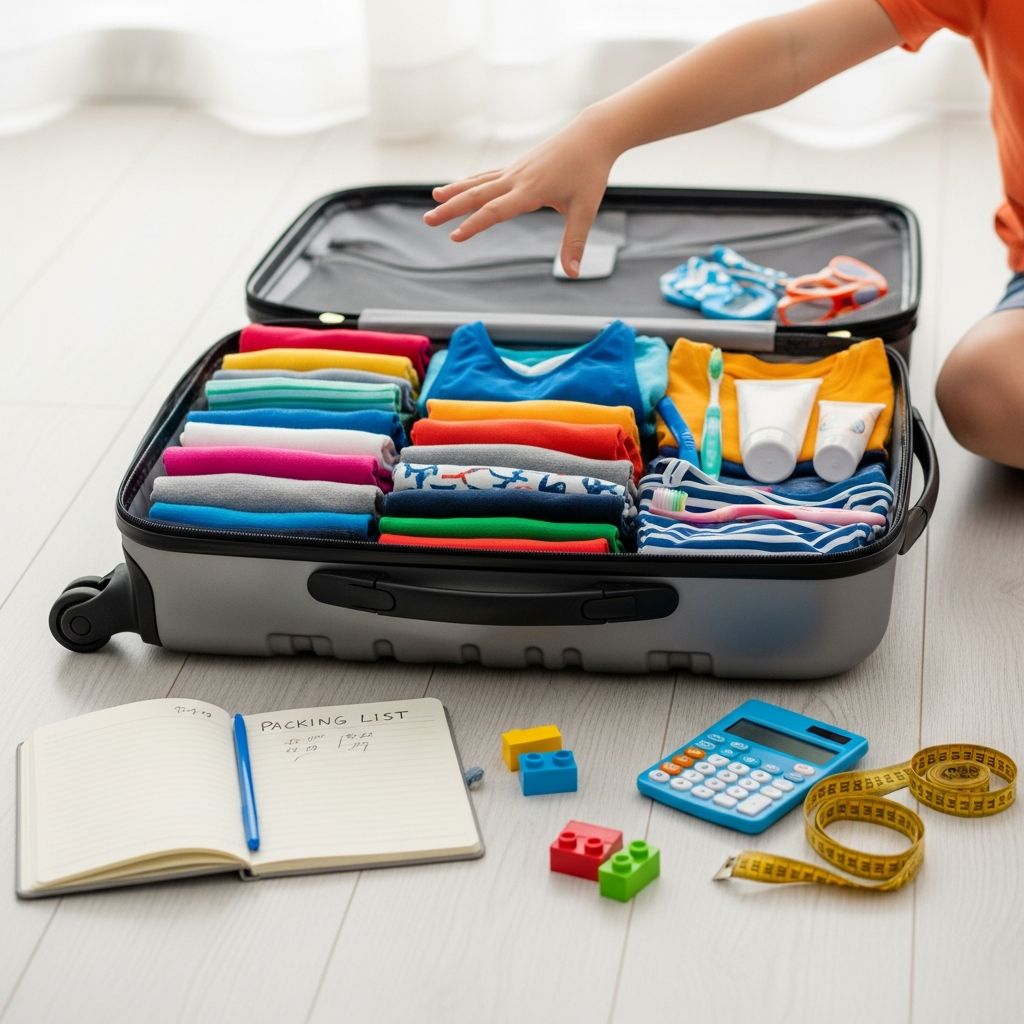
Packing for a family trip offers a practical arena for children to develop key mathematical abilities and organizational prowess. Through hands-on involvement, kids apply concepts like counting, measurement, and budgeting in ways that make learning engaging and relevant.
Building Foundational Counting and Estimation Abilities
One of the first steps in preparing luggage involves determining the quantity of essentials needed for the journey. Children can calculate daily requirements for clothing, such as shirts or underwear, based on the trip’s length. For instance, if a vacation spans five days, a child might figure out needing at least six pairs of underwear to account for one extra, practicing basic multiplication and rounding up.
This process sharpens estimation skills, as kids predict how many items fit without overpacking. Parents can guide them to list necessities and multiply by days, turning abstract arithmetic into tangible decisions. Such exercises enhance number sense, helping children grasp why precise counting prevents shortages or excess baggage.
- Estimate outfits per day: Multiply clothing needs by trip duration.
- Round up for safety: Add buffers for unexpected needs like spills.
- Compare totals: Discuss if predictions match actual packing.
Applying Budgeting Principles to Travel Expenses
Beyond clothing, packing extends to financial planning, where kids learn to allocate limited resources. Setting a budget for souvenirs, snacks, or extras during the trip mirrors holiday spending math, involving addition, subtraction, and percentages.
For example, with a $50 allowance, children can divide it across categories like food ($20), activities ($15), and mementos ($15). They practice subtracting spent amounts after each purchase, reinforcing staying within limits. This mirrors real-world financial literacy, as studies show early budgeting exposure improves long-term money management.
| Budget Category | Allocated Amount | Spent | Remaining |
|---|---|---|---|
| Souvenirs | $15 | $8 | $7 |
| Snacks | $20 | $12 | $8 |
| Activities | $15 | $10 | $5 |
| Total | $50 | $30 | $20 |
This table illustrates a simple tracking method kids can use, promoting accountability and adjustment skills.
Mastering Spatial Reasoning Through Luggage Arrangement
Efficiently fitting items into a suitcase introduces geometry and spatial awareness. Kids visualize shapes, volumes, and how objects tessellate, akin to bin packing algorithms that optimize space.
Start with larger items like shoes or toiletries at the bottom, then layer clothes around them. Children estimate suitcase capacity in terms of item counts, developing problem-solving as they rearrange for better fits. This builds transferable skills for puzzles or real-life organization.
Activities like measuring suitcase dimensions and item sizes encourage unit conversions, such as inches to centimeters, further embedding measurement math.
Crafting Itineraries with Time Management Math
Packing isn’t isolated; it ties into overall trip scheduling. Children create daily plans, calculating travel times, meal breaks, and activity durations using distance-speed-time formulas.
For a road trip, estimate arrival by dividing miles by speed: 200 miles at 50 mph takes 4 hours. Add buffers for stops, practicing addition and realistic adjustments. This fosters time-telling proficiency and sequencing events logically.
- Map routes: Use mile markers to predict travel durations.
- Schedule breaks: Allocate time for meals and rests.
- Adjust for delays: Recalculate if traffic extends journeys.
Data Collection and Analysis During Journeys
Trips provide opportunities for observational math. Kids track license plates by state, restaurant counts, or weather patterns, then graph findings to spot trends.
Using simple tools like notebooks or apps, they tally data daily and create bar graphs or pie charts. This introduces statistics basics, mean calculations, and visual representation, making math exploratory and fun.
Adapting Skills for Staycations and Day Trips
Not all learning requires distant travel. Local outings apply the same principles: pack day bags with estimated snacks based on hours out, budget small spends, and plan timelines.
Visiting parks or museums involves counting exhibits, measuring paths, or estimating group costs, keeping skills sharp without overnight packing.
Age-Appropriate Strategies for Maximum Learning
Tailor activities to developmental stages for optimal engagement.
Ages 4-7: Focus on counting items and simple matching, like pairing socks.
Ages 8-11: Introduce budgeting subsets and basic geometry for packing.
Ages 12+: Handle full budgets, percentages for discounts, and itinerary creation with variables like weather.
Enhancing Family Bonds Through Shared Math Adventures
Involving kids in packing and planning strengthens family dynamics. Discussions about choices teach prioritization and compromise, blending math with life lessons like gratitude during budgeting for gifts.
Post-trip reviews—comparing plans to reality—build reflection skills, encouraging iterative improvements for future adventures.
Frequently Asked Questions
What math concepts do kids practice most when packing?
Primarily counting, estimation, addition/subtraction for budgeting, and spatial geometry for arranging items.
How can parents make packing educational without frustration?
Break tasks into small steps, use visuals like lists or tables, and celebrate accurate predictions.
Is this useful for non-travel planning too?
Yes, skills transfer to school projects, grocery lists, or event organizing.
What if my child struggles with numbers?
Start with visuals, games like ‘I Spy’ for descriptions, and build gradually.
Can tech enhance these activities?
Apps for star gazing with distances or mapping tools add layers like real-time calculations.
Turning Vacations into Lasting Learning Experiences
By integrating math into trip prep, parents transform routine tasks into skill-building opportunities. These practices not only boost academic performance but also equip kids with practical tools for independence. Encourage experimentation, like testing packing theories, to ignite curiosity.
Expand with journals for sketching observations, costing meals, or charting stars, deepening engagement. For longer trips, simulate full budgets including flights or hotels, introducing larger-scale arithmetic.
Incorporate group challenges: Who packs lightest while meeting needs? This gamifies efficiency. During travel, roadside math like fuel efficiency (miles per gallon) or tip calculations refines percentages.
Local explorations count footsteps for distance or compare park entry fees, proving education’s ubiquity. Reflection journals post-trip analyze variances, honing analytical thinking.
These methods align with educational emphases on real-world application, fostering confident problem-solvers.
References
- 10 Ways Maths Helps With Your Holiday — Teaching Maths Scholars. 2023-01-15. https://teachingmathsscholars.org/10waysmathshelpswithyourholiday
- 7 Fun Math Practice Ideas for Summer Vacation — Best in Class Education. 2022-06-10. https://bestinclasseducation.com/7-fun-math-practice-ideas-for-summer-vacation/
- Budgeting for the Holidays: Practical Math Skills for Holiday Spending — Demme Learning. 2023-11-20. https://demmelearning.com/blog/holiday-budgeting/
- New Year Travel Distance Math: A Holiday Learning Adventure — Think Academy. 2024-01-05. https://www.thethinkacademy.com/blog/edubriefs-new-year-travel-distance-math-a-holiday-learning-venture/
- Planning Your Fantasy Vacation – A Kids Vacation Planning Project — Around the World with Kids. 2021-02-15. https://aroundtheworldwithkids.net/2021/02/15/fantasy-vacation-worksheet/
- Summer Math Fun: Vacation Planning — Mathnasium. 2015-06-17. https://www.mathnasium.com/au/blog/20150617-summer-math-fun-vacation-planning

- Integrated M.A. in Applied Linguistics, University of Hyderabad
- 5+ years in editorial, instructional, SEO, and research-based writing
Sneha is a relationships and lifestyle writer with a strong foundation in applied linguistics and certified training in relationship coaching. She brings over five years of writing experience to theskillvault, crafting thoughtful, research-driven content that empowers readers to build healthier relationships, boost emotional well-being, and embrace holistic living. Her writing and insights reflect the belief that beauty, happiness, and wellness…