
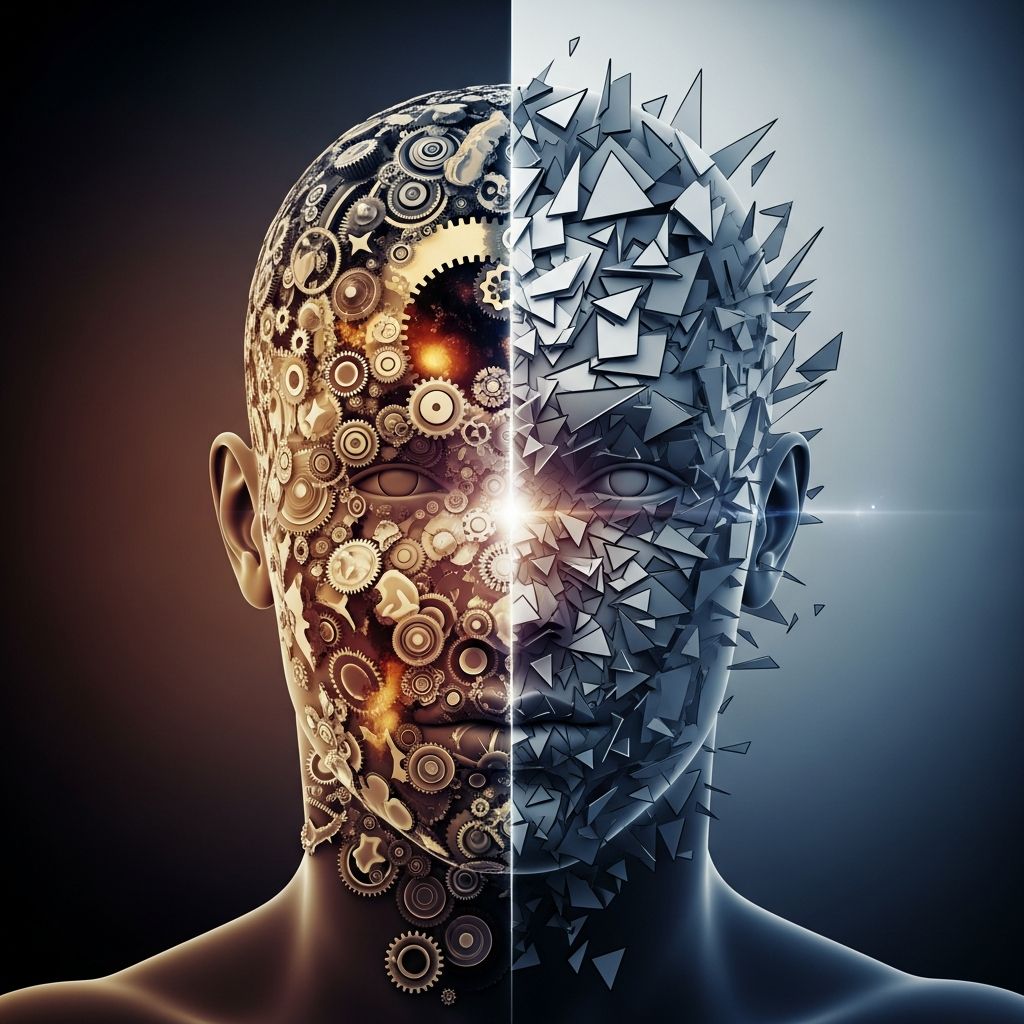
How We Decide: The Hidden Role of Personality in Belief and Doubt
Every day, we make countless judgments: what to trust, what to question, who to believe, and when to hold back. Behind these choices lies a quiet but powerful force—our personality. Whether we instinctively reach for evidence or lean into intuition, whether we trust a claim at face value or demand proof, is not random. It’s shaped by deep-seated cognitive patterns that influence how we process information, weigh risks, and form convictions.
Understanding this connection helps us see why some people are quick to believe, while others are slow to accept anything without scrutiny. More importantly, it allows us to recognize our own biases and adjust our thinking when needed—whether we’re evaluating a news story, a medical claim, or a relationship.
The Two Default Settings: Belief and Skepticism
At the most basic level, people tend to operate from one of two default positions when encountering new information:
- Belief-oriented: These individuals are more likely to accept information unless it clearly contradicts their values or experience. They trust sources, traditions, or personal intuition more readily and are comfortable acting on incomplete data.
- Skepticism-oriented: These individuals start from a position of doubt. They withhold judgment until they see evidence, consistency, and logical coherence. They are more likely to question motives, sources, and assumptions before forming an opinion.
Neither approach is inherently better. Belief can foster connection, hope, and action in uncertain situations. Skepticism can protect against misinformation, manipulation, and poor decisions. But when either becomes automatic or extreme, it can lead to problems—blind faith on one end, chronic doubt on the other.
Personality as a Cognitive Filter
Personality doesn’t just shape how we act; it shapes how we think. Certain traits make us more likely to favor belief or skepticism as a default strategy. These tendencies aren’t about intelligence or education—they’re about cognitive style, emotional priorities, and how we define what counts as “truth.”
Research into personality and decision-making consistently shows that people with certain traits are more likely to:
- Trust others’ intentions and statements
- Accept information that aligns with their values
- Demand logical consistency and empirical support
- Be influenced by emotion, tradition, or social consensus
These patterns aren’t rigid, but they are predictable. Recognizing them helps us understand not only others’ reactions but also our own blind spots.
Thinking Styles and the Skeptical Mindset
People who naturally prioritize logic, consistency, and analysis tend to default to skepticism. They approach new claims like a scientist testing a hypothesis: “What evidence supports this? What would disprove it? Are there alternative explanations?”
This mindset is often associated with:
- A preference for structured, rule-based reasoning
- Discomfort with ambiguity and inconsistency
- A tendency to dissect arguments for logical flaws
- High value placed on objectivity and verifiability
For these individuals, belief is earned, not given. They may struggle with decisions that require intuition or trust in the absence of data. They can also come across as overly critical or detached, especially in emotionally charged situations where others are seeking reassurance rather than analysis.
However, this style is particularly effective in domains where evidence matters: science, engineering, finance, and policy. It helps filter out misinformation and avoid costly mistakes based on emotion or social pressure.
Feeling Styles and the Belief-Oriented Approach
People who prioritize values, relationships, and emotional resonance tend to default to belief. They are more likely to accept information if it feels right, aligns with their values, or comes from a trusted source. For them, truth is often tied to meaning, connection, and moral coherence rather than pure logic.
This approach is often characterized by:
- A focus on whether something “feels true” or “makes sense” in a personal or relational context
- Greater comfort with uncertainty when it serves a higher purpose (e.g., hope, faith, loyalty)
- Strong reactions to perceived hypocrisy or insincerity
- Willingness to act on incomplete information if it aligns with their values
For these individuals, skepticism can feel like coldness or distrust. They may see excessive questioning as a barrier to connection or action. At the same time, this style can make them vulnerable to manipulation, especially when emotionally appealing narratives are presented without strong evidence.
Yet, this orientation is essential in areas where relationships, ethics, and meaning matter: caregiving, leadership, art, and community building. It allows people to act with compassion, hope, and moral clarity even when certainty is impossible.
Concrete vs. Abstract: How Information Type Matters
Another layer in this dynamic is how people relate to different kinds of information. Some are more comfortable with concrete, observable facts; others are drawn to abstract patterns, possibilities, and meanings.
Those who prefer concrete information tend to:
- Trust what they can see, measure, or verify directly
- Be skeptical of claims that lack practical grounding
- Value experience and precedent over theory
- Be more cautious about adopting new ideas without clear evidence of effectiveness
Those who prefer abstract or pattern-based thinking tend to:
- Look for underlying meanings, connections, and future implications
- Be more open to unconventional or speculative ideas
- Accept claims that fit a broader narrative, even if evidence is limited
- Be more comfortable with ambiguity and theoretical models
Neither is inherently more accurate. Concrete thinkers may miss important patterns; abstract thinkers may overinterpret noise as signal. The key is recognizing which style dominates and compensating when necessary—by seeking data when intuition is strong, or by considering context when data feels incomplete.
When Belief and Skepticism Go Too Far
Both belief and skepticism become problematic when they become rigid or automatic. When belief turns into unquestioning faith, it can lead to:
- Accepting harmful or false claims because they feel comforting
- Ignoring contradictory evidence that challenges core beliefs
- Trusting sources that exploit emotional vulnerability
- Resisting change even when it’s clearly needed
When skepticism turns into chronic doubt, it can result in:
- Paralysis in decision-making due to over-analysis
- Difficulty trusting others, even when evidence supports reliability
- Isolation from communities or relationships that value faith or intuition
- Missing opportunities because nothing ever feels “certain enough”
Healthy thinking requires flexibility: the ability to believe when appropriate and to question when necessary. This balance is not about becoming neutral or indifferent, but about developing the capacity to shift gears depending on the situation.
Practical Implications in Daily Life
Understanding how personality shapes belief and doubt has real-world consequences. It affects how we:
- Evaluate news and information online
- Make health and financial decisions
- Interact with authority figures and institutions
- Navigate relationships and conflicts
For example:
- A belief-oriented person might be more likely to trust a charismatic expert or a compelling personal story, even if the evidence is weak.
- A skepticism-oriented person might dismiss a valid concern because it’s presented emotionally or lacks rigorous data.
Recognizing these tendencies allows us to:
- Pause before accepting or rejecting a claim
- Seek out perspectives that challenge our default style
- Adjust our communication to be more persuasive or more receptive, depending on the audience
- Build teams and relationships that balance belief and skepticism for better outcomes
Building Cognitive Flexibility
No one style is perfect for every situation. The goal isn’t to eliminate belief or skepticism, but to develop cognitive flexibility—the ability to use both as tools rather than as fixed identities.
Strategies for building this flexibility include:
- Self-monitoring: Notice when you’re automatically believing or disbelieving something. Ask: “Is this based on evidence, emotion, or habit?”
- Seeking disconfirming evidence: Actively look for information that challenges your current view, especially when the stakes are high.
- Practicing perspective-taking: Try to understand why someone with a different style might see things differently. This reduces polarization and improves communication.
- Setting decision thresholds: Define in advance what kind of evidence or reasoning would be enough to change your mind on important issues.
- Using structured decision aids: Checklists, pros-and-cons lists, or decision matrices can help balance intuition and analysis.
Over time, this practice helps create a more balanced, resilient mindset—one that can believe when it’s wise and doubt when it’s necessary.
FAQs: Belief, Skepticism, and Personality
Can someone be both a believer and a skeptic?
Yes. Many people operate from a default style but can shift depending on the context. For example, someone might be highly skeptical about medical claims but more trusting in personal relationships. The healthiest thinkers are those who can toggle between belief and skepticism as the situation demands.
Is skepticism the same as cynicism?
No. Skepticism is a method: it involves questioning claims and requiring evidence before accepting them. Cynicism is an attitude: it assumes the worst about people’s motives and often dismisses ideas without fair consideration. Skeptics are open to being convinced; cynics are often closed off from change.
Does being more skeptical make someone smarter?
Not necessarily. Intelligence involves many factors, including reasoning, knowledge, and emotional insight. While analytical thinking is valuable, over-reliance on skepticism can impair decision-making, especially in social or ambiguous situations. Wisdom often lies in knowing when to believe and when to question.
How can I tell if I’m too belief-oriented?
Signs include: frequently trusting people or sources that later prove unreliable, feeling shocked when trusted claims turn out to be false, avoiding contradictory information, or making decisions based primarily on how something feels rather than on evidence. If this describes you, practicing more structured evaluation can help.
How can I tell if I’m too skeptical?
Signs include: chronic indecision, difficulty trusting others even when they’ve proven reliable, dismissing ideas too quickly because of minor flaws, or feeling isolated because others see you as overly critical. If this sounds familiar, practicing more openness and trust in low-risk situations can build balance.
Can personality change over time?
Core personality traits tend to be relatively stable, but cognitive habits can evolve. With practice, people can become more flexible in how they approach belief and doubt, even if their underlying preferences remain. Therapy, education, and life experiences all contribute to this growth.
Final Thoughts: Toward a Balanced Mind
Belief and skepticism are not opposites to be resolved, but complementary tools for navigating a complex world. Personality shapes which tool we reach for first, but it doesn’t have to dictate our choices forever.
By understanding our natural inclinations—whether we lean toward trust or doubt, feeling or analysis—we gain the power to step back, reflect, and choose more wisely. We can learn to believe with discernment and to question with openness, creating a mindset that is both grounded and adaptable.
In a world full of information, misinformation, and emotional appeals, that balance may be one of the most valuable skills we can develop.
References
- Individual Differences in Reasoning: Implications for the Rationality Debate? — Keith E. Stanovich & Richard F. West. Behavioral and Brain Sciences, 2000. https://doi.org/10.1017/S0140525X00003435
- The Role of Personality Traits and Online Behavior in Belief in Fake News — Nature Human Behaviour, 2024. https://doi.org/10.1038/s41599-024-03573-6
- Personality and the Foundations of Political Beliefs — John R. Hibbing et al. American Journal of Political Science, 2014. https://doi.org/10.1111/ajps.12071

Medha Deb is an editor with a master's degree in Applied Linguistics from the University of Hyderabad. She believes that her qualification has helped her develop a deep understanding of language and its application in various contexts. Medha specializes in the areas of beauty, health, sports, and wellness and is committed to ensuring that the content on the website is…