
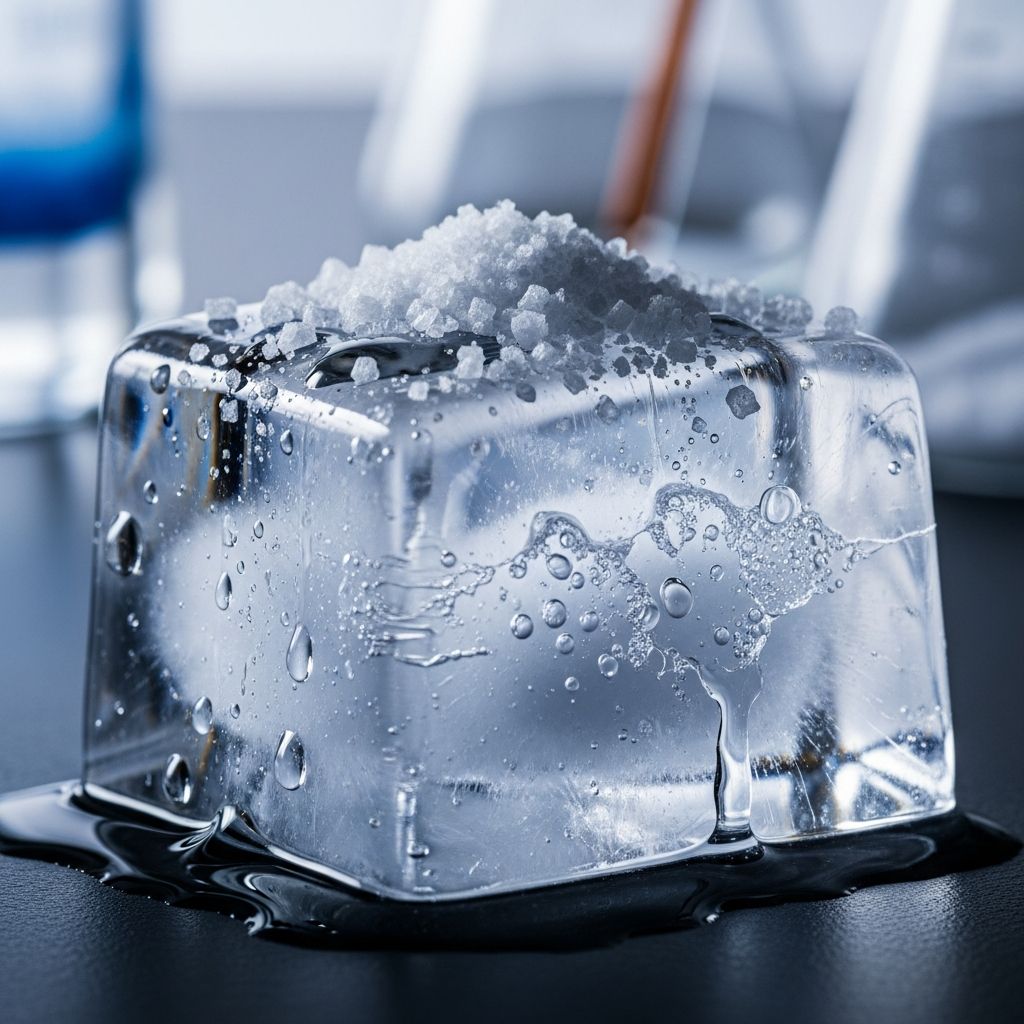
Salt melts ice by dissolving into its thin surface water layer, disrupting molecular bonds through a process called freezing point depression, which lowers the temperature needed for water to freeze and causes existing ice to liquefy.
The Molecular Dance: Water and Ice at Play
Water molecules in liquid form move freely, but at 32°F (0°C), they slow down and form rigid hydrogen bonds, creating the crystalline structure of ice. Even below freezing, ice surfaces maintain a quasi-liquid layer just a few molecules thick, where water molecules vibrate slightly and interact dynamically. This layer is crucial because it provides the initial medium for solutes like salt to act.
When temperatures drop further, this layer persists but becomes less mobile. Salt ions exploit this vulnerability by integrating into the layer, altering its composition and forcing more solid ice to dissolve to restore equilibrium. This self-perpetuating cycle accelerates melting without requiring external heat.
Freezing Point Depression: The Core Mechanism
Freezing point depression is a colligative property, meaning its effect depends on the number of solute particles rather than their identity. Sodium chloride (NaCl), common table salt, dissociates into two ions—Na⁺ and Cl⁻—per molecule in water. These ions surround water molecules, preventing them from aligning into the orderly lattice required for ice formation.
The resulting brine solution has a freezing point below that of pure water. For instance, a 10% salt solution freezes around 20°F (-7°C), and higher concentrations drop it even lower, up to about -6°F (-21°C) for saturated solutions. This depression allows the brine to remain liquid at temperatures where pure ice would persist.
- Ion interference: Na⁺ and Cl⁻ ions create an ionic cloud that sterically hinders hydrogen bonding.
- Entropy increase: Dissolved particles boost disorder, favoring the liquid state over the ordered solid.
- Raoult’s Law application: Solutes reduce water’s vapor pressure, shifting the melting-freezing equilibrium.
Why Salt Outperforms Other Substances
Not all materials lower freezing points equally. Sugar, for example, dissociates into single molecules, producing fewer particles than salt’s two ions, making it far less effective. Urea or alcohols work somewhat but lack salt’s efficiency and availability.
Salt’s edge comes from its high dissociation and low cost. Rock salt (coarse NaCl) is standard for roads, but finer grains increase surface contact, speeding dissolution.
Temperature Limits and Optimal Conditions
Salt excels between 15°F to 25°F (-9°C to -4°C), where enough surface moisture exists for dissolution. Below 15°F, the quasi-liquid layer freezes solid, rendering salt inert until temperatures rise. At very low temps like -10°F, saturation limits further depression.
| Material | Effective Range (°F) | Ions per Molecule | Notes |
|---|---|---|---|
| Sodium Chloride (NaCl) | 15 to 32 | 2 | Cost-effective, widely used |
| Calcium Chloride (CaCl₂) | -25 to 32 | 3 | Exothermic dissolution, faster melt |
| Magnesium Chloride (MgCl₂) | -13 to 32 | 3 | Less corrosive than NaCl |
| Sugar | 25 to 32 | 1 | Ineffective for deicing |
Practical Strategies for Maximum Effectiveness
To optimize salt use, prioritize surface area exposure. Smaller ice particles or pre-wetting salt with water enhances contact and reaction speed. Applying salt in thin layers prevents waste, as excess forms brine pools without further melting.
Timing matters: salt works best on fresh snow or thin ice. For packed ice, mechanical removal first exposes more surface. Combining salt with sand improves traction while melting proceeds.
- Clear loose snow manually.
- Spread 100-300 lbs per 1,000 sq ft, adjusting for conditions.
- Reapply after heavy precipitation.
- Avoid over-application to minimize runoff.
Environmental and Infrastructure Concerns
While effective, salt runoff contaminates waterways, harming aquatic life and accelerating soil salinization. It corrodes vehicles and infrastructure, costing billions annually in repairs. Alternatives like calcium magnesium acetate (CMA) offer lower environmental impact but higher expense.
Safe practices include using only necessary amounts and shielding vegetation with barriers. Emerging tech like beet juice additives reduces chloride levels while boosting low-temp performance.
Debunking Winter Myths
Myth: Salt generates heat to melt ice. Reality: Melting is endothermic; salt enables it by preventing refreezing, not adding thermal energy.
Myth: More salt always means faster melt. Reality: Beyond saturation, excess salt sits unused.
Myth: All salts are equal. Reality: Ion count and solubility dictate efficacy.
Frequently Asked Questions
What temperature is too cold for salt to melt ice?
Salt becomes ineffective below about 15°F (-9°C) due to insufficient surface liquid for dissolution.
Does salt work on snow as well as ice?
Yes, but it prevents bonding into compact snow; fresh snow melts via the same depression mechanism.
Is calcium chloride better than rock salt?
Yes, it works at lower temps, releases heat upon dissolving, and requires less quantity.
Can sugar melt ice like salt?
No, sugar produces fewer particles and is far less efficient.
How does salt damage the environment?
Runoff increases soil salinity and chloride levels in water, affecting plants, animals, and infrastructure.
Future Innovations in Deicing
Research focuses on eco-friendly brines from agricultural byproducts, like sugar beet molasses, which enhance salt performance at low temps with reduced corrosion. Geomelt, a salt-brine-polymer mix, minimizes bounce-off and runoff. Electrochemical methods and enzyme-based melters promise targeted, low-impact solutions.
Climate-adaptive formulations adjust for varying winter severities, balancing efficacy, cost, and sustainability.
References
- Why Does Salt Melt Ice? The Science Explained — Old Station Landscape Supply. 2023. https://oldstationlandscapesupply.com/why-does-salt-melt-ice/
- Why Salt Melts Ice, According to Science — Popular Mechanics. 2022-01-12. https://www.popularmechanics.com/science/a41936364/why-does-salt-melt-ice/
- Why Does Salt Melt Ice? — Britannica. 2023. https://www.britannica.com/story/why-does-salt-melt-ice
- De-icing with Salt Safely — California Governor’s Office of Emergency Services (Cal OES). 2024-01-15. https://www.news.caloes.ca.gov/de-icing-with-salt-safely/
- How Does Salt Melt Ice? — American Chemical Society (YouTube). 2018-12-10. https://www.youtube.com/watch?v=JkhWV2uaHaA

Medha Deb is an editor with a master's degree in Applied Linguistics from the University of Hyderabad. She believes that her qualification has helped her develop a deep understanding of language and its application in various contexts. Medha specializes in the areas of beauty, health, sports, and wellness and is committed to ensuring that the content on the website is…