
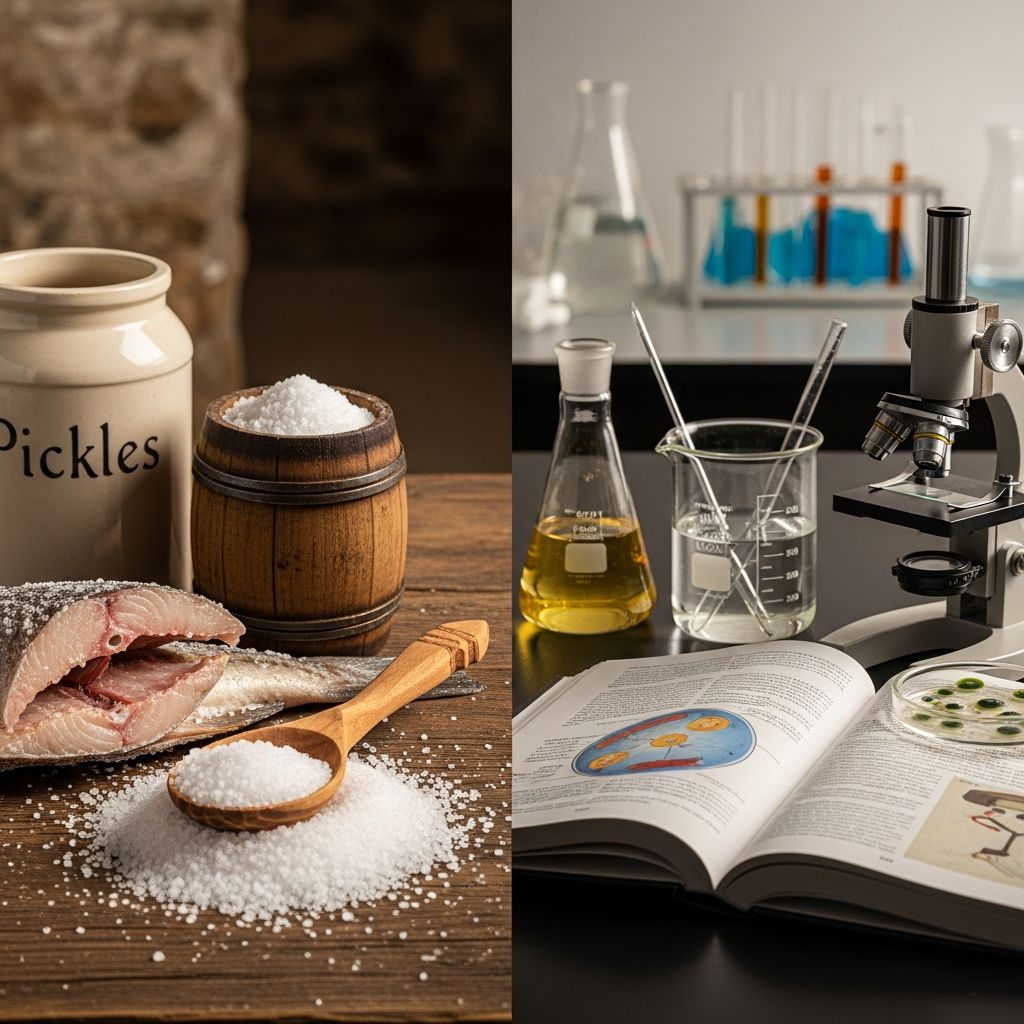
Salt has safeguarded human food supplies for millennia by inhibiting microbial growth and extending shelf life through fundamental biological and chemical processes. This article delves into the mechanisms, historical evolution, practical applications, and contemporary relevance of salt as a preservative.
The Fundamental Science of Salt Preservation
At its core, salt preserves food by creating an environment hostile to bacteria, yeasts, and molds that cause spoilage. Microorganisms require water to thrive, and salt disrupts their access to it via osmosis, a process where water moves from areas of lower solute concentration to higher ones across cell membranes.
When salt is applied to food, it draws moisture out of microbial cells, dehydrating them and halting reproduction. Foods naturally have high water activity (a_w), typically around 0.99, which supports bacterial growth above 0.85 a_w. Salt reduces this to levels below 0.85, starving microbes.
Beyond dehydration, salt disrupts essential microbial functions. It interferes with enzymes and damages DNA, preventing metabolic processes. This dual action—physical dehydration and biochemical disruption—makes salt exceptionally effective.
Historical Roots of Salting Foods
Humans have used salt for preservation since prehistoric times, long before mechanical refrigeration. Ancient Egyptians applied it to fish and meats, recognizing its ability to draw out moisture and enable long-term storage.
By Roman times, salt-cured products like bacon and herring sustained armies and navies. The term “salary” derives from salarium, Roman soldiers’ salt rations, underscoring its value. Salt’s scarcity sparked trade routes, wars, and economies, as it was vital for survival in eras without cold storage.
In the 18th century, French innovator Nicolas Appert combined salt with heat in canning, revolutionizing preservation for navies and explorers. These practices evolved from empirical observation into scientifically understood methods.
Key Methods of Salt Preservation
Salt is applied in two primary forms: dry salting and brining, each suited to different foods.
- Dry Curing: Granular salt is rubbed onto meats or fish, penetrating slowly over weeks. This ancient technique firms texture and intensifies flavor while dehydrating the product.
- Wet Brining: Foods are submerged in saltwater solutions, accelerating preservation. Modern injections speed the process for large cuts like hams.
Table 1 compares these methods:
| Method | Process | Best For | Time |
|---|---|---|---|
| Dry Curing | Salt rubbed on surface | Meats, fish | Weeks |
| Wet Brining | Submerged in brine | Vegetables, poultry | Days |
Osmosis and Water Activity in Detail
Osmosis is the cornerstone: salt ions outside cells create hypertonic conditions, pulling water from inside microbes until equilibrium. This plasmolysis shrinks cells, rendering them dormant or dead.
Water activity (a_w) quantifies free water availability. Pure water is 1.0; salt lowers it by binding water molecules as a solute. Most pathogens cease growth below 0.85 a_w, while salt-tolerant halophiles survive higher concentrations but are controlled by combinations like drying or acidity.
In practice, salted foods become denser and firmer as water exits, altering color and texture predictably.
Salt’s Synergy with Other Preservation Techniques
Salt rarely works alone; it enhances methods like smoking, drying, and fermentation.
- Drying: Salt initiates dehydration, amplified by air exposure.
- Smoking: Combines salt’s osmosis with smoke’s antimicrobials for products like jerky.
- Fermentation: Salt selectively inhibits harmful bacteria, allowing lactic acid producers to lower pH. In sauerkraut or cheese, it acts as a “gatekeeper,” fostering beneficial microbes. In cheesemaking, salt regulates moisture and aids aging.
This synergy extends to sugar preservation, where both solutes compete for water, as in jams where sugar stabilizes a_w and interacts with pectin.
Modern Applications and Food Safety
Today, salt preserves processed meats, cheeses, pickles, and canned goods, preventing pathogens like Salmonella. In canning, granulated sugar and salt maintain color, texture, and flavor during heat processing.
Regulatory bodies like the USDA endorse salt in HACCP plans for its reliability. However, over-reliance risks hypertension, prompting low-sodium alternatives like celery powder.
Industrial brining ensures uniform penetration via tumbling or injection, scaling ancient methods for mass production.
Practical Tips for Home Preservation
- Select high-quality, fine-grained salt for faster absorption.
- Use 20-25% salt by weight for dry curing meats.
- For brines, aim for 5-10% solutions; refrigerate to control halophiles.
- Combine with refrigeration or freezing for optimal safety.
- Monitor for off-odors or slime, indicating failure.
These steps empower home cooks to replicate ancestral techniques safely.
Limitations and Halophile Challenges
Salt isn’t infallible. Halophilic bacteria thrive in moderate salinity, necessitating adjunct methods. Fine salts absorb faster but cost more historically. Over-salting imparts bitterness, balanced by rinsing in recipes like bacalao.
Climate affects efficacy; humid environments slow drying, requiring controlled conditions.
Frequently Asked Questions (FAQs)
Can salt kill all bacteria?
No, it primarily inhibits growth via dehydration. Halophiles survive, so combine with heat or acid.
Is salting safe for vegetables?
Yes, brining creates pickles or ferments like kimchi, enhancing nutrition via probiotics.
How long do salted foods last?
Months to years if properly stored; monitor water activity below 0.85.
Does iodized salt work for curing?
It does, but non-iodized is preferred to avoid off-flavors in long cures.
Why do salted foods change color?
Osmosis removes water, concentrating pigments and firming proteins.
Global Cultural Examples
Salt preservation varies worldwide:
- Prosciutto (Italy): Dry-cured ham aged months.
- Bacalao (Portugal): Salted cod, rehydrated for cooking.
- Sauerkraut (Germany): Fermented cabbage.
- Fish sauce (Asia): Brined, fermented anchovies.
These showcase salt’s versatility across cuisines.
In summary, salt’s preservation power stems from osmosis-driven dehydration, microbial disruption, and synergy with other processes, bridging ancient wisdom and modern science for safer, flavorful foods.
References
- Real Sugar and Salt: Effective and All-Natural Food Preservatives — Sugar.org. 2023-05-15. https://www.sugar.org/blog/real-sugar-and-salt-effective-and-all-natural-food-preservatives/
- How Does Salt Preserve Food? [ID0913] — YouTube (History of Simple Things). 2023-08-20. https://www.youtube.com/watch?v=EROyh0iHCI4
- Why does salt prevent food from spoiling? — HowStuffWorks. 2024-02-10. https://recipes.howstuffworks.com/tools-and-techniques/salt-prevent-food-from-spoiling.htm
- Salting (food) — Wikipedia. 2025-03-01. https://en.wikipedia.org/wiki/Salting_(food)

Medha Deb is an editor with a master's degree in Applied Linguistics from the University of Hyderabad. She believes that her qualification has helped her develop a deep understanding of language and its application in various contexts. Medha specializes in the areas of beauty, health, sports, and wellness and is committed to ensuring that the content on the website is…