
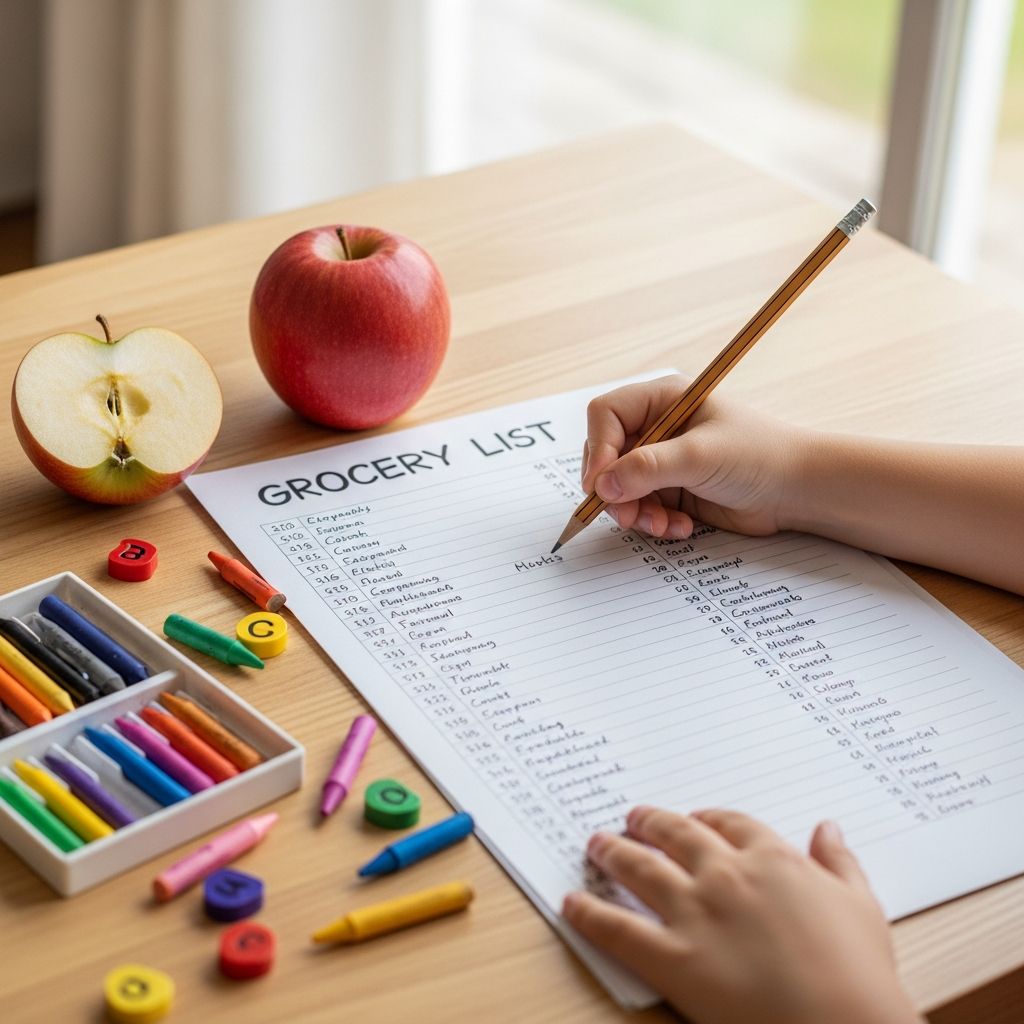
Everyday family routines offer unexpected opportunities for meaningful learning experiences. One such activity that often goes overlooked is the humble task of creating a shopping list together with children. What might seem like a simple domestic chore becomes a multifaceted educational opportunity when parents and caregivers recognize its potential to nurture essential developmental skills. The process of planning purchases, selecting items, and organizing information creates a natural environment for children to explore written communication, develop practical problem-solving abilities, and build confidence in their emerging literacy skills.
The Foundation of Written Communication Through Real-World Practice
Children learn to write most effectively when they encounter writing in meaningful contexts rather than through isolated exercises or worksheets. Creating a family shopping list provides exactly this kind of purposeful literacy practice. When children see their parents deliberately thinking about what needs to be purchased and committing those thoughts to paper, they begin to understand that writing serves a concrete purpose—it communicates ideas and plans that will be acted upon.
The act of sitting down together to compose a shopping list introduces children to the fundamental concept that written words hold meaning and consequence. Unlike copying letters or practicing letter formations in abstract contexts, writing for shopping carries immediate relevance. A child learns that if they write “milk” on the list, that item will actually appear in the cart at the store. This direct connection between written symbols and real-world outcomes transforms writing from an abstract academic exercise into a powerful communication tool.
Parents can enhance this experience by narrating their thinking process aloud as they write. Phrases like “We need milk because we’re running low” or “I’m adding tomatoes because we want to make pasta sauce tonight” help children understand the reasoning behind items on the list. This verbal scaffolding bridges the gap between abstract writing and concrete decision-making, modeling how writers think through what they want to communicate.
Developing Spelling Competence in a Supportive Environment
Spelling represents one of the most challenging aspects of writing for emergent learners, yet the shopping list context offers a uniquely forgiving space for spelling development. Unlike formal writing assignments where errors might be marked with red ink, the grocery list is a working document that prioritizes function over perfection. This distinction is crucial for building children’s confidence and willingness to attempt new words.
Young children often begin their writing journey with what educators call “invented spelling” or “phonetic spelling,” where they represent sounds they hear in words using letter combinations they know. A child might write “tomatoe” instead of “tomato” or “choc” for “chocolate.” Rather than representing failure, these attempts demonstrate active engagement with the spelling system and phonemic awareness. Parents who respond positively to these early attempts—praising the child’s effort and willingness to represent their thinking in writing—encourage continued participation and risk-taking.
As children’s exposure to printed words increases through their shopping list participation, they gradually internalize conventional spelling patterns. Repeated exposure to common grocery items, their spellings, and their consistent appearance in the same format builds visual memory for word forms. Over time, what began as invented spelling naturally evolves toward conventional spelling through accumulated experience rather than memorization exercises.
Parents can support this natural progression by occasionally pointing out how words are conventionally spelled, not as a correction but as information sharing. “I notice you wrote ‘bred’—that’s a great attempt! Bread is spelled with an ‘a’ instead, like this…” This approach validates the child’s thinking while introducing them to standard conventions without creating anxiety around the writing process.
Mastering Organization and Categorization Skills
Beyond spelling and basic writing practice, the shopping list context provides an ideal framework for developing organizational thinking. Effective shopping lists represent more than random collections of items; they embody systematic organization that reflects how information will be used. The most efficient shopping lists often arrange items according to store layout, grouping all produce items together, then dairy, then pantry staples, and so forth.
This organizational principle teaches children sophisticated thinking about how information should be structured for its intended purpose. When children participate in arranging list items by category or location, they engage in higher-order cognitive tasks including analysis, categorization, and strategic planning. Rather than memorizing arbitrary organizational systems, they discover through practical application why certain arrangements make sense and function more effectively.
Young children might begin by grouping items simply: “food we eat” and “other things we need.” As they mature, they can refine categories further: separating fruits from vegetables, distinguishing between fresh items and pantry staples, or organizing by which family members prefer certain items. This progressive development of categorization represents growth in abstract thinking and organizational capacity.
The physical act of moving list items around, discussing why certain items belong together, and considering different possible arrangements reinforces that organization serves a purpose. Children begin to internalize that when information is well-organized, it becomes easier to use. This principle extends far beyond shopping lists to become a foundational understanding applicable to many contexts: organizing toys, planning schedules, or managing academic information.
Connecting Reading and Writing in Practical Context
The shopping list provides an authentic context for children to practice reading their own writing and that of others. After composing items on the list, children can attempt to read what they’ve written, reinforcing the reading-writing connection. Parents can support this by asking “What did you write there?” and encouraging children to “read” their list items, whether those items are conventional words or personal markings the child created.
This bidirectional practice—writing items and then reading them later—helps children understand that writing exists to be read and must therefore be clear enough to be interpreted. Young children might create elaborate squiggles or marks that mean something specific to them but appear nonsensical to others. Through the shopping list experience, children gradually learn that writing must be legible enough for its intended audience to interpret, even if the audience is the child reading their own list later.
At the store, the reading practice continues as children examine their lists and attempt to locate matching items on shelves. A parent asking “What does your list say we need next?” prompts the child to read their writing in context, matching their written items to real products. This contextual reading differs from formal reading instruction because it carries genuine purpose and provides immediate concrete feedback.
Building Vocabulary Through Shopping Experiences
The vocabulary demands of shopping list creation expose children to diverse food and product names they might not encounter in everyday conversation. Terms like “zucchini,” “cilantro,” “hummus,” or “quinoa” appear on shopping lists and gradually become part of children’s active vocabulary. This vocabulary expansion represents more than memorization; it reflects genuine engagement with concepts that have meaning in the child’s life.
Parents can deliberately expand vocabulary by discussing items before they go on the list. Asking questions like “What ingredient do we need for spaghetti?” or “What do we eat at breakfast?” prompts children to retrieve vocabulary from memory and apply it in context. When children attempt to spell or write these terms, they engage even more deeply with the words, creating stronger memory traces and more elaborate understanding.
The sensory experience of the supermarket reinforces vocabulary learning. Children see the actual items they wrote about, often touching them, examining their packaging, and perhaps smelling them. This multisensory engagement creates much stronger word-meaning connections than isolated vocabulary practice ever could achieve. A child who has smelled fresh basil, examined a cilantro bundle, and discussed how it tastes develops far richer understanding of that vocabulary word than a child who simply looked it up in a dictionary.
Cultivating Practical Life Skills Through Writing
Beyond academic literacy skills, shopping list participation teaches children essential life management competencies. Children learn to think ahead about what will be needed, to plan for multiple days or a complete week, and to coordinate multiple people’s needs and preferences into a single organized document. These metacognitive skills—thinking about planning and organization—represent advanced developmental achievements.
As children mature, their participation in list creation can become increasingly sophisticated. Older children might manage the list for a specific meal or event, taking responsibility for researching recipes and identifying required ingredients. This expanded role develops research skills, reading comprehension, mathematical thinking (measuring quantities), and project planning.
The shopping list also introduces children to resource management concepts. Discussing why certain items appear on the list and others don’t—perhaps due to budget constraints or dietary preferences—teaches children that resources are limited and choices must be made strategically. Understanding that money is finite and purchases must be prioritized represents an important life skill foundation.
Creating an Emotionally Safe Learning Environment
One significant advantage of the shopping list context for literacy development is the emotionally supportive environment it naturally creates. Unlike formal educational settings where writing is evaluated and graded, the shopping list is a collaborative, low-pressure activity where both parent and child are working toward the same practical goal.
When children feel their writing attempts are valued and functional rather than judged as correct or incorrect, they develop greater confidence and willingness to engage in writing. A parent who enthusiastically receives a child’s shopping list contribution—even if the spelling is unconventional or the penmanship is illegible—reinforces that the child’s participation matters and their emerging abilities are respected.
This positive emotional foundation becomes particularly important for children who struggle with writing in academic contexts. For a child who may feel anxious about writing in school, the relaxed, purposeful environment of creating a shopping list together can help build confidence and reduce writing anxiety. As they experience success in this low-stakes context, they develop greater willingness to attempt writing in other situations.
Extending Learning Beyond the List
While the shopping list itself provides substantial learning value, it also becomes a springboard for extended educational conversations. Discussions about nutrition, recipe planning, cultural food traditions, money and budgeting, seasonal availability of produce, and environmental considerations all naturally emerge from shopping list conversations.
Parents might discuss why certain items are essential (nutritious foods for health), how items connect to cultural traditions (“Your grandmother’s recipe needs these ingredients”), or environmental impacts (“We’re choosing the package with less plastic”). These conversations expand children’s understanding of the world while reinforcing the central importance of the written shopping list as an organizing tool for complex information and planning.
Practical Implementation Strategies
Successfully using shopping lists as a literacy tool requires minimal setup but intentional engagement. Begin by setting aside focused time to create the list together, free from major distractions. Provide the child with their own paper and writing implement, positioning them as active participants rather than observers. As you write, narrate your thinking and occasionally pause to invite the child’s contributions.
Accept all forms of written attempts—from elaborate squiggles to conventional letters to invented spellings. Let the child observe you writing as well, modeling writing behavior and demonstrating how you tackle spelling challenges or organize information. At the store, actively reference the list, engaging the child in matching written items to physical products and celebrating successful “reading” of the list items.
Frequently Asked Questions
Q: At what age can children begin participating in shopping list writing?
A: Children can begin participating at very early ages, even when they cannot yet form recognizable letters. Young toddlers can make marks on paper while sitting with a parent creating a list, beginning to understand that written symbols carry meaning. As children develop, their participation becomes more sophisticated, but even young mark-makers benefit from the exposure to written communication and the positive engagement with a parent around a purposeful task.
Q: Should I correct my child’s invented spelling on the shopping list?
A: Rather than corrections that might discourage writing attempts, responses that validate effort while gently introducing conventional spelling are most effective. “Great attempt! Bread is spelled this way…” maintains encouragement while exposing the child to correct forms. The shopping list is a working document; prioritize function and engagement over perfection.
Q: How does shopping list writing compare to formal spelling instruction?
A: Shopping list writing provides contextual, purposeful spelling practice that complements formal instruction. The authentic purpose of the activity—actually using the list to shop—creates powerful motivation and memory encoding that isolated spelling exercises cannot replicate. Many literacy experts recommend combining both approaches for optimal development.
Q: Can shopping list activities work for children with writing difficulties?
A: Yes, the low-pressure, purposeful nature of shopping list activities makes them particularly valuable for children who struggle with writing. The emotional safety and immediate practical application often help children with writing anxiety engage more willingly. Children can participate at their developmental level, and the shared nature of the activity (parent and child working together) provides natural support.
Q: What if my child loses interest in the shopping list activity?
A: Interest often ebbs and flows with developmental readiness and life circumstances. If interest wanes, take a break and reintroduce the activity later. You might also vary the approach—creating lists for different purposes (picnic, birthday party, craft project) rather than always grocery shopping can reignite engagement.
References
- Writing A Shopping List — Bright Horizons. 2024. https://www.brighthorizons.co.uk/family-zone/family-resources/play-and-learning/play-and-learning-at-home/growing-writers/writing-a-shopping-list
- Writing Lessons from a Shopping List — National Council of Teachers of English (NCTE). October 2019. https://ncte.org/blog/2019/10/writing-lessons-shopping-list/
- Children’s Shopping List Activity — Making Shopping Lists with Your Child — National Literacy Trust (Words for Life). 2024. https://wordsforlife.org.uk/activities/making-shopping-lists-your-child/

- Integrated M.A. in Applied Linguistics, University of Hyderabad
- 5+ years in editorial, instructional, SEO, and research-based writing
Sneha is a relationships and lifestyle writer with a strong foundation in applied linguistics and certified training in relationship coaching. She brings over five years of writing experience to theskillvault, crafting thoughtful, research-driven content that empowers readers to build healthier relationships, boost emotional well-being, and embrace holistic living. Her writing and insights reflect the belief that beauty, happiness, and wellness…