
Understanding the Connection Between Thought and Reality
The relationship between our thoughts and the outcomes we experience is far more significant than most people realize. Research demonstrates that our minds are not passive observers of the world around us; instead, they actively participate in shaping our experiences and circumstances. When we understand this fundamental principle, we gain access to a powerful tool for personal transformation and achievement.
The human brain processes thousands of thoughts daily, each one carrying subtle influence over our emotions, decisions, and behaviors. These mental patterns create a framework through which we interpret events, respond to challenges, and pursue opportunities. By becoming aware of how our thinking shapes our reality, we can begin to intentionally direct our thoughts toward outcomes we genuinely desire.
One of the most compelling demonstrations of mind-body connection comes from psychological research on the placebo effect. When individuals believe they are receiving treatment for a condition, measurable improvements often occur even without any active pharmaceutical intervention. This illustrates that our beliefs and thoughts trigger real physiological changes in our bodies and influence our overall well-being.
The Power of Intentional Mental Focus
Your mind operates like a suggestion engine, continuously offering ideas, interpretations, and possibilities about every situation you encounter. The critical insight is recognizing that these mental suggestions are not orders; they are options from which you can choose. This distinction gives you significant agency over your life trajectory and outcomes.
When you direct your mental focus toward specific goals and desired outcomes, you activate neural pathways and create cognitive biases that help you notice opportunities aligned with your intentions. This process is sometimes called the reticular activating system in action—your brain literally becomes tuned to notice information relevant to what you’re thinking about. If you’re thinking about purchasing a particular car model, you’ll suddenly notice that model everywhere on the road.
The key is to maintain consistent, deliberate focus on what you want to create rather than allowing your attention to scatter across anxieties and doubts. This requires regular practice and awareness, but the results compound over time as your thoughts increasingly direct your actions toward meaningful outcomes.
Clearing Mental Obstacles and Limiting Beliefs
Before you can effectively manifest your aspirations, you must identify and address the mental barriers that prevent forward movement. These obstacles typically take the form of limiting beliefs—deeply held convictions about what is possible for you, what you deserve, or what you are capable of achieving.
Limiting beliefs often operate below conscious awareness, influencing decisions and behaviors without your explicit recognition. They might sound like “I’m not talented enough,” “People like me don’t succeed in that field,” or “I always fail when I try something new.” These beliefs create self-fulfilling prophecies where your actions unconsciously align with your beliefs, producing results that confirm what you already believed.
To transform limiting beliefs, start by becoming aware of your thought patterns. Use mindfulness practices to observe what thoughts arise throughout your day, particularly in challenging moments. Notice which thoughts feel restrictive or disempowering. Rather than fighting these thoughts, acknowledge them with compassion—they developed for reasons, often as protective mechanisms. Then deliberately choose to entertain alternative thoughts that are equally valid but more empowering and aligned with your goals.
Building Emotional Alignment with Your Vision
Creating your desired reality requires more than intellectual agreement with your goals; it demands emotional alignment where you genuinely feel the emotional states associated with your desired outcome. Your emotions are powerful drivers of behavior and attract circumstances that match your emotional frequency.
One effective technique for building emotional alignment is vivid visualization. By imagining your desired outcome in rich sensory detail—seeing the images, hearing the sounds, feeling the physical sensations—you activate the same neural networks that would activate if the event were actually occurring. Your nervous system doesn’t distinguish between a vividly imagined scenario and a real one, which is why athletes use visualization to improve performance and why you can experience physical responses to imagined situations.
When you vividly imagine positive, advantageous scenarios, you simultaneously shift your thoughts, mood, outlook, and behavior. This internal shift naturally influences how you show up in the world and what actions you take. You begin making different choices from this elevated emotional state, choices that move you toward your vision rather than away from it.
Transforming Negative Thought Patterns Into Constructive Ones
Everyone experiences negative thoughts; this is a normal function of the human mind. The question is not whether negative thoughts arise but whether you believe them and allow them to control your mental landscape. Research shows that positive thinking improves psychological well-being and can lower rates of depression and distress.
When you catch yourself thinking “This will never work” or “Everything is ruined,” you have an opportunity to redirect. Rather than suppressing the negative thought, which often reinforces it, try the “Name It to Tame It” technique. By labeling a negative thought as a “story” rather than a fact, you create psychological distance from it. If you recognize that you’re catastrophizing, you can deliberately choose to examine the evidence for your thought and consider alternative interpretations.
Challenge your inner critic by asking: Is this thought actually true? Is this thought useful in any way? What evidence contradicts this thought? Through this process of questioning, you retrain your brain to evaluate thoughts more critically rather than automatically accepting them as truth. Over time, this practice creates new neural pathways where positive, realistic thinking becomes more habitual.
Strategic Behavior Aligned With Your Mental Vision
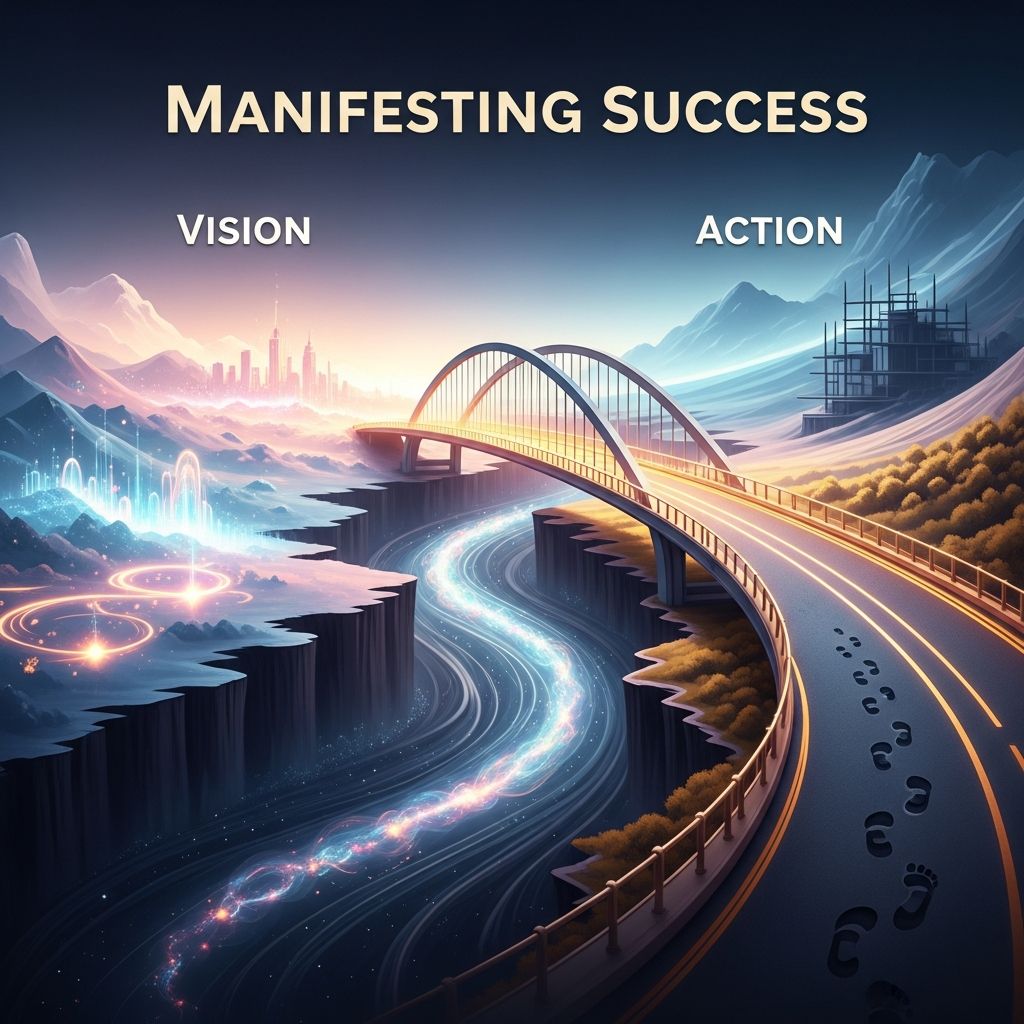
The bridge between thought and reality is action. Changing your thoughts alone is insufficient; you must behave in ways consistent with your vision. This alignment is what separates wishful thinking from genuine manifestation.
Once you have cultivated a clear mental image of your desired outcome and shifted your beliefs to support this possibility, identify the specific actions that move you toward this reality. These might include developing new skills, networking with relevant people, taking calculated risks, or simply showing up consistently in your area of focus.
The power of aligned action is that it reinforces your new beliefs and thought patterns. Each time you take an action despite fear or doubt, you gather evidence that contradicts limiting beliefs. You prove to yourself that you are capable, that opportunities exist for you, and that your vision is achievable. This evidence then strengthens your beliefs, making it easier to maintain positive thought patterns and take further aligned action.
Creating Environmental Support for Mental Transformation
Your physical and social environment significantly influences your thought patterns and emotional states. If your surroundings consistently trigger stress, negativity, or feelings of limitation, manifestation becomes exponentially more difficult. Conversely, strategically designing your environment to support your vision creates numerous micro-moments of reinforcement throughout your day.
Consider the following environmental adjustments:
- Modify spaces where you spend significant time to reflect your aspirations and values
- Curate your media consumption to include content that inspires and educates rather than depletes
- Spend time in natural settings that calm your nervous system and expand your perspective
- Create physical reminders of your vision, such as vision boards or written affirmations, in visible locations
- Evaluate relationships and community connections to ensure they support rather than undermine your goals
Your environment communicates messages to your subconscious mind throughout the day. When your surroundings reflect your values and aspirations, your brain receives constant reinforcement that this vision is normal and achievable for you. This environmental support makes maintaining positive thought patterns significantly easier and more natural.
Developing Mental Resilience and Adaptive Thinking
As you work to manifest your goals, you will encounter setbacks, disappointments, and challenges that test your commitment. Mental resilience—the ability to maintain your vision and positive thinking despite difficulties—is essential for sustained progress.
Building resilience involves understanding what triggers negative emotional responses in you and developing strategies to manage these triggers. Rather than avoiding situations that make you anxious or uncertain, develop adaptive thinking patterns. If anxiety rises, practice deep breathing and consciously redirecting your thoughts toward what you can influence rather than dwelling on what you cannot.
Recognize that obstacles are not indicators that your vision is impossible; they are part of the natural process of growth and creation. When you encounter resistance, pause and ask yourself: What is this situation teaching me? What strength or skill does this challenge invite me to develop? What adjustment do my plans require? This reframing transforms obstacles from evidence of failure into valuable learning experiences that strengthen your capability and resolve.
Anchoring Your Vision Through Daily Practice
Manifestation is not a one-time event; it is an ongoing practice that strengthens through repetition and consistency. Daily practices anchor your vision in your consciousness and reinforce the neural pathways associated with your desired outcomes.
Consider incorporating these practices into your daily routine:
- Begin your day by identifying three things you are grateful for, which elevates your emotional baseline
- Spend five to ten minutes in meditation or mindfulness to observe your thoughts without judgment
- Write or review your vision statement and specific goals to maintain mental focus
- Visualize your desired outcome in sensory detail for five minutes
- Recite affirmations or mantras that reinforce empowering beliefs about your capabilities and deservingness
- Take at least one action, however small, aligned with your goals
- Reflect on the day, noting moments where your thoughts and actions aligned with your vision
These daily practices maintain the momentum of your manifestation work and keep your subconscious mind consistently oriented toward your vision. Over weeks and months, the cumulative effect of these practices produces measurable shifts in your circumstances and opportunities.
Understanding the Science of Mindset Intervention
Recent research from leading universities confirms that brief, targeted mindset interventions produce lasting results in various life domains. Scientists studying the mind-body connection have discovered that relatively short interventions can help people train their brains toward positive outcomes, from reducing chronic pain to improving recovery from medical procedures.
This scientific validation demonstrates that your thoughts and beliefs are not trivial or merely psychological; they produce tangible, measurable effects on your physical body and life circumstances. The mind is not separate from reality; it is intricately woven into the fabric of your experience and actively shapes what becomes possible for you.
Frequently Asked Questions
Q: Is manifestation just positive thinking?
A: No. While positive thinking is a component, genuine manifestation requires aligning your thoughts, beliefs, emotions, and actions toward your desired outcome. It is the integration of these elements that produces real results.
Q: How long does it take to see results from manifestation practices?
A: Results vary depending on the nature of your goals, your consistency with practices, and the magnitude of change required. Some people notice shifts in perspective and opportunities within weeks, while larger transformations typically require months of sustained practice.
Q: Can manifestation work if I have doubts?
A: Perfect certainty is not required. What matters is consistent practice and gradually building evidence that supports your desired belief. As you take aligned action and notice positive results, your doubts naturally diminish.
Q: What should I do if I catch myself thinking negatively despite my manifestation practice?
A: Negative thoughts are normal and do not undo your progress. Simply notice the thought, label it as a story rather than fact, and consciously redirect your attention toward what you want to create. Consistency matters more than perfection.
Q: Can I manifest multiple goals simultaneously?
A: Yes, though maintaining focused attention on multiple goals requires clear prioritization and deliberate attention. Many people find it helpful to identify one primary vision while allowing secondary goals to develop naturally.
References
- How to Change Your Reality by Changing Your Thoughts — Caroline Ferguson. Accessed January 19, 2026. https://carolineferguson.com/change-your-reality-by-changing-your-thoughts/
- How to Retrain Your Brain: Tips for Positivity & Success — University of Sports and Allied Health. Accessed January 19, 2026. https://www.usa.edu/blog/how-to-retrain-your-brain/
- Master Your Thoughts – Create Your Reality — Josie Thomson. Accessed January 19, 2026. https://josiethomson.com/createyourreality/
- Stanford Researchers Explore How the Human Mind Shapes Reality — Stanford News. June 2018. https://news.stanford.edu/stories/2018/06/four-ways-human-mind-shapes-reality

Medha Deb is an editor with a master's degree in Applied Linguistics from the University of Hyderabad. She believes that her qualification has helped her develop a deep understanding of language and its application in various contexts. Medha specializes in the areas of beauty, health, sports, and wellness and is committed to ensuring that the content on the website is…