
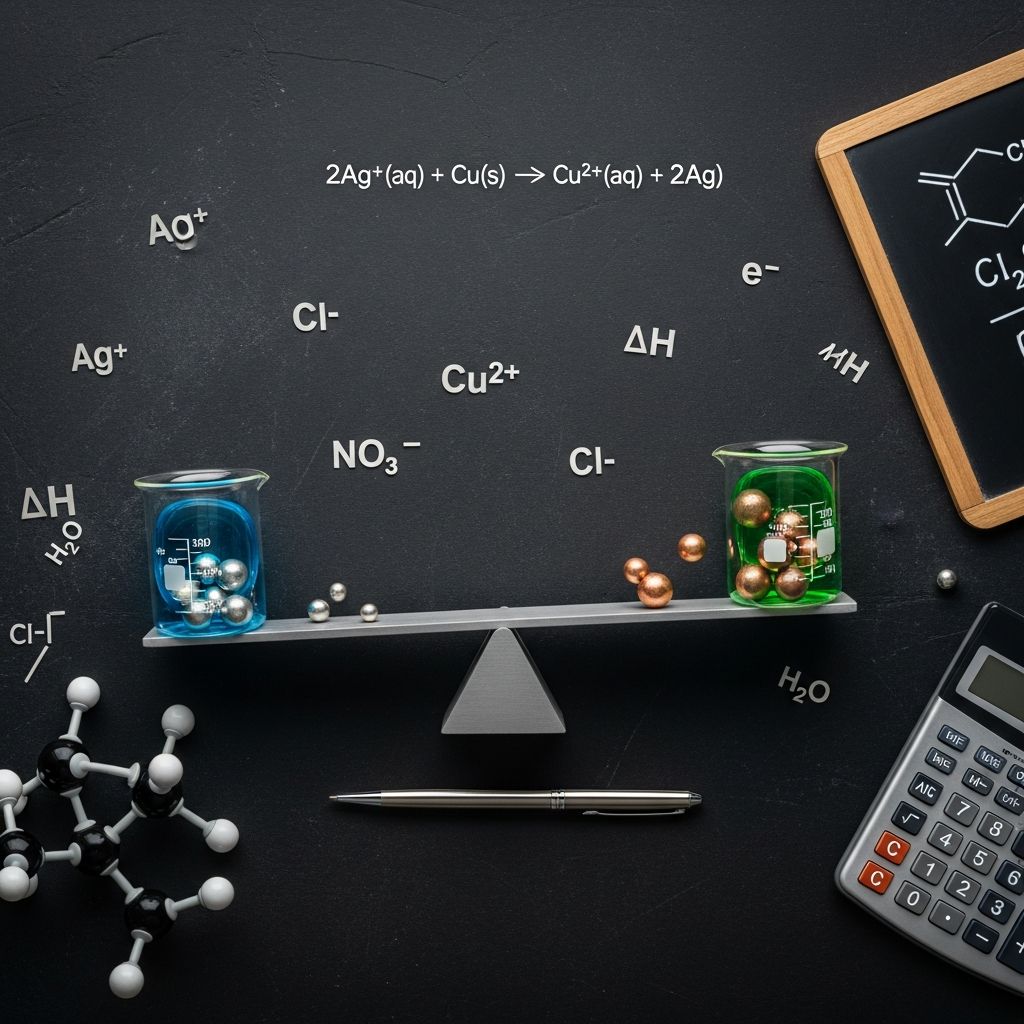
Ionic equations represent chemical reactions in solutions where electrolytes dissociate into ions. Balancing them correctly reveals the true species involved in reactions, stripping away irrelevant components. This article explores the process comprehensively, from basic principles to advanced applications.
Understanding the Foundations of Ionic Equations
Chemical reactions in aqueous solutions often involve ionic compounds that break apart into charged particles. A **molecular equation** shows all reactants and products as intact formulas, while the **complete ionic equation** displays dissociated ions, and the **net ionic equation** eliminates unchanged ‘spectator ions’. Grasping these distinctions is crucial for accurate balancing.
Spectator ions remain unchanged throughout the reaction, appearing identically on both sides. Removing them simplifies the equation to focus on reacting species. All ionic equations must balance both atoms (mass) and charges, ensuring conservation laws hold.
Core Steps to Balance Any Ionic Equation
Follow this systematic approach to balance ionic equations reliably:
- Start with the balanced molecular equation: Ensure correct formulas and stoichiometric coefficients for all compounds, including states like (aq), (s), (l), (g).
- Convert to complete ionic form: Dissociate strong electrolytes (soluble salts, strong acids/bases) into ions; leave weak electrolytes, precipitates, and nonelectrolytes intact.
- Identify and cancel spectators: Cross out identical ions on both sides to derive the net ionic equation.
- Verify balance: Confirm equal atoms and net charge on both sides. Adjust coefficients if needed.
This method works for precipitation, acid-base, and many redox reactions in solution.
Practical Examples: Precipitation Reactions
Consider silver nitrate reacting with sodium chloride: AgNO₃(aq) + NaCl(aq) → AgCl(s) + NaNO₃(aq). First, balance the molecular equation (already balanced). Dissociate solubles:
Ag⁺(aq) + NO₃⁻(aq) + Na⁺(aq) + Cl⁻(aq) → AgCl(s) + Na⁺(aq) + NO₃⁻(aq)
Cancel Na⁺ and NO₃⁻: Ag⁺(aq) + Cl⁻(aq) → AgCl(s). Balanced by mass and charge (net zero).
| Molecular Equation | Complete Ionic | Net Ionic |
|---|---|---|
| AgNO₃(aq) + NaCl(aq) → AgCl(s) + NaNO₃(aq) | Ag⁺ + NO₃⁻ + Na⁺ + Cl⁻ → AgCl(s) + Na⁺ + NO₃⁻ | Ag⁺(aq) + Cl⁻(aq) → AgCl(s) |
| CuCl₂(aq) + K₃PO₄(aq) → Cu₃(PO₄)₂(s) + KCl(aq) | 3Cu²⁺ + 6Cl⁻ + 2K⁺ + 2PO₄³⁻ → Cu₃(PO₄)₂(s) + 6K⁺ + 6Cl⁻ | 3Cu²⁺(aq) + 2PO₄³⁻(aq) → Cu₃(PO₄)₂(s) |
The table illustrates progression, highlighting charge balance (e.g., +6 left, zero right in Cu example, with solid neutral).
Acid-Base Neutralization in Ionic Form
HCl(aq) + NaOH(aq) → NaCl(aq) + H₂O(l). Molecular balanced. Complete ionic: H⁺ + Cl⁻ + Na⁺ + OH⁻ → Na⁺ + Cl⁻ + H₂O(l). Cancel Na⁺, Cl⁻: H⁺(aq) + OH⁻(aq) → H₂O(l). Classic net ionic for strong acid-base reactions.
For polyprotic acids like H₂SO₄ + 2NaOH → Na₂SO₄ + 2H₂O: Net ionic H₂SO₄ fully dissociates to 2H⁺ + SO₄²⁻, yielding 2H⁺ + 2OH⁻ → 2H₂O.
Balancing Redox Ionic Equations
Redox reactions in acidic or basic media require half-reaction methods. In acid:
- Balance non-O, H atoms.
- Add H₂O for oxygen.
- Add H⁺ for hydrogen.
- Balance charge with e⁻.
- Equalize electrons in oxidation/reduction halves and combine.
Example: MnO₄⁻ + Fe²⁺ → Mn²⁺ + Fe³⁺ (acidic).
Reduction: MnO₄⁻ → Mn²⁺ (balance Mn; add 4H₂O right; 8H⁺ left; +5e⁻ right).
Oxidation: Fe²⁺ → Fe³⁺ (+1e⁻ left). Multiply oxidation ×5, add: MnO₄⁻ + 5Fe²⁺ + 8H⁺ → Mn²⁺ + 5Fe³⁺ + 4H₂O.
In basic media, add OH⁻ to neutralize H⁺, converting to H₂O.
Solubility Rules for Accurate Dissociation
Determine states using solubility guidelines:
- Nitrates (NO₃⁻), most acetates (CH₃COO⁻): soluble.
- Group 1 salts, NH₄⁺: soluble.
- Halides soluble except Ag⁺, Pb²⁺, Hg₂²⁺.
- Sulfates soluble except Ba²⁺, Pb²⁺, Sr²⁺.
- Carbonates, phosphates, hydroxides insoluble except Group 1, NH₄⁺.
These rules dictate which compounds ionize in water.
Common Mistakes and How to Avoid Them
- Forgetting states: Always specify (aq) for dissociation.
- Charge imbalance: Double-check net charges; use polyatomic ion charges (e.g., SO₄²⁻).
- Not balancing molecular first: Ensures correct stoichiometry.
- Missing weak electrolytes: Acetic acid CH₃COOH doesn’t fully dissociate.
- Redox pitfalls: Balance Cr in Cr₂O₇²⁻ before proceeding.
Advanced Applications and Practice Problems
Practice: Balance net ionic for Pb(NO₃)₂(aq) + Na₂SO₄(aq) → PbSO₄(s) + NaNO₃(aq). Solution: Pb²⁺(aq) + SO₄²⁻(aq) → PbSO₄(s).
Redox: Cl₂ + Fe²⁺ → Cl⁻ + Fe³⁺. Net: Cl₂ + 2Fe²⁺ → 2Cl⁻ + 2Fe³⁺.
These build proficiency. Use tools like solubility tables for verification.
Frequently Asked Questions (FAQs)
What is a spectator ion?
Spectator ions do not participate in the reaction and cancel out in net ionic equations.
Do net ionic equations always balance charge?
Yes, both mass and charge must balance on both sides.
How do I handle polyatomic ions?
Treat them as single units if unchanged; balance atoms within if reacting.
Can I balance net ionic directly without molecular?
Possible but risky; start with molecular for accuracy.
What’s the difference in acidic vs. basic redox?
Acidic uses H⁺/H₂O; basic converts to OH⁻/H₂O.
References
- Balancing Net Ionic Equations — University of Maryland. Accessed 2026. https://terpconnect.umd.edu/~wbreslyn/chemistry/net-ionic/index.html
- 5.7: Net Ionic Equations — Chemistry LibreTexts, Saint Francis University. 2023-10-15. https://chem.libretexts.org/Courses/Saint_Francis_University/CHEM_113:_Human_Chemistry_I_(Muino)/05:_Classification_and_Balancing_of_Chemical_Reactions/5.07:_Net_Ionic_Equations
- Writing ionic equations for redox reactions — Chemguide (University-level resource). Accessed 2026. https://www.chemguide.co.uk/inorganic/redox/equations.html

Medha Deb is an editor with a master's degree in Applied Linguistics from the University of Hyderabad. She believes that her qualification has helped her develop a deep understanding of language and its application in various contexts. Medha specializes in the areas of beauty, health, sports, and wellness and is committed to ensuring that the content on the website is…