
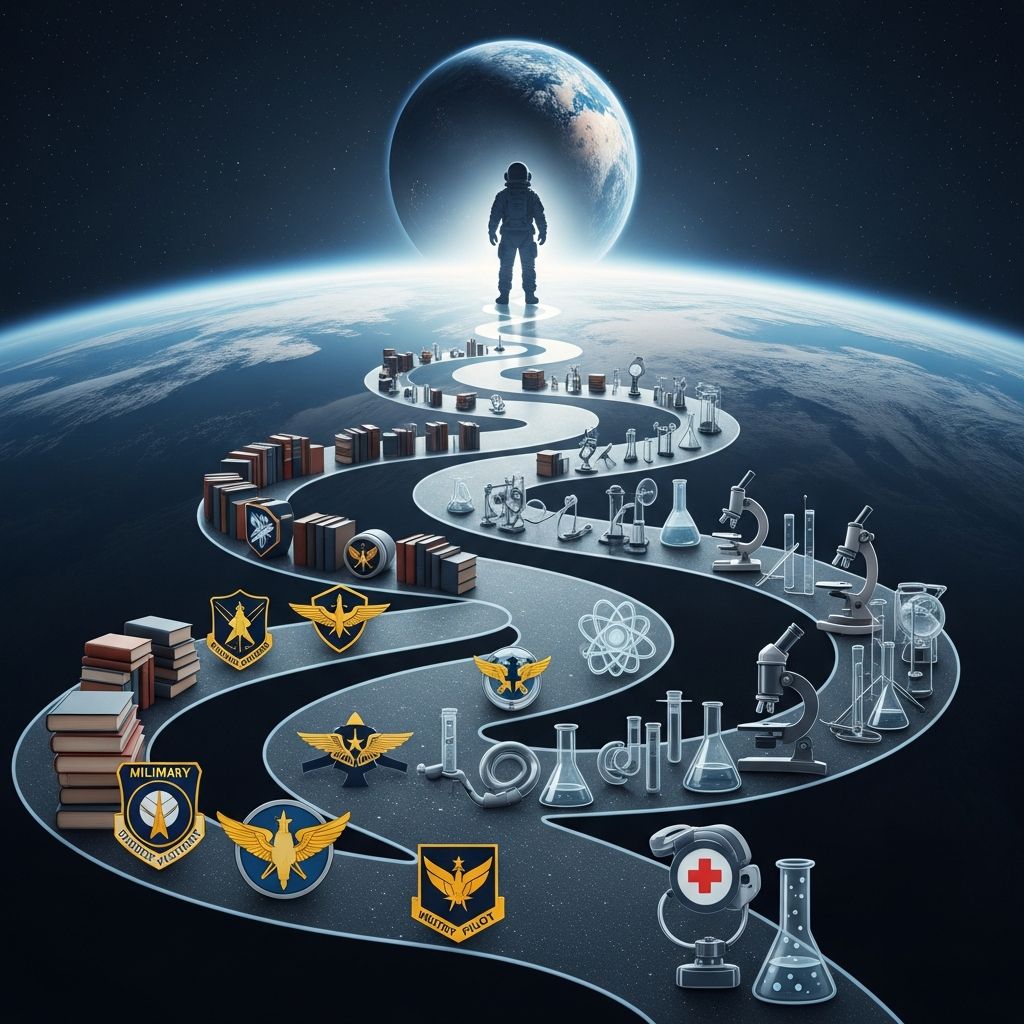
Becoming an astronaut represents one of humanity’s most demanding career pursuits, blending cutting-edge science, physical endurance, and unyielding determination. NASA’s astronaut corps pioneers space exploration, operating on the International Space Station, preparing for lunar missions, and gearing up for Mars voyages. This guide outlines the foundational qualifications, skill development strategies, rigorous selection process, and comprehensive training regimen required to join this elite group.
Core Eligibility Criteria for Aspiring Astronauts
Astronaut candidates must first satisfy NASA’s baseline requirements, designed to ensure readiness for the extreme conditions of spaceflight. U.S. citizenship is mandatory, reflecting the program’s national scope and security needs.
Educational standards emphasize STEM excellence. Candidates need a master’s degree in engineering, biological science, physical science, computer science, mathematics, or a related field from an accredited institution. Alternatives include two years toward a doctorate in a STEM discipline, a Doctor of Medicine or Doctor of Osteopathic Medicine degree, or completion of a nationally recognized test pilot school program.
- Engineering: Covers mechanics, dynamics, thermodynamics, materials science, and structural analysis—vital for spacecraft design and operations.
- Biological/Physical Sciences: Essential for conducting experiments in microgravity, studying human physiology, and analyzing extraterrestrial environments.
- Computer Science/Mathematics: Powers data analysis, simulations, and autonomous systems control.
Professional experience is equally critical: at least two to three years post-degree in a relevant field, or 1,000 hours of pilot-in-command time on jet aircraft, with 850 hours in high-performance jets preferred for pilot roles. Medical residencies count toward this for physicians, provided completion by specified deadlines like June 2025.
Physical and Medical Standards
Spaceflight imposes unprecedented physiological stresses, from microgravity’s impact on bones and muscles to high-g forces during launch and reentry. Candidates must pass the NASA long-duration flight physical, assessing overall health, cardiovascular fitness, and resilience.
| Requirement | Details | Purpose |
|---|---|---|
| Height | 62-75 inches (157.5-190.5 cm) | Fit within spacecraft cabins and suits without impeding controls. |
| Vision | 20/20 (natural or corrected) | Operate instruments and perform visual tasks in space. |
| Blood Pressure | ≤140/90 | Withstand microgravity’s circulatory shifts. |
| General Fitness | Pass comprehensive exam | Endure isolation, radiation, and zero-gravity for months. |
These standards evolve with mission demands, prioritizing candidates who can thrive in prolonged space environments.
Indispensable Skills for Spacefarers
Beyond credentials, astronauts embody a unique skill matrix. Analytical prowess enables precise experiment execution and data interpretation amid anomalies.
- Decision-Making: Split-second choices in crises, balancing risks to crew and mission.
- Communication: Convey complex ideas to ground teams and collaborate internationally.
- Interpersonal/Teamwork: Foster harmony in confined quarters during extended missions.
- Math/Mechanical Aptitude: Tackle calculus, geometry, and engineering repairs on-the-fly.
- Problem-Solving: Innovate solutions when systems fail in the void of space.
Pilot astronauts benefit from test flight experience, honing reflexes for spacecraft handling. Mission specialists leverage domain expertise in science or medicine.
Navigating the Competitive Selection Process
Competition is fierce; NASA’s 2016 call drew 18,300 applications. The Astronaut Selection Board evaluates submissions for qualification alignment and standout potential.
- Application Review: Holistic assessment of education, experience, and leadership.
- Initial Interviews: Top candidates visit Johnson Space Center in Houston for evaluations.
- Final Selection: Roughly half of interviewees advance; selects undergo two years of candidacy training.
Candidates train in spacewalking, T-38 jet piloting, robotics, and ISS operations, transitioning to full astronauts upon certification.
Building a Launchpad: Preparation Strategies
Achieving astronaut status demands proactive groundwork. Pursue STEM graduate studies at top programs, targeting fields like aerospace engineering or astrobiology. Gain hands-on experience through research labs, industry roles at Boeing or SpaceX, or military aviation.
For pilots, complete officer training via academies or ROTC, securing a science degree alongside commissioning. Accumulate jet hours in Navy or Air Force squadrons, aiming for test pilot schools.
Civilians build credentials via progressively responsible roles—e.g., NASA internships, university research, or private sector R&D. Teaching K-12 STEM counts as qualifying experience.
Advanced degrees substitute for experience: master’s equals one year, doctorate three years.
Physical prep involves marathon training, strength conditioning, and hypoxia simulations. Cultivate soft skills through team sports, public speaking, or international exchanges.
Astronaut Training: From Candidate to Space Pioneer
Selected candidates report to Johnson Space Center for Basic Astronaut Training, a grueling two-year odyssey.
- Survival Training: Wilderness and water egress to handle post-landing emergencies.
- Spacewalk Simulations: Neutral buoyancy labs mimic EVAs.
- Robotics: Master ISS Canadarm operations.
- Aircraft Proficiency: T-38 flights sharpen piloting.
- Science/Mission Rehearsals: Experiment runs and orbital mechanics.
Graduates earn the Astronaut pin, eligible for flights like Artemis lunar program.
Career Progression and Opportunities
Astronauts rotate through missions, support roles, and leadership. Post-flight, many transition to program management or private space ventures. Commercial astronaut paths emerge via companies like Sierra Space, broadening access.
Frequently Asked Questions (FAQs)
What is the minimum education for a NASA astronaut?
A master’s in a STEM field, or equivalents like a medical degree or test pilot program.
Do I need to be a pilot to become an astronaut?
No, but pilots need 1,000 jet hours; mission specialists require related professional experience.
How physically fit must I be?
Pass NASA’s long-duration physical: height 62-75 inches, 20/20 vision, blood pressure ≤140/90.
How many apply, and what are selection odds?
Thousands apply per cycle (e.g., 18,300 in 2016); only a dozen or so selected.
Can non-U.S. citizens become astronauts?
NASA requires citizenship; international partners select via agencies like ESA or JAXA.
Emerging Horizons in Astronautics
With Artemis and Mars ambitions, NASA seeks diverse experts in geology, robotics, and sustainability. Private firms like Sierra Space train commercial crews for orbital habitats, potentially easing entry barriers. Stay vigilant for USAJOBS postings.
This path tests human limits but rewards with unparalleled contributions to discovery. Start today—your trajectory to the stars awaits.
References
- Astronaut Requirements — NASA. 2023. https://www.nasa.gov/humans-in-space/astronauts/astronaut-requirements/
- Astronaut – College of Science — Purdue University. 2024. https://purdue.edu/science/careers/what_can_i_do_with_a_major/Career%20Pages/astronaut.html
- How to Become an Astronaut — Career Girls. 2023. https://www.careergirls.org/careers/astronaut/
- What Degree Do You Need to Be An Astronaut? — Space Foundation. 2022-07-18. https://www.spacefoundation.org/2022/07/18/what-degree-do-you-need-to-be-an-astronaut/
- Become An Astronaut — NASA. 2025. https://www.nasa.gov/humans-in-space/astronauts/become-an-astronaut/
- To Become An Astronaut — Mike Mullane. 2023. https://mikemullane.com/to-become-an-astronaut/
- How to Become a Commercial Astronaut — Sierra Space. 2024. https://www.sierraspace.com/blog/how-to-become-a-commercial-astronaut/

- Integrated M.A. in Applied Linguistics, University of Hyderabad
- 5+ years in editorial, instructional, SEO, and research-based writing
Sneha is a relationships and lifestyle writer with a strong foundation in applied linguistics and certified training in relationship coaching. She brings over five years of writing experience to theskillvault, crafting thoughtful, research-driven content that empowers readers to build healthier relationships, boost emotional well-being, and embrace holistic living. Her writing and insights reflect the belief that beauty, happiness, and wellness…