
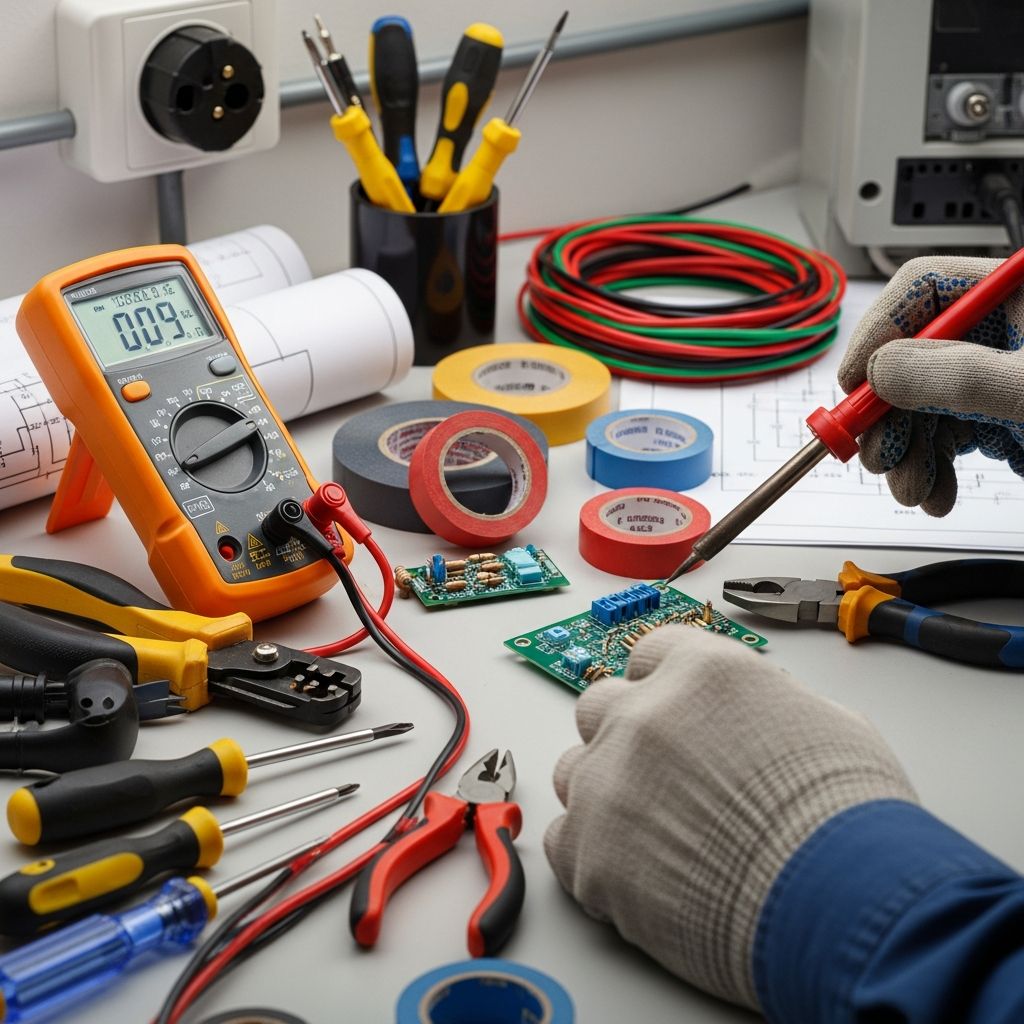
Electricians play a critical role in powering modern infrastructure, requiring a blend of technical proficiency, safety awareness, and practical problem-solving abilities. Success in this field demands rigorous training, hands-on experience, and adherence to industry standards, leading to stable employment and opportunities for advancement.
Building a Strong Foundation: Educational Prerequisites
Aspiring electricians must start with a solid educational base to grasp complex concepts like electrical circuits and codes. A high school diploma or GED is typically the minimum entry point, emphasizing subjects such as algebra, physics, and technical drawing.
- Mathematics Proficiency: Algebra and geometry are indispensable for calculating wire sizes, load capacities, and circuit angles, ensuring installations meet safety margins.
- Science Fundamentals: Understanding physics principles, including voltage, current, and resistance (Ohm’s Law), forms the bedrock for diagnosing system failures.
- Communication Skills: English classes aid in interpreting blueprints and documenting work, vital for teamwork and compliance reporting.
Without this groundwork, candidates often struggle in aptitude tests required for apprenticeships, which evaluate math, reading, and mechanical comprehension.
Pathways to Professional Training
Training options vary, but all combine theory with practice to prepare individuals for real-world challenges. Trade schools offer accelerated programs lasting 6 months to 2 years, covering wiring, blueprints, and the National Electrical Code (NEC).
| Training Type | Duration | Key Benefits | Hours Toward Licensing |
|---|---|---|---|
| Trade School | 6 months – 2 years | Hands-on labs, NEC focus | Credits toward apprenticeship |
| Apprenticeship | 4-5 years | Paid work, mentorship | 6,000-10,000 hours |
| Community College | 1-2 years | Certificates/degrees | Partial credit in some states |
Apprenticeships, often union-sponsored, provide 8,000+ hours of supervised experience alongside 576+ hours of classroom instruction, making them a comprehensive route.
Core Technical Competencies
Technical mastery distinguishes proficient electricians. Key areas include electrical theory, installation techniques, and diagnostic skills.
- Circuit Analysis: Apply Kirchhoff’s laws and AC/DC principles to troubleshoot imbalances and prevent overloads.
- Blueprint Reading: Decode wiring diagrams and schematics to execute precise installations.
- Tool Proficiency: Safely operate multimeters, conduit benders, and power tools for tasks like cable routing and fixture mounting.
- Code Compliance: Internalize NEC and local regulations to avoid violations during repairs or new builds.
These skills evolve with technology, such as smart home systems and renewable energy integrations, requiring ongoing education.
Prioritizing Safety in Every Task
Safety is non-negotiable; electricians face high risks from shocks, arcs, and falls. OSHA standards mandate awareness of lockout/tagout procedures, PPE usage, and hazard recognition.
- Risk Assessment: Identify live wires, improper grounding, or overloaded panels before starting work.
- Personal Protective Equipment (PPE): Use insulated gloves, arc-rated clothing, and safety glasses routinely.
- Emergency Protocols: Train in first aid, CPR, and fire suppression for arc flash incidents.
OSHA 10 certification, often required for government projects, reinforces these practices and boosts employability.
Soft Skills for On-the-Job Excellence
Beyond technical know-how, electricians need interpersonal and cognitive strengths. Critical thinking aids in isolating faults under pressure, while attention to detail prevents costly errors.
- Problem-Solving: Systematically test components to pinpoint issues like intermittent shorts.
- Time Management: Prioritize tasks on job sites, balancing multiple repairs efficiently.
- Customer Interaction: Explain technical issues clearly to clients, fostering trust and repeat business.
- Physical Stamina: Handle ladders, heavy conduits, and awkward positions in diverse environments.
These attributes enable career progression from apprentice to leadership roles.
Navigating Licensing and Certification
Licensing validates expertise and is mandatory in most states. Journeyman status requires 4-5 years of experience, training completion, and passing an exam on theory, codes, and safety.
Master electrician licensure demands additional years (e.g., 2,000 supervisory hours in some states) and exams, allowing business ownership.
- Journeyman Path: 8,000 hours supervised + exam.
- Master Path: Journeyman + extra experience/exam.
- Specialty Certs: Low-voltage, solar, or EV charging for niche markets.
Requirements vary; check state boards for specifics.
Advancing Your Electrician Career
Long-term growth involves specialization and continuous learning. Areas like industrial automation, green energy, or building management systems offer higher pay.
- Supervisory Roles: Lead teams after master status.
- Entrepreneurship: Start contracting firms with business skills.
- Tech Integration: Master IoT and automation for smart grids.
Average training costs at public two-year schools hover around $4,000, with apprenticeships providing wages from day one.
Common Challenges and Solutions
Electricians encounter hurdles like evolving codes and labor shortages. Solutions include annual NEC updates and networking via trade associations.
Physical demands require fitness, while mental resilience combats irregular hours.
Frequently Asked Questions (FAQs)
Do I need a college degree to become an electrician?
No, a high school diploma suffices, followed by trade school or apprenticeship.
How long does electrician training take?
Typically 4-5 years via apprenticeship, shorter for trade programs.
What is the National Electrical Code?
A standard for safe installations, tested in licensing exams.
Can women succeed as electricians?
Yes, the trade welcomes diverse talent with equal opportunities.
What salary can I expect as a journeyman?
Varies by location, but often $50,000+ annually post-licensing.
References
- Electrician Prerequisites: What You Need to Start Your Training — Century College. 2023. https://www.centuracollege.edu/blogs/trades-industry/electrician-prerequisites-training/
- Electrician skills required for career advancement — EmployBridge. 2024. https://www.employbridge.com/blog/career-path/electrician-skills-required-for-career-advancement
- How to Become an Electrician — BestColleges. 2024. https://www.bestcolleges.com/trades/electrical-technology/how-to-become-an-electrician/
- What Skills Do You Need to Be an Electrician — Church & Dwight Careers. 2023. https://careers.churchdwight.com/winning-together/global-operations/skills-needed-to-be-an-electrician/
- Top Electrician Skills Every Technician Needs — ServiceTitan. 2024. https://www.servicetitan.com/blog/electrician-skills
- Electrician Skills: OSHA Standard for Electrical Safety — 360training. 2023. https://www.360training.com/blog/osha-standard-electrical-safety
- Electrician — U.S. Department of Energy. 2024. https://www.energy.gov/eere/water/electrician

Medha Deb is an editor with a master's degree in Applied Linguistics from the University of Hyderabad. She believes that her qualification has helped her develop a deep understanding of language and its application in various contexts. Medha specializes in the areas of beauty, health, sports, and wellness and is committed to ensuring that the content on the website is…