
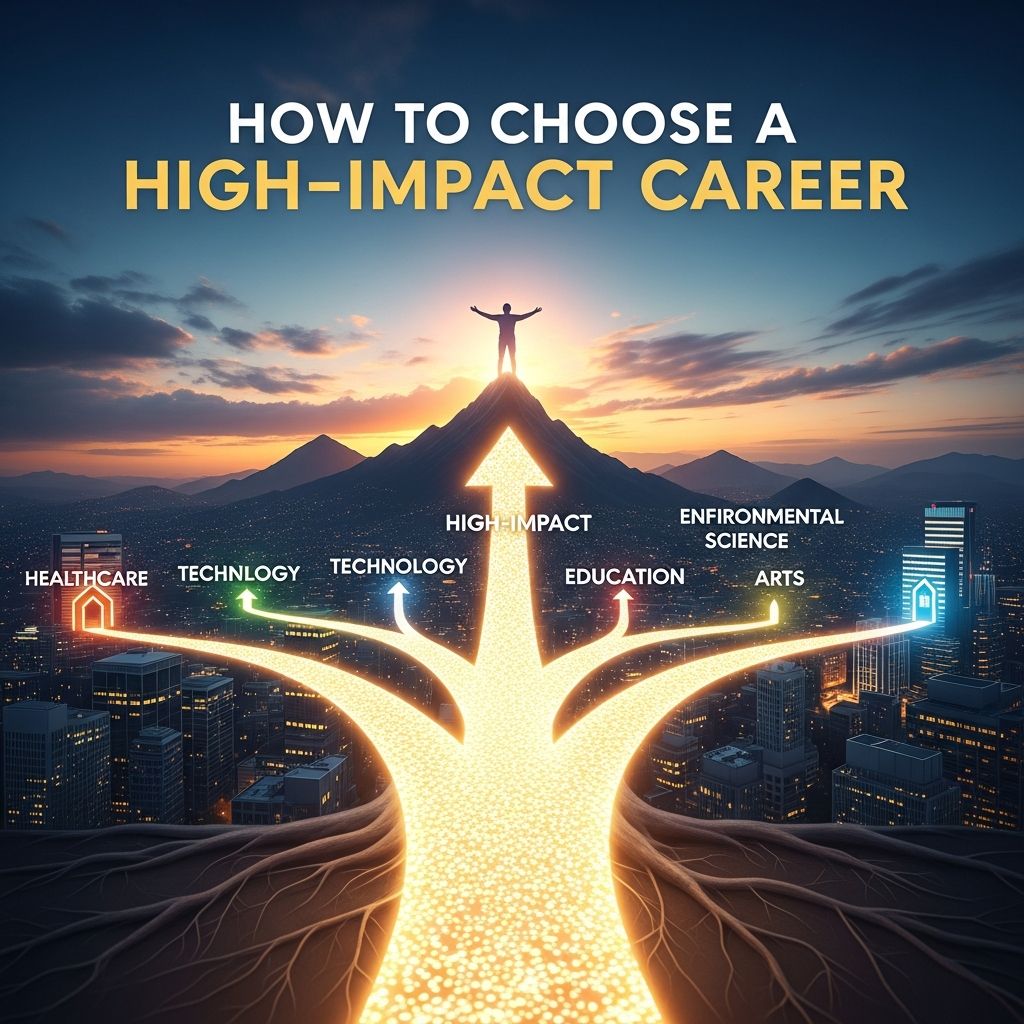
Most people will spend around 80,000 hours working over their lifetime. Choosing how to use that time is one of the most important decisions you will ever make, both for your own fulfillment and for the wider world.
This guide explains how to think strategically about your career if you want to help others as much as you reasonably can, without sacrificing your long-term wellbeing.
Why High-Impact Careers Matter
Careers that focus on solving major social and global challenges can save or improve many lives, protect the environment, and reduce future risks. Research on global health, climate change, and catastrophic risks suggests that the benefits of well-targeted interventions can be extremely large compared with typical charitable efforts.
Instead of only asking “What job do I like?”, high-impact career planning adds questions such as:
- Which problems are most pressing? Some issues affect billions of people or have long-lasting consequences.
- Where are additional people most needed? In some areas, extra funding matters most; in others, there is a shortage of skilled talent.
- How can my skills grow over time? Building rare, flexible skills early can multiply your impact later.
What Makes a Job High Impact?
No job is automatically “high impact” just from its title. The impact of a role depends on a combination of factors that can be assessed systematically.
1. Importance of the Problem
Work is more impactful when it targets problems that are large in scale, severe in harm, and under-addressed relative to their importance.
- Scale: How many people are affected, and by how much?
- Neglectedness: How few resources currently go toward solving it?
- Tractability: Are there realistic ways progress can be made?
2. Your Personal Fit
Evidence from labor economics and industrial-organizational psychology suggests that individuals who use their strongest skills and feel engaged at work tend to perform better and have more staying power.
- Relative strengths: Where do you perform better than people with a similar background?
- Motivation: Can you see yourself working on this for many years without burning out?
- Values alignment: Does the mission of the role match your ethical commitments?
3. Leverage and Scale
Some roles allow one person to influence many more people than they could help directly.
- Policy and governance: Shaping regulation or public spending can affect entire populations.
- Research and innovation: New ideas or technologies can be reused by others worldwide.
- Community building and education: Empowering others to act can multiply your effect.
4. Replaceability and Counterfactual Impact
To understand your true contribution, you need to consider what would probably happen if you did not take a role.
- If the job would be filled by someone almost as effective, your extra impact might be modest.
- If you bring rare skills or unusual dedication to a neglected area, your unique contribution can be large.
5. Long-Term Trajectory
A job can be high impact either because it is directly valuable now, or because it builds skills, credentials, or networks that substantially increase your future impact.
| Type of role | Main benefit | Example outcomes |
|---|---|---|
| Direct impact | Solves urgent problems now | Reducing disease, regulating hazards, improving safety standards |
| Skill-building | Increases your future contribution | Technical training, policy experience, leadership development |
| Earning to give | Generates funding for effective work | Supporting evidence-based global health or climate programs |
Five Broad Ways to Have a High-Impact Career
Different people will be best suited to different pathways. Below are five broad categories of high-impact careers that together cover most of the options highlighted in research-based career guides.
1. Research and Innovation
Careers focused on generating new knowledge, technologies, or methods can be extremely influential when directed at major global problems.
Examples of promising research areas include:
- Global health and development research to identify cost-effective ways to reduce disease, poverty, and early death.
- Climate and energy research to accelerate decarbonization and adaptation.
- Risk reduction research related to pandemics, biosecurity, or emerging technologies.
Typical roles:
- Academic or think-tank researcher
- Applied scientist in industry or government labs
- Data scientist working on public-interest questions
2. Policy, Regulation, and Public Service
Governments and international organizations shape laws, incentives, and systems that affect millions of people. Public-sector decisions on health, environment, technology, and security can have large social returns.
- Public policy roles in health, climate, technology governance, or economic development.
- Legislative and executive branch staff who help design and implement evidence-based policy.
- Diplomatic and international organization roles addressing cross-border challenges.
Useful backgrounds: public policy, law, economics, international relations, or technical training combined with policy experience.
3. Mission-Driven Organizations and Nonprofits
Social purpose organizations work directly on problems such as poverty, education, human rights, and environmental protection. They can exist as charities, social enterprises, or hybrid models.
- Global health and development organizations implementing interventions like vaccination programs, cash transfers, or basic services.
- Climate and environmental nonprofits focused on mitigation, adaptation, or conservation.
- Organizations focused on catastrophic risk reduction, such as pandemic preparedness or disaster resilience.
Common roles include program management, operations, monitoring and evaluation, fundraising, and communications.
4. Earning to Give
In some situations, taking a higher-earning role and donating a substantial fraction of your income to evidence-based charities can be one of the most effective ways to help others.
High-earning roles might include:
- Quantitative finance or analytics
- Senior roles in technology or engineering
- Entrepreneurship in sectors not dominated by social harm
The impact of this path depends heavily on:
- The proportion of income you donate consistently over time.
- How carefully you select high-impact organizations, ideally using independent evaluations.
- Your ability to stay healthy and engaged in a demanding role.
5. Community Building, Communication, and Education
Some people can have their greatest impact by enabling many others to contribute more effectively.
- Community organizing and professional networks that connect people to impactful opportunities.
- Public communication and journalism about high-stakes issues and evidence-based solutions.
- Education and training that build crucial skills in future decision-makers.
These paths particularly suit people who enjoy mentoring, writing, speaking, or facilitating collaboration.
Examples of Promising Focus Areas
The ideal focus area will depend on emerging evidence, your skills, and your values. However, several issues are widely considered especially important by policy and research institutions.
- Global health and extreme poverty: Reducing preventable disease, improving nutrition, and supporting basic income security in low-income countries.
- Climate change and environmental resilience: Cutting greenhouse gas emissions, protecting ecosystems, and helping communities adapt.
- Pandemic preparedness and biosecurity: Strengthening surveillance, laboratory safety, and emergency response capacity.
- Risks from emerging technologies: Ensuring powerful technologies such as advanced AI or biotechnology are governed responsibly.
- Strengthening institutions and democracy: Supporting transparent, accountable, and evidence-driven governance.
How to Plan Your Own High-Impact Career
Turning these ideas into concrete decisions requires a structured process. The steps below provide a practical roadmap.
Step 1: Clarify Your Values and Constraints
Start by understanding what you care about and what you need your career to provide.
- Your ethical views and priorities (for example, global poverty, animal welfare, or future generations).
- Non-negotiable constraints such as geography, family responsibilities, or health.
- Your risk tolerance regarding income variability, relocation, or further study.
Step 2: Explore Problem Areas and Roles
Next, create a longlist of paths that could plausibly be a good fit. Useful actions include:
- Reading research-based career guides and job boards that specialize in social impact work.
- Talking to professionals working in policy, nonprofits, research, and mission-driven companies.
- Testing your fit through short projects, internships, or volunteering.
Step 3: Compare Options Systematically
To avoid being swayed mainly by prestige or familiarity, score each option along the dimensions discussed earlier.
| Criterion | Guiding question |
|---|---|
| Problem importance | How big and serious is the issue addressed? |
| Neglectedness | How many people and organizations already focus here? |
| Tractability | Is there clear evidence that additional effort can help? |
| Personal fit | Do your skills and interests match the demands of the work? |
| Career capital | Will this build skills, network, and credibility for later roles? |
Step 4: Build Career Capital Early
In the first decade of your career, it often makes sense to place significant weight on learning and flexibility.
- Pursue roles that teach you in-demand, transferable skills, such as data analysis, management, communication, or quantitative reasoning.
- Seek organizations with strong mentorship and a culture of feedback.
- Consider further education when it clearly opens doors (for example, certain master’s degrees or technical PhDs relevant to your target path).
Step 5: Adjust Over Time
Your views on what matters and where you fit best will change as you gain experience. Revisit your plan every year or two:
- Update your understanding of global priorities using new data and research.
- Reflect honestly on your performance, energy levels, and satisfaction.
- Be willing to pivot if evidence suggests you could contribute more elsewhere.
Common Misconceptions about Helping Others with Your Career
Several widely held beliefs can unintentionally limit your impact.
- Myth: Only frontline charity work helps.
Many of the highest-impact roles are in research, policy, or organization-building, which indirectly enable large improvements for others. - Myth: Passion is all that matters.
Interest is important for motivation, but career capital, problem selection, and leverage often make a bigger difference to impact. - Myth: High-earning jobs are always selfish.
If used to support rigorously evaluated programs and if the work itself is not harmful, high earnings can fund substantial good. - Myth: Impact means sacrificing wellbeing.
Burnout reduces long-term effectiveness. Sustainable impact usually requires adequate rest, social support, and financial stability.
Frequently Asked Questions
How do I choose between personal fulfillment and social impact?
Fulfillment and impact often reinforce each other. Research on job satisfaction suggests that using your strengths, having autonomy, and working toward a meaningful purpose are key drivers of wellbeing. Instead of framing it as a trade-off, look for roles that meet your basic needs and values while also addressing important problems. If you face a genuine conflict, you might aim for a balance—for example, taking a moderately impactful role that is highly sustainable for you, or using part of your income or time to support effective causes.
Do I need an advanced degree to have a high-impact career?
Advanced degrees are essential in some paths (such as academic research, certain policy roles, or specialized technical work) but unnecessary in others. Before committing to more study, check whether it is a standard requirement for the jobs you want, and compare it with alternative ways to gain similar skills, such as targeted training, certificates, or on-the-job learning.
What if I’m already mid-career?
Transitioning later in your career can still be highly valuable. Mid-career professionals often bring management experience, domain expertise, and networks that are scarce in nonprofits or public-interest projects. Start by mapping your existing skills to problems that need them—operations, leadership, finance, and product development are all in demand in social impact organizations.
Is it risky to focus on emerging or uncertain problems?
Some high-priority problems, especially those involving emerging technologies or long-term risks, come with more uncertainty. You can manage this by diversifying your options, building broadly useful skills, and choosing roles that remain valuable even if your views about specific risks evolve.
How can I find concrete job opportunities?
Look at curated job boards and professional networks that specialize in social impact, global development, climate action, and risk reduction. Combine these with mainstream platforms, filtering for mission-driven organizations and policy roles. Informational interviews often reveal opportunities that never appear on public listings.
References
- Research-backed guide to a fulfilling career that does good — 80,000 Hours. 2023-10-01. https://80000hours.org/career-guide/
- Building a Career in Social Impact: A Guide for Aspiring Change-Makers — University of Puget Sound, CES. 2024-12-12. https://ces.pugetsound.edu/blog/2024/12/12/building-a-career-in-social-impact-a-guide-for-aspiring-change-makers/
- Your Guide to Career Paths in the Social-Impact Space — Idealist. 2022-06-15. https://www.idealist.org/en/careers/guide-career-paths-social-impact
- 80,000 Hours: How to make a difference with your career — 80,000 Hours. 2023-05-05. https://80000hours.org
- Career Guide: How to Do Good With Your Work — Probably Good. 2023-11-01. https://probablygood.org/career-guide/
- High-Impact Job Board — Probably Good. 2024-04-10. https://jobs.probablygood.org
- High Impact Professionals: Transition to a high-impact career — High Impact Professionals. 2024-03-20. https://www.highimpactprofessionals.org

- Integrated M.A. in Applied Linguistics, University of Hyderabad
- 5+ years in editorial, instructional, SEO, and research-based writing
Sneha is a relationships and lifestyle writer with a strong foundation in applied linguistics and certified training in relationship coaching. She brings over five years of writing experience to theskillvault, crafting thoughtful, research-driven content that empowers readers to build healthier relationships, boost emotional well-being, and embrace holistic living. Her writing and insights reflect the belief that beauty, happiness, and wellness…