
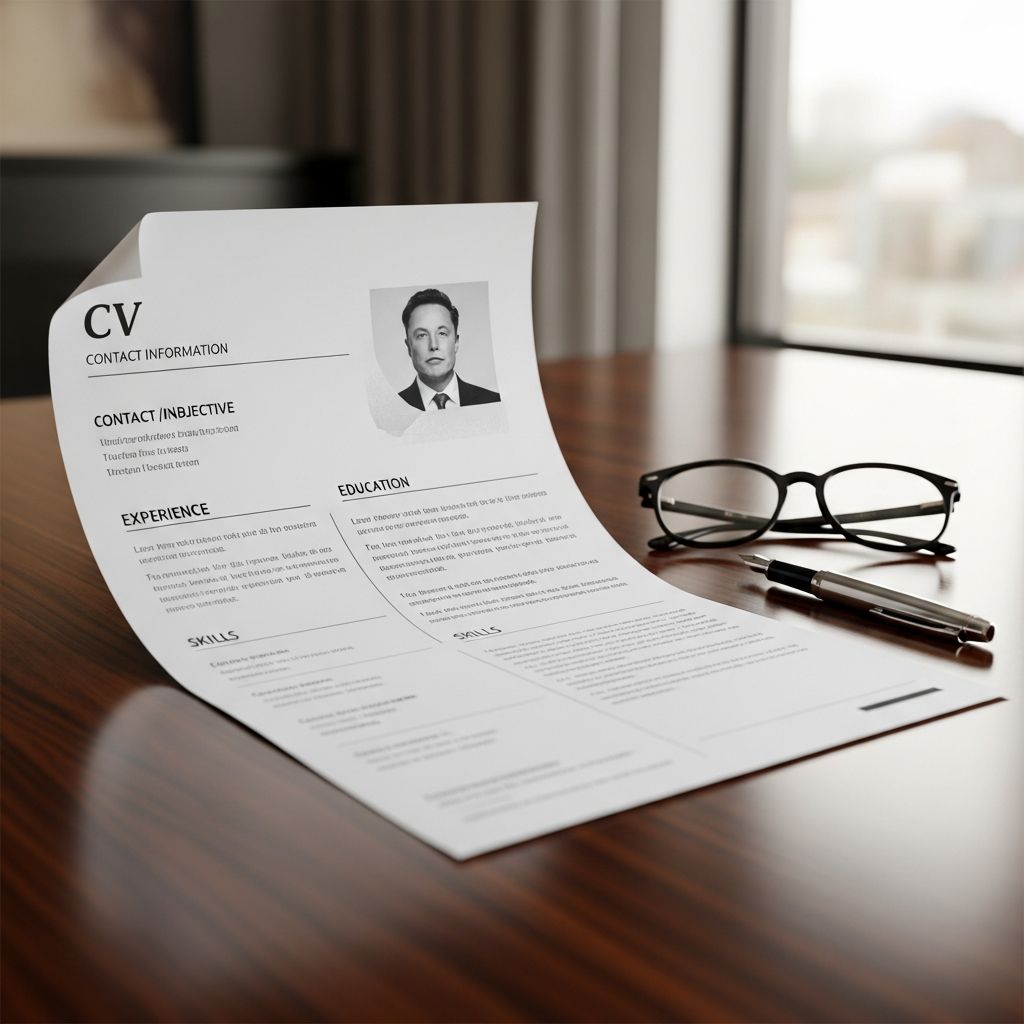
Elon Musk is widely associated with ambitious companies such as SpaceX, Tesla, and Neuralink, but one of the most intriguing career-related ideas linked to him is the concept of a single, powerful page summarizing an extraordinary professional journey. While most people will never need to fit rockets, electric cars, and AI startups into a single document, the design logic behind a Musk-style one-page resume is extremely useful for any modern job seeker.
This article explains how to translate the storytelling power of a one-page Elon Musk resume into a practical template for your own CV—without copy-pasting anything from the original and without trying to pretend you are a billionaire founder. Instead, you will learn how to present your career with clarity, focus, and visual punch.
Why the One-Page Resume Still Matters
Recruiters routinely skim resumes in seconds, not minutes. Eye-tracking studies and employer surveys consistently show that hiring managers focus on a few key areas: current role, past titles, core skills, and standout achievements. Condensing all of this onto one page forces you to:
- Highlight only your most relevant experience.
- Cut vague or repetitive bullet points.
- Make your value proposition obvious at a glance.
- Use layout and design to guide the reader’s eye.
When a Musk-inspired resume goes viral, it is not because it lists every detail of his biography—his childhood in South Africa, early ventures like Zip2 and X.com, or the full history of SpaceX and Tesla. It is because one page communicates a coherent story about impact, innovation, and scale.
Core Principles Behind a Musk-Style Resume
Before you copy any layout ideas, understand the deeper principles that make this style work. They are surprisingly adaptable to non-tech, non-founder careers.
| Principle | How It Appears on a Musk-Type CV | How You Can Use It |
|---|---|---|
| Extreme focus | Only high-level roles (CEO, Founder, Lead Architect) and major companies appear. | Show only roles and projects that directly support your target job. |
| Outcome first | Accomplishments such as reusable rockets, bestselling EVs, or satellite constellations take center stage. | Lead bullets with results: revenue, savings, growth, or efficiency gains. |
| Visual hierarchy | Company names and positions are clearly separated from descriptions. | Use headings, bold text, and spacing to structure information. |
| Cross-domain narrative | Space, cars, energy, AI, tunnels and social media all tie into a future-focused vision. | Connect your roles through 1–2 career themes (e.g., “data-driven marketing” or “patient-centered care”). |
Structuring Your Own One-Page Resume
You do not need world-changing ventures to benefit from a well-structured resume. A clean, compressed layout helps any candidate—from entry-level graduates to experienced managers—communicate faster and better.
1. Craft a Clear Top Section
The top quarter of your page should answer three questions instantly: Who are you? What do you do? How can someone contact you?
- Name & title: Place your name in a larger font, and add a professional tagline such as “Senior Data Analyst” or “Product Marketing Manager.”
- Contact details: Keep it simple: email, phone (if relevant), city/region, and a portfolio or LinkedIn URL.
- Professional summary: Replace generic objectives with a 3–4 line snapshot of your value, e.g. “Data analyst with 5+ years experience turning complex financial data into actionable insights for executive decision-making.”
Think of this as the headline for your career. For Elon Musk, that headline might emphasize founding and leading companies like SpaceX and Tesla; for you, it should focus on your primary function and top strengths.
2. Turn Experience into a Timeline of Impact
In Musk’s public biography, his career forms a clear timeline: software company (Zip2), online payments (X.com, PayPal), rockets (SpaceX), electric cars (Tesla), solar energy (SolarCity), and later ventures like Neuralink and a high-speed tunneling company. Your resume should do something similar on a smaller scale.
For each role, include:
- Job title and employer.
- Dates (month/year–month/year).
- 1–2 lines describing your scope and responsibilities.
- 3–6 bullet points of measurable achievements.
Good bullets start with strong verbs and end with specific outcomes:
- “Increased online sales by 23% by implementing A/B-tested landing pages.”
- “Reduced onboarding time by 30% by redesigning training materials and workflows.”
The result is a narrative where every role shows progression and supports your current target.
3. Consolidate Skills into Themed Clusters
A Musk-style resume does not list every programming language, hobby, or side-interest. It highlights a small, powerful set of capabilities that align with his ventures—engineering, product design, leadership, and systems thinking.
Do the same by grouping your skills instead of listing them randomly:
- Technical: Software, tools, platforms, or methods you use daily.
- Analytical: Data analysis, research, reporting, or forecasting skills.
- Leadership & communication: Team management, stakeholder communication, mentoring, or presentation abilities.
Use 6–12 skills total. If everything is labeled “expert,” nothing stands out; be honest about your strongest areas.
4. Add Select Education & Credentials
Elon Musk’s formal education in physics and economics is often mentioned because it underpins his later work in engineering and business. Likewise, your education section should support your story.
- Include your highest and most relevant degrees (major, institution, location, graduation year).
- Add key certifications that are required or strongly valued in your field.
- Skip minor courses or short workshops unless they fill a major skills gap.
Visual Design Tips Borrowed from High-Impact One-Pagers
Even when the content is strong, layout and design can determine whether a recruiter reads to the bottom. You do not need a designer’s skills—just a few deliberate choices.
Use Space and Alignment Strategically
- Margins: Moderate margins (around 1.5–2 cm) keep the page airy while fitting enough text.
- Columns: A two-column layout often works well: a narrower side column for skills and contact info, and a wider column for experience.
- Consistent alignment: Align dates, headings, and bullet points to create visual order.
Limit Fonts and Colors
- Fonts: Use one or two professional fonts; vary size and weight (bold) rather than typeface.
- Colors: Base the design on black or dark gray text with one accent color for headings or icons.
- Emphasis: Rely on bold sparingly to highlight job titles, key numbers, or role names.
Make Numbers Impossible to Miss
Musk’s public accomplishments are defined by striking figures: orbital launches, vehicle deliveries, miles of range, or valuation milestones. Recruiters respond to numbers just as strongly.
- Quantify revenue, savings, or growth where possible.
- Use approximate figures if exact numbers are confidential (e.g. “low seven figures,” “double-digit growth”).
- Place the most impressive metrics near the top of each job description.
Tailoring Your Resume Like a Product Launch
Musk’s ventures typically launch with a clear target: reusable rockets to lower launch costs, electric vehicles to drive sustainable transport, or brain–computer interfaces to explore human–AI integration. Treat each job application with a similar level of specificity.
Align with the Job Description
- Scan for keywords: Identify 5–10 recurring terms in the posting (tools, methods, responsibilities).
- Mirror language thoughtfully: Use the employer’s terminology where it accurately reflects your skills and experience.
- Reorder sections: Move the most relevant experience or projects higher on the page.
Highlight the Right Projects
You may not have built a reusable rocket or a global EV brand, but you can showcase specific projects that demonstrate initiative and outcomes.
- Pick 2–4 projects that best match the role’s challenges.
- Summarize each with a problem–action–result structure.
- Include tools and methods only when they matter for the target position.
Common Mistakes When Imitating Famous Resumes
Seeing a stylized Elon Musk one-page resume often tempts people to focus on looks rather than substance. Avoid these traps:
- Over-design: Heavy graphics, complex charts, or dense sidebars can break applicant tracking systems and distract from content.
- Unrealistic claims: Trying to sound like a tech icon leads to buzzwords with no evidence. Always back claims with concrete examples.
- Ignoring context: Musk’s roles span decades and billion-dollar ventures; copying that structure directly rarely makes sense for a student or mid-career professional.
- Neglecting clarity: If a recruiter cannot quickly identify what you do and why you matter, design has failed.
Mini Checklist for a Musk-Inspired One-Page CV
Use this quick checklist before sending your resume.
- Is your core role or target position obvious in the top section?
- Does each job include at least one measurable achievement?
- Are your skills grouped into meaningful categories instead of scattered?
- Have you removed outdated or irrelevant details?
- Can someone skim the whole page in 15–20 seconds and understand your story?
Frequently Asked Questions (FAQs)
Q: Do I really have to limit my resume to one page?
For most early and mid-career professionals, a focused one-page resume is ideal because recruiters spend very little time on each application. Senior leaders, academics, or consultants with extensive publications and board roles can reasonably use two pages, but only if both are dense with relevant material.
Q: How can I make my resume impressive without big-name companies?
You do not need famous employers to stand out. Focus on measurable outcomes: saving time, improving quality, increasing sales, reducing errors, or introducing better processes. These concrete results often matter more to hiring managers than brand names.
Q: What if I am changing careers and my past roles are not directly related?
Use your summary and skills sections to connect the dots. Emphasize transferable skills—such as project management, communication, data analysis, or customer service—and highlight projects that mirror the kind of work you want to do next, even if they come from volunteering or side work.
Q: Should I include every job I have ever had?
No. Include the last 10–15 years of relevant roles, plus any earlier experience that is uniquely important for your story. Older or unrelated positions can often be summarized briefly or removed entirely to save space and maintain focus.
Q: Are creative layouts compatible with applicant tracking systems?
Many applicant tracking systems still work best with simple structures: clear headings, standard fonts, and linear text. If you use a more visual layout, always keep a plain, ATS-friendly version with straightforward sections and minimal graphics for online applications.
References
- Elon Musk — Tesla, Inc. 2024-03-01. https://www.tesla.com/elon-musk
- Elon Musk — Encyclopaedia Britannica. 2024-04-30. https://www.britannica.com/money/Elon-Musk
- A Complete Timeline of Elon Musk’s Business Endeavors — TIME. 2022-04-14. https://time.com/6170834/elon-musk-business-timeline-twitter/
- Lifetime of Achievement: Elon Musk — EV Magazine. 2023-04-20. https://evmagazine.com/articles/lifetime-of-achievement-elon-musk
- Elon Musk — Biography and career overview. 2024-02-10. https://en.wikipedia.org/wiki/Elon_Musk

- Integrated M.A. in Applied Linguistics, University of Hyderabad
- 5+ years in editorial, instructional, SEO, and research-based writing
Sneha is a relationships and lifestyle writer with a strong foundation in applied linguistics and certified training in relationship coaching. She brings over five years of writing experience to theskillvault, crafting thoughtful, research-driven content that empowers readers to build healthier relationships, boost emotional well-being, and embrace holistic living. Her writing and insights reflect the belief that beauty, happiness, and wellness…