
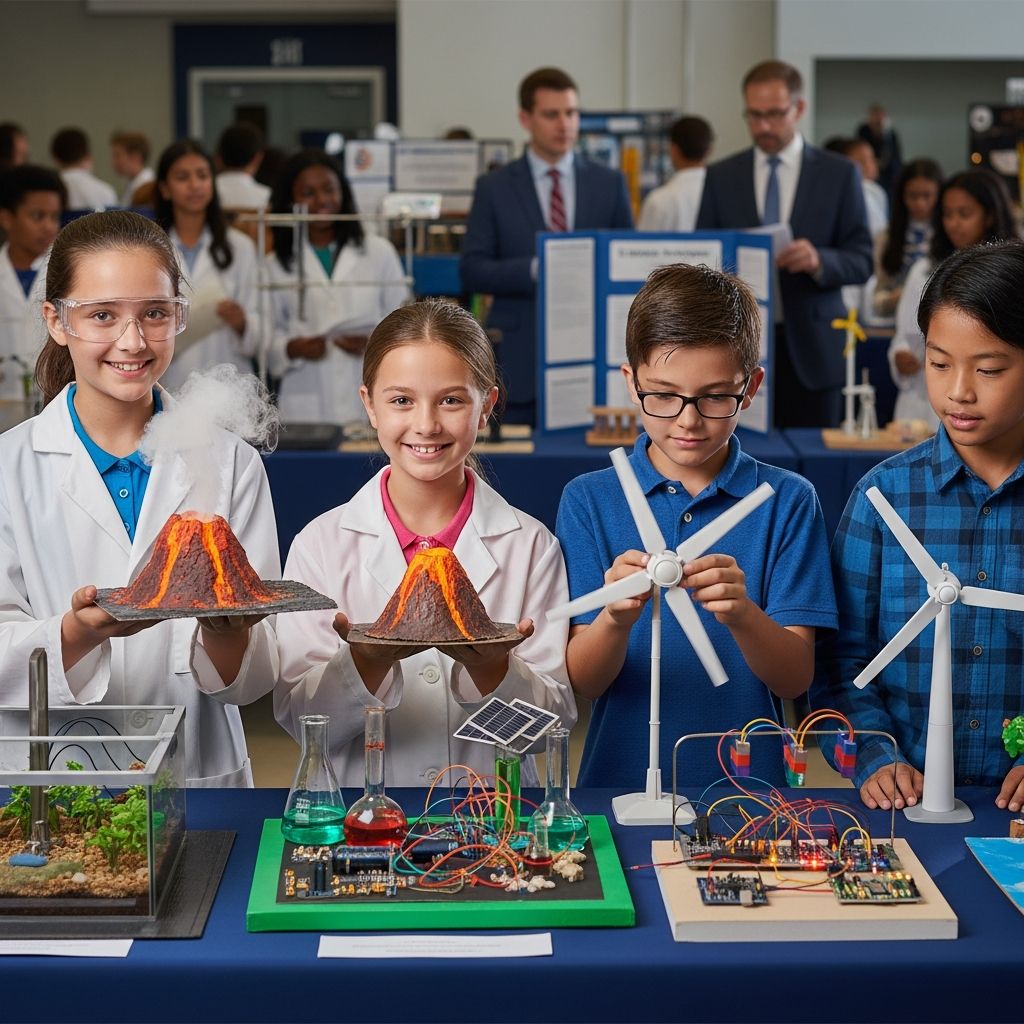
Science fairs offer students a unique opportunity to explore scientific inquiry, develop critical thinking skills, and showcase their creativity through hands-on projects. Whether you’re a parent, teacher, or student, this guide provides a roadmap to building projects that stand out. Drawing from established scientific processes, it emphasizes originality, thorough documentation, and clear communication to maximize success.
Understanding the Scientific Method Foundation
The cornerstone of any successful science fair project is the **scientific method**, a systematic approach to investigation that ensures reliable results. This method involves observing a phenomenon, asking a testable question, researching background information, forming a hypothesis, designing and conducting an experiment, analyzing data, and drawing conclusions.
Students must own every step, from idea generation to final presentation, fostering independence and deep learning. Judges prioritize projects demonstrating rigorous application of this process over flashy displays.
Selecting a Topic That Sparks Passion and Feasibility
Begin by encouraging students to choose topics rooted in personal interests, such as environmental issues, biology curiosities, or physics puzzles. A strong topic addresses a specific, testable question with one independent variable—something the student can control and measure.
- Brainstorm from daily life: Does music affect plant growth? How does temperature impact battery life?
- Avoid overly broad ideas; narrow to: “Does the type of music influence bean plant height after 10 days?”
- Ensure access to materials and safety; no hazardous substances without approval.
Topic selection sets the project’s direction. Feasible projects use household items or school lab equipment, keeping costs low while proving scientific merit.
Conducting Thorough Background Research
Before experimenting, dive into research using credible sources like academic journals, government sites, and educational databases. This step validates the question’s novelty and informs the hypothesis.
Compile at least five major references, noting key findings in a dedicated journal. This bibliography strengthens credibility and demonstrates scholarly effort. For instance, researching plant growth might reveal light wavelength effects, guiding a focused hypothesis.
Crafting a Testable Hypothesis
A hypothesis is an educated prediction: “If [independent variable] increases, then [dependent variable] will [change] because [reason].” It must be falsifiable through experimentation.
| Example Question | Hypothesis |
|---|---|
| How does salt concentration affect water boiling point? | If salt concentration increases, then the boiling point will rise because salt disrupts water molecules. |
| Does caffeine boost goldfish activity? | If goldfish consume caffeinated water, then their swimming speed will increase due to stimulant effects. |
Refine hypotheses through discussion with teachers to ensure testability.
Designing and Planning the Experiment
Outline procedures like a recipe: list materials, detail steps, specify controls (constants), independent/dependent variables, and replication (at least 3-5 trials for reliability).
- Control group: Untreated sample for comparison.
- Variables: One changed (independent), one measured (dependent), others fixed.
- Safety: No vertebrates at home; get approvals for microbes or chemicals.
Prepare a research plan including timelines, data collection methods, and analysis tools before starting.
Maintaining a Detailed Research Journal
The lab notebook is the project’s backbone, serving as proof of process for judges. Record daily: dates, observations, data, sketches, and reflections in ink, first-person active voice.
- Date and sign every page.
- Include raw data tables, photos, and calculations—no erasures, just strike-throughs.
- Title sections clearly: “Trial 1 Data,” “Unexpected Observations.”
This habit builds accountability and aids report writing.
Executing Experiments and Collecting Data
Follow the plan meticulously, repeating trials to account for variability. Use tools like rulers, timers, scales for quantitative data; note qualitative changes like color shifts.
Organize data in tables immediately:
| Trial | Salt Amount (g) | Boil Time (min) |
|---|---|---|
| 1 | 0 | 5.2 |
| 2 | 5 | 5.1 |
| 3 | 10 | 4.9 |
Photodocument setups and results for authenticity.
Analyzing Data with Graphs and Statistics
Transform raw data into visuals: bar graphs for categories, line graphs for trends. Calculate averages, percentages; use simple stats like mean and range.
Discuss anomalies: “Outlier in Trial 2 due to thermometer calibration error.” This shows critical thinking. Software like Excel aids graphing.
Drawing Conclusions and Reflecting
State if the hypothesis was supported: “Data confirmed higher salt delayed boiling by 0.3 minutes on average.” Discuss real-world implications, limitations (e.g., small sample), and future research.
Error analysis elevates projects: Identify sources like measurement precision and suggest improvements.
Writing a Compelling Research Paper
Structure the report like a mini-thesis: Title, Abstract (250 words max summarizing all), Introduction (background/hypothesis), Methods, Results (data/graphs), Discussion, Conclusion, References.
Past tense, objective language: “Plants grew 2cm taller under red light.” Aim for clarity and citations.
Building an Eye-Catching Display Board
The tri-fold board communicates at a glance: Title top-center, sections left-to-right (Question, Hypothesis, Methods, Results, Conclusion). Use bold fonts, colors sparingly, graphs over text.
- Fonts: 24-36pt titles, 18pt body.
- Visuals: 60% of space; label everything.
- No spirals or clutter; proof for typos.
Practice 3D elements like models if relevant, but prioritize data.
Mastering the Oral Presentation
Judges quiz on process: Explain variables, justify methods, defend conclusions confidently. Rehearse a 3-minute pitch; anticipate questions like “Why this variable?.”
- Stand tall, make eye contact.
- Use board as visual aid, not crutch.
- Dress neatly; enthusiasm wins points.
Navigating Rules, Forms, and Safety
Complete ISEF forms pre-experiment: Checklist (1A), Research Plan (1B), approvals for hazards. Elementary uses simplified versions. No home vertebrates/microbes.
Adult sponsors review plans; ethics matter for human subjects.
Project Ideas by Grade Level
- Elementary: Which soda dissolves teeth fastest? (Use candy models.)
- Middle: Solar panel efficiency by angle.
- High: Antibiotic resistance in bacteria (school lab only).
Adapt to rules; innovate within bounds.
Common Pitfalls and How to Avoid Them
- Overcomplicating: Stick to one variable.
- Poor Records: Journal daily.
- Weak Analysis: Quantify and graph everything.
- Last-Minute Rush: Start 2-3 months early.
FAQs
What if my hypothesis is wrong?
That’s success! Discuss why; it shows learning.
Can I work in teams?
Some fairs allow; check rules. Individuals emphasize personal effort.
How many trials?
Minimum 3-5 for validity.
What’s the best display color?
Neutral backgrounds; focus on content.
Need a mentor?
Teachers yes; parents guide, don’t do work.
Science fairs build lifelong skills. With planning and passion, any student can shine.
References
- Student Guide: How to Do a Science Fair Project — Society for Science and the Public. 2015-06-01. https://scifair.com/wp-content/uploads/2015/06/student_guide_312_0.pdf
- How to Do a Project — North Carolina Science & Engineering Fair (ncsef.org). 2023. https://ncsef.org/students/how-to-do-a-project/
- Science and Technology Fair Directions — Iowa State University Science Bound. 2020. https://www.sciencebound.iastate.edu/media/118/file/SCIENCE-Fair-directions.pdf
- Guidelines for Elementary & Middle School Teachers & Science Fair — University of Nevada Las Vegas (.edu). 2024. https://www.unlv.edu/sites/default/files/24/guidelines-science-teachers.pdf
- The Basics — Society for Science (isef.org). 2025. https://www.societyforscience.org/isef/the-basics/
- Science Fair Information — Ella Fitzgerald Middle School (.k12.va.us). 2024. https://fitzgerald.nn.k12.va.us/sciencefair.html

Medha Deb is an editor with a master's degree in Applied Linguistics from the University of Hyderabad. She believes that her qualification has helped her develop a deep understanding of language and its application in various contexts. Medha specializes in the areas of beauty, health, sports, and wellness and is committed to ensuring that the content on the website is…