
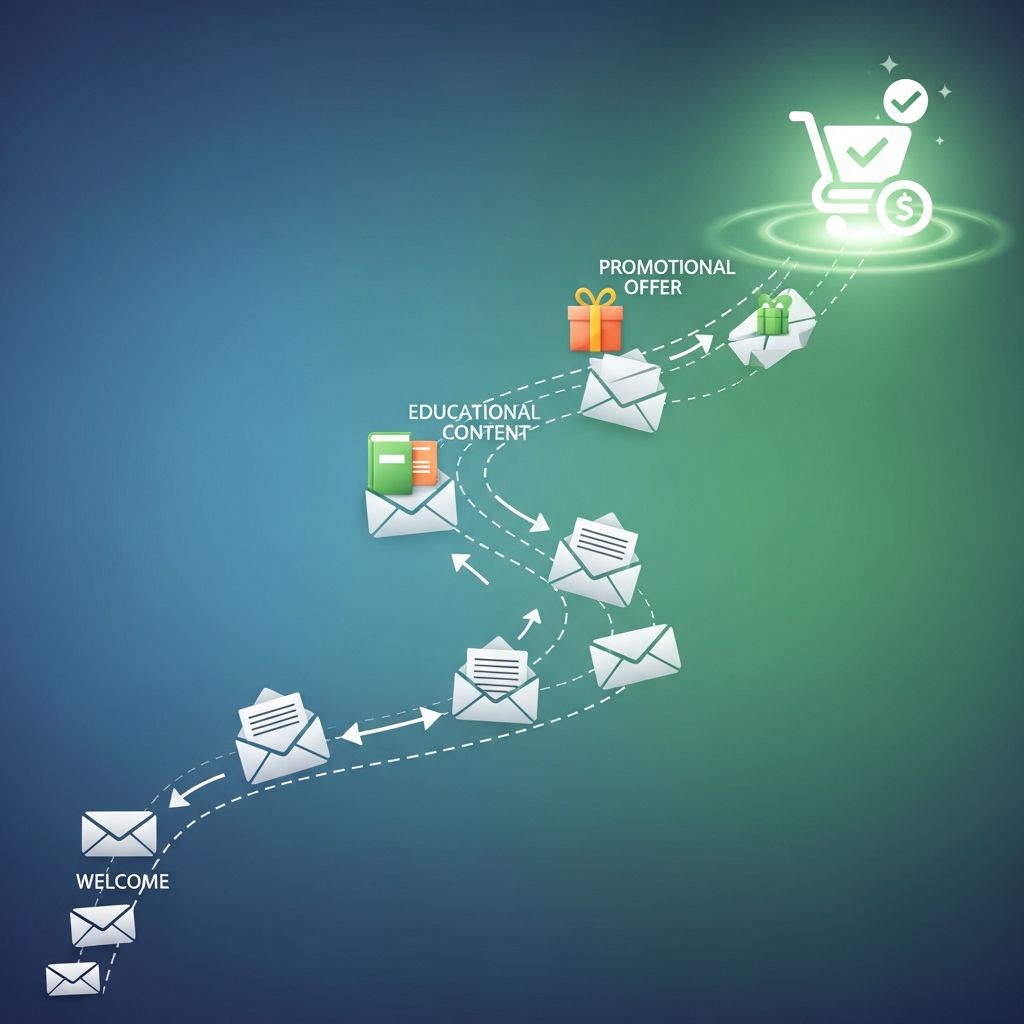
Email nurture sequences are one of the most reliable ways to turn new leads into confident buyers. Instead of pushing hard for a sale in a single message, you educate, reassure, and guide prospects step by step until they are ready to say yes.
This guide walks you through how to design, write, and automate a complete nurture sequence that supports your sales funnel and improves conversion rates.
What Is an Email Nurture Sequence?
An email nurture sequence is a planned series of automated emails sent to leads over time with the goal of building trust, delivering value, and moving them toward a specific action, such as booking a call or purchasing a product.
Unlike one-off blasts, nurture sequences match messages to where someone is in their buyer’s journey—from first discovering your brand to evaluating options and making a decision.
Key characteristics of an effective nurture sequence
- Relevant: Emails are tailored to the subscriber’s interests, behavior, or segment.
- Timed: Messages arrive at strategic intervals, not randomly.
- Goal-driven: The sequence pushes toward a clear, measurable outcome.
- Automated: Once built, it runs in the background using marketing automation tools.
- Value-focused: Education and support come before sales pitches.
Why Nurture Sequences Matter for Revenue
Lead nurturing is not just about staying in touch; it is a proven revenue driver. Research cited by major marketing platforms indicates that nurtured leads are more likely to become sales opportunities than those who are not nurtured.
Business benefits you can expect
- Higher conversion rates: Nurtured leads receive information that reduces uncertainty and makes it easier to choose you.
- Shorter sales cycles: Consistent education speeds up decisions by addressing questions before a prospect ever talks to sales.
- Better-qualified leads: People who stay engaged through the sequence are typically more serious and better aligned with your offer.
- Improved customer relationships: Helpful content over time builds confidence in your brand and keeps you top of mind.
- Scalable follow-up: Automation lets you follow up with every lead, not just the few sales has time to call.
Clarifying Your Nurture Strategy Before You Write
The most common mistake with nurture sequences is opening an email editor and writing from the top of your head. Strategy first, copy second.
1. Define one primary goal
Decide what a “win” looks like at the end of the sequence. Examples:
- Book a sales demo or consultation
- Start a free trial
- Purchase a low-priced introductory product
- Activate or adopt a key feature in your software
Your goal will guide your calls to action, timing, and how many emails you need.
2. Map the buyer’s journey for this sequence
Most nurture flows support one phase of the journey more than others. A simple journey map might include:
- Awareness: Prospect recognizes they have a problem.
- Consideration: They compare approaches and providers.
- Decision: They choose a specific solution or vendor.
Decide where subscribers typically enter the sequence (for example, after downloading a guide or signing up for a newsletter) and where you want them to exit.
3. Choose your audience segments
Segmentation makes your nurture sequence dramatically more effective. Even simple distinctions make a difference, such as:
- New leads vs. existing customers
- Customers on different pricing tiers
- Leads from different industries or company sizes
- Leads who engaged with specific content (webinars, white papers, feature pages)
Marketing automation platforms and CRM tools can track behavior such as pages visited, emails opened, and links clicked, which you can use to dynamically adapt sequences.
Planning the Structure of Your Sequence
Once you know your goal and audience, design the high-level flow: how many emails, what each one covers, and how they connect.
Typical sequence length and pacing
There is no universal rule, but many effective nurture sequences run for 5–10 emails over 2–6 weeks. A common pattern is:
- More frequent at the start (for example, every 1–2 days for the first few emails)
- Then gradually spaced out (every 3–5 days)
This cadence keeps your brand visible without overwhelming subscribers.
| Stage | Primary Objective | Typical Email Types |
|---|---|---|
| Welcome & Awareness | Set expectations and show quick value | Welcome, “here’s what you’ll get”, top resources |
| Education & Problem Framing | Clarify the problem and consequences | How-to content, primers, checklists |
| Solution & Credibility | Explain how your approach works | Case studies, product education, social proof |
| Conversion | Prompt a clear next step | Trial/demos, limited-time offers, comparison guides |
Mapping individual emails
Give each email a single purpose. For example:
- Email 1: Welcome and expectation-setting
- Email 2: Deepen the problem and its impact
- Email 3: Introduce your solution’s core idea
- Email 4: Share social proof (case study, testimonial)
- Email 5: Direct sales CTA (demo, trial, or purchase)
- Email 6+: Objection handling, FAQs, or additional resources
Writing Emails That Educate and Persuade
Effective nurture emails feel like helpful guidance from an expert, not automated corporate announcements.
1. Start with compelling, honest subject lines
Subject lines should be clear, benefit-driven, and true to the content. Techniques that work well include:
- Curiosity with context: Hint at the lesson inside without being vague.
- Specific outcomes: Highlight a concrete result the reader cares about.
- Personalization: Reference a relevant behavior or attribute when possible.
2. Lead with empathy
Open your emails by acknowledging the reader’s situation or challenge. Show that you understand the problem before you talk about solutions. This builds rapport and makes the rest of the email more persuasive.
3. Focus on one big idea per email
Each message should revolve around a single insight, tip, or story. Trying to cover too much leads to skimming and low engagement. Use:
- Short paragraphs
- Descriptive subheadings
- Bullet points for lists
- Bold text sparingly for key phrases
4. Connect value to your offer, but do not oversell
Nurture emails should give genuine standalone value while gently linking that value to what you sell. You can:
- Explain why a problem exists, then show how your approach addresses the root cause.
- Share a useful framework or checklist and note that your product automates part of it.
- Describe outcomes customers achieved with your solution, focusing on their story rather than your features.
5. End with a clear, low-friction call to action
Every email should ask for one simple next step, even if it is just reading another resource. Match the CTA to the stage:
- Early-stage: “Read the full guide”, “Watch the tutorial”, “Reply with your biggest challenge”
- Mid-stage: “Explore how this works in our product walk-through”, “Compare options in this checklist”
- Late-stage: “Start your trial”, “Book a demo”, “Talk to our team”
Using Automation and Triggers Smartly
Automation makes nurture sequences practical at scale. Modern tools can react to what subscribers do—opening emails, clicking certain links, or visiting specific pages—so you are always sending the most relevant next step.
Core triggers to consider
- Sign-up events: Newsletter subscription, content download, webinar registration, trial start.
- Engagement signals: Opening key emails, clicking on specific topics, repeated visits to high-intent pages.
- Lifecycle milestones: New customer onboarding, renewal windows, usage drops.
Basic automation rules
- Entry criteria: Define exactly who is added to the sequence and when.
- Exit criteria: Remove people who convert, unsubscribe, or clearly lose interest.
- Branching paths: Send more advanced content to highly engaged leads and lighter touchpoints to those less active.
Measuring and Improving Your Sequence
Even a well-planned nurture sequence is a starting point. You will improve performance over time by tracking metrics and running experiments.
Essential metrics to monitor
- Open rate: Indicates whether your subject lines and sender reputation are working.
- Click-through rate: Shows how compelling your content and calls to action are.
- Conversion rate: The percentage of leads who complete your primary goal (trial, demo, purchase).
- Unsubscribe & spam complaints: Signals if content or frequency feels irrelevant or intrusive.
Practical optimization ideas
- Test different subject line angles for the first two emails.
- Shorten or clarify calls to action in low-click emails.
- Reorder emails if you notice engagement dropping sharply at a specific point.
- Use behavior-based segments for re-engagement instead of sending the same follow-up to everyone.
Common Pitfalls to Avoid
Even experienced marketers fall into predictable traps when setting up nurture sequences.
- Overloading new leads: Sending too many emails too fast often leads to unsubscribes.
- Endless “value” with no ask: Being helpful is good, but eventually you must clearly invite the sale.
- Generic, one-size-fits-all content: Ignoring segments and behavior makes messages feel irrelevant.
- Failing to close the loop with sales: Not passing engaged leads to sales teams in time wastes warm opportunities.
- Ignoring compliance and preferences: You must honor unsubscribe requests and privacy rules to maintain trust.
Simple Process Checklist for Building Your First Sequence
Use this checklist as a quick, repeatable process when you design new nurture flows.
- Choose a single, specific conversion goal.
- Document how your ideal buyer moves from awareness to decision.
- Define who enters and exits the sequence and why.
- Sketch 5–10 emails, each with one objective and one CTA.
- Write empathetic, benefit-focused copy with clear subject lines.
- Set up automation triggers, delays, and branching rules.
- Launch with simple metrics dashboards in your email platform.
- Review performance after the first few hundred sends and optimize.
Frequently Asked Questions (FAQs)
Q: How many emails should be in a nurture sequence?
Most effective sequences run between 5 and 10 emails, but the right length depends on your sales cycle and the complexity of your offer. Longer B2B cycles often benefit from extended education and multiple touchpoints before a direct sales ask.
Q: How often should I send nurture emails?
A common cadence is every 1–2 days at the start, then every 3–5 days as the sequence progresses. Adjust frequency based on engagement and unsubscribe rates so that your brand stays visible without becoming intrusive.
Q: What tools do I need to run an automated nurture sequence?
You will need an email service or marketing automation platform that supports segmentation, behavior-based triggers, and basic reporting. Many customer experience and CRM platforms now include automated lead nurturing features as standard.
Q: Should I create different sequences for leads and customers?
Yes. Prospects need problem education and proof that your solution works, while customers benefit from onboarding, adoption tips, and upsell or renewal reminders. Separate sequences allow you to send more relevant messages to each group.
Q: How do I know if my nurture sequence is working?
Track open rates, click-through rates, and the percentage of subscribers who complete your primary goal. Compare the performance of nurtured vs. non-nurtured leads—organizations often see a measurable increase in qualified opportunities and revenue from nurtured cohorts.
References
- What is Lead Nurturing? — Oracle. 2022-06-15. https://www.oracle.com/cx/marketing/lead-management/what-is-lead-nurturing/
- Email Nurture Campaign: What Is It? A Beginner’s Guide — Iterable. 2023-04-10. https://iterable.com/resources/articles/cross-channel-marketing/email-marketing/what-is-an-email-nurture-campaign-beginners-guide/
- What Is Lead Nurturing? Benefits, Strategies & Tools — BIGContacts. 2023-08-21. https://www.bigcontacts.com/blog/what-is-lead-nurturing/
- A Simple Guide for Email Nurturing Campaigns With Examples — Waseem Bashir. 2022-11-03. https://www.waseembashir.com/post/email-nurturing-campaigns
- What Is Automated Lead Nurturing? How It Works and Benefits — Salesforce. 2023-01-12. https://www.salesforce.com/sales/engagement-platform/automated-lead-nurturing/
- Email Welcome or Nurture Sequence Definition — Dave Chaffey, Smart Insights. 2021-09-07. https://www.davechaffey.com/digital-marketing-glossary/email-welcome-or-nurture-sequence/
- What are the Benefits of Lead Nurturing? — Red Shark Digital. 2022-05-18. https://www.redsharkdigital.com/faqs/what-are-the-benefits-of-lead-nurturing

- Integrated M.A. in Applied Linguistics, University of Hyderabad
- 5+ years in editorial, instructional, SEO, and research-based writing
Sneha is a relationships and lifestyle writer with a strong foundation in applied linguistics and certified training in relationship coaching. She brings over five years of writing experience to theskillvault, crafting thoughtful, research-driven content that empowers readers to build healthier relationships, boost emotional well-being, and embrace holistic living. Her writing and insights reflect the belief that beauty, happiness, and wellness…