
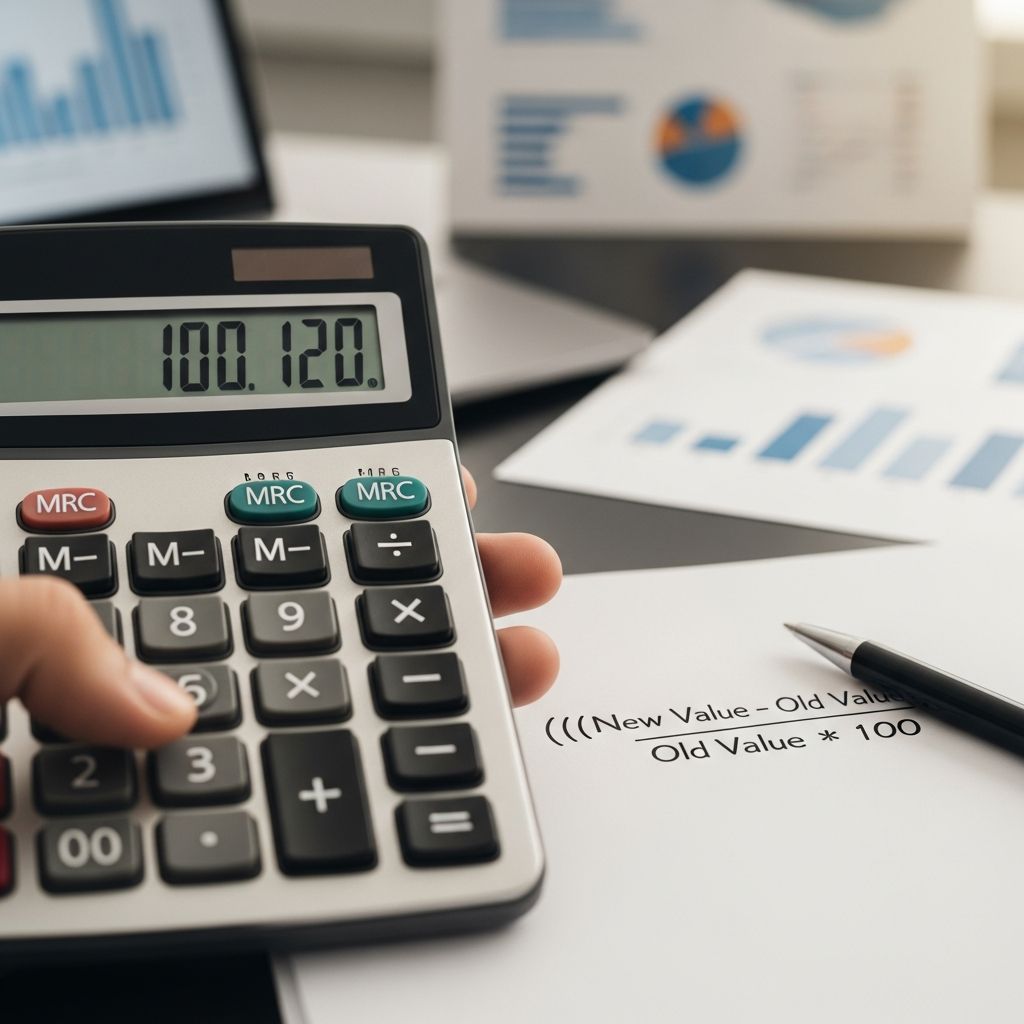
Percentage change is a fundamental mathematical concept that measures how much a value has increased or decreased relative to its original amount. This calculation appears frequently in business decisions, financial analysis, academic settings, and everyday life. Whether you’re analyzing sales figures, tracking investment returns, or comparing prices, understanding how to calculate percentage change enables you to make informed decisions based on quantifiable data. The ability to express changes as percentages provides a standardized way to compare values across different scales and contexts.
Why Percentage Change Matters in Real-World Scenarios
Percentage change serves as a universal language for communicating relative shifts in quantities. Unlike absolute changes, which only show the raw difference between two values, percentage change reveals the proportional impact of that difference. A $10 increase means something different when the original value is $50 compared to when it’s $1,000. By expressing this relationship as a percentage, stakeholders can immediately understand the magnitude of change regardless of the initial value’s size.
In business contexts, percentage change helps managers evaluate performance metrics such as revenue growth, customer acquisition rates, and operational efficiency. Financial analysts rely on percentage calculations to assess investment performance and market trends. Healthcare professionals use percentage changes to track patient progress and medication effectiveness. Students encounter percentage problems across mathematics, sciences, and social studies. The versatility of this calculation makes it an indispensable tool across virtually every professional field.
The Foundation: Core Formula and Components
The percentage change calculation rests on a straightforward mathematical relationship. The formula divides the difference between two values by the original value, then multiplies by 100 to convert to percentage form. This approach captures how much the value has shifted relative to where it started.
The basic formula is expressed as:
Percentage Change = ((New Value − Original Value) ÷ Original Value) × 100
Each component serves a specific purpose. The new value represents the final or current amount being measured. The original value represents the starting point or baseline. The difference between them shows the absolute change in quantity. Dividing by the original value normalizes this difference, expressing it as a ratio. Multiplying by 100 converts this decimal ratio into percentage form, making it easier to interpret and communicate.
Understanding what constitutes the “original” value is critical. In time-based comparisons, this is typically the earlier value. In before-and-after scenarios, it’s the before measurement. Misidentifying which value is original versus new will produce incorrect results with potentially reversed signs.
Method One: The Difference-Based Approach
The first calculation method emphasizes understanding the absolute change before converting to percentage form. This approach often feels more intuitive because it breaks the calculation into digestible steps.
Step-by-Step Process
- Step 1: Calculate the absolute difference by subtracting the original value from the new value. If the result is positive, the value increased; if negative, the value decreased.
- Step 2: Divide the difference by the original value. This produces a decimal number representing how many times larger (or smaller) the change is compared to the original value.
- Step 3: Multiply by 100 to convert the decimal into percentage form. Add the percentage symbol to complete the calculation.
Worked Example: Price Adjustment
A retail item originally priced at $80 is marked down to $60. To find the percentage decrease:
- Difference: $60 − $80 = −$20
- Divide by original: −$20 ÷ $80 = −0.25
- Convert to percentage: −0.25 × 100 = −25%
The negative result indicates a 25% decrease from the original price. This method clarifies what happened at each stage of the calculation.
Method Two: The Ratio-Based Approach
An alternative method calculates percentage change by first establishing what percentage the new value represents of the original value, then subtracting 100% to find the change. This approach works particularly well when you want to see the new value as a proportion of the original.
Step-by-Step Process
- Step 1: Divide the new value by the original value. This shows what fraction of the original value the new value represents.
- Step 2: Multiply by 100 to express this ratio as a percentage. This percentage shows what the new value equals relative to the original.
- Step 3: Subtract 100% to isolate the change amount. A positive result indicates an increase; a negative result indicates a decrease.
Worked Example: Sales Growth
A company’s quarterly revenue increased from $250,000 to $312,500. Using the ratio method:
- Divide new by original: $312,500 ÷ $250,000 = 1.25
- Convert to percentage: 1.25 × 100 = 125%
- Calculate change: 125% − 100% = 25%
The new revenue equals 125% of the original, representing a 25% increase. This method effectively shows that the new value is 1.25 times the original value.
Comparison of Methods: Advantages and Use Cases
| Aspect | Difference-Based Method | Ratio-Based Method |
|---|---|---|
| Primary Focus | Isolating and measuring the change itself | Understanding the new value’s scale relative to original |
| Intuitive Appeal | Often easier for beginners to follow | Reveals proportional relationship more explicitly |
| Calculation Steps | Three straightforward steps | Three straightforward steps |
| Best For | Quick mental calculations and written work | Understanding scale and proportion |
Both methods yield identical results and require the same computational effort. The choice between them depends on personal preference and the context in which you’re communicating results. Some professionals prefer one method consistently, while others choose based on which approach clarifies their specific situation best.
Handling Special Cases and Negative Numbers
Percentage change calculations involving negative numbers require particular attention to ensure accuracy. When dealing with negative values, the absolute value of the original number is used in the denominator to prevent mathematical distortions.
Negative to Positive Change
Consider a company’s quarterly profit changing from −$50,000 (a loss) to $30,000 (a gain). Using absolute value in the denominator:
- Difference: $30,000 − (−$50,000) = $80,000
- Divide by absolute value of original: $80,000 ÷ |−$50,000| = $80,000 ÷ $50,000 = 1.6
- Convert to percentage: 1.6 × 100 = 160%
The profit improved by 160%, moving from a loss situation to profitability.
Negative to More Negative Change
When both values are negative but the situation worsens, the calculation reveals how the loss magnitude increased. A temperature dropping from −10°C to −25°C:
- Difference: −25°C − (−10°C) = −15°C
- Divide by absolute value: −15°C ÷ |−10°C| = −15 ÷ 10 = −1.5
- Convert: −1.5 × 100 = −150%
The negative sign indicates worsening conditions, with a 150% decrease in temperature (the value became more negative).
Practical Applications Across Industries
Financial Analysis
Investors and financial managers use percentage change calculations daily to assess investment performance, track market indices, and evaluate company financial health. A stock increasing from $45 to $54 per share represents a 20% gain. Calculating percentage changes across multiple periods helps identify trends and momentum.
Retail and E-Commerce
Retailers track percentage changes in sales, inventory levels, and customer traffic. Understanding these metrics reveals whether business strategies are working. A 15% month-over-month sales increase suggests successful marketing, while a 10% decline in customer traffic might indicate the need for promotional activity.
Healthcare and Medicine
Medical professionals monitor percentage changes in vital signs, laboratory values, and patient symptoms. A 25% reduction in blood pressure after medication administration or a 12% increase in cholesterol levels both carry clinical significance that percentage changes communicate effectively.
Education and Assessment
Teachers and administrators use percentage changes to evaluate student improvement over time. A student improving test scores from 70% to 84% shows measurable progress, expressed as a percentage change of approximately 20%.
Common Mistakes and How to Avoid Them
Reversing Original and New Values
A frequent error involves swapping which value is original and which is new. This produces a result with the opposite sign or an entirely incorrect magnitude. Always clearly identify which value represents the starting point before beginning calculations.
Forgetting the Multiplication by 100
Omitting the final step of multiplying by 100 leaves results in decimal form rather than percentage form. While mathematically the proportion remains correct, this prevents proper interpretation of results.
Ignoring Negative Values
Failing to use absolute values when dealing with negative numbers in the denominator can produce misleading results. Always apply the absolute value principle when the original value is negative.
Misinterpreting Multiple Changes
When multiple percentage changes occur sequentially, simply adding the percentages produces incorrect results. A 20% increase followed by a 20% decrease does not return a value to its original amount. Each percentage applies to the value at that stage, not the original.
Frequently Asked Questions
What’s the difference between percentage change and percentage point change?
Percentage point change refers to the simple arithmetic difference between two percentages. If approval ratings move from 45% to 52%, that’s a 7 percentage point change. Percentage change calculates how much the 45% increased proportionally. The 7 percentage point increase represents a percentage change of approximately 15.6%, calculated as (52 − 45) ÷ 45 × 100.
Can percentage change be greater than 100%?
Yes. A value increasing from $20 to $100 represents a 400% increase. Percentage change has no upper limit and can exceed 100% in either direction. Increases greater than 100% indicate the new value is more than double the original value.
How do I calculate the original value if I know the percentage change?
Rearrange the percentage change formula. If you know the new value and the percentage change, divide the new value by (1 plus the percentage change expressed as a decimal). For a 25% increase resulting in a new value of $125: Original = $125 ÷ 1.25 = $100.
Is percentage change the same as percentage difference?
No. Percentage change applies to ordered data where one value precedes the other. Percentage difference applies to unordered values being compared symmetrically. Percentage difference averages the two values in the denominator, whereas percentage change uses only the original value.
References
- Percentage Change — Math is Fun. Accessed February 2026. https://www.mathsisfun.com/numbers/percentage-change.html
- Percentage Change Calculator — Omni Calculator. Accessed February 2026. https://www.omnicalculator.com/math/percentage-change
- Percent Change in Excel | Formula + Calculator — Wall Street Prep. Accessed February 2026. https://www.wallstreetprep.com/knowledge/percent-change/
- Percentage Change Calculator — Calculator Soup. Accessed February 2026. https://www.calculatorsoup.com/calculators/algebra/percent-change-calculator.php
- Calculating Percent Changes — U.S. Bureau of Labor Statistics. Accessed February 2026. https://www.bls.gov/cpi/factsheets/calculating-percent-changes.htm

- Integrated M.A. in Applied Linguistics, University of Hyderabad
- 5+ years in editorial, instructional, SEO, and research-based writing
Sneha is a relationships and lifestyle writer with a strong foundation in applied linguistics and certified training in relationship coaching. She brings over five years of writing experience to theskillvault, crafting thoughtful, research-driven content that empowers readers to build healthier relationships, boost emotional well-being, and embrace holistic living. Her writing and insights reflect the belief that beauty, happiness, and wellness…