
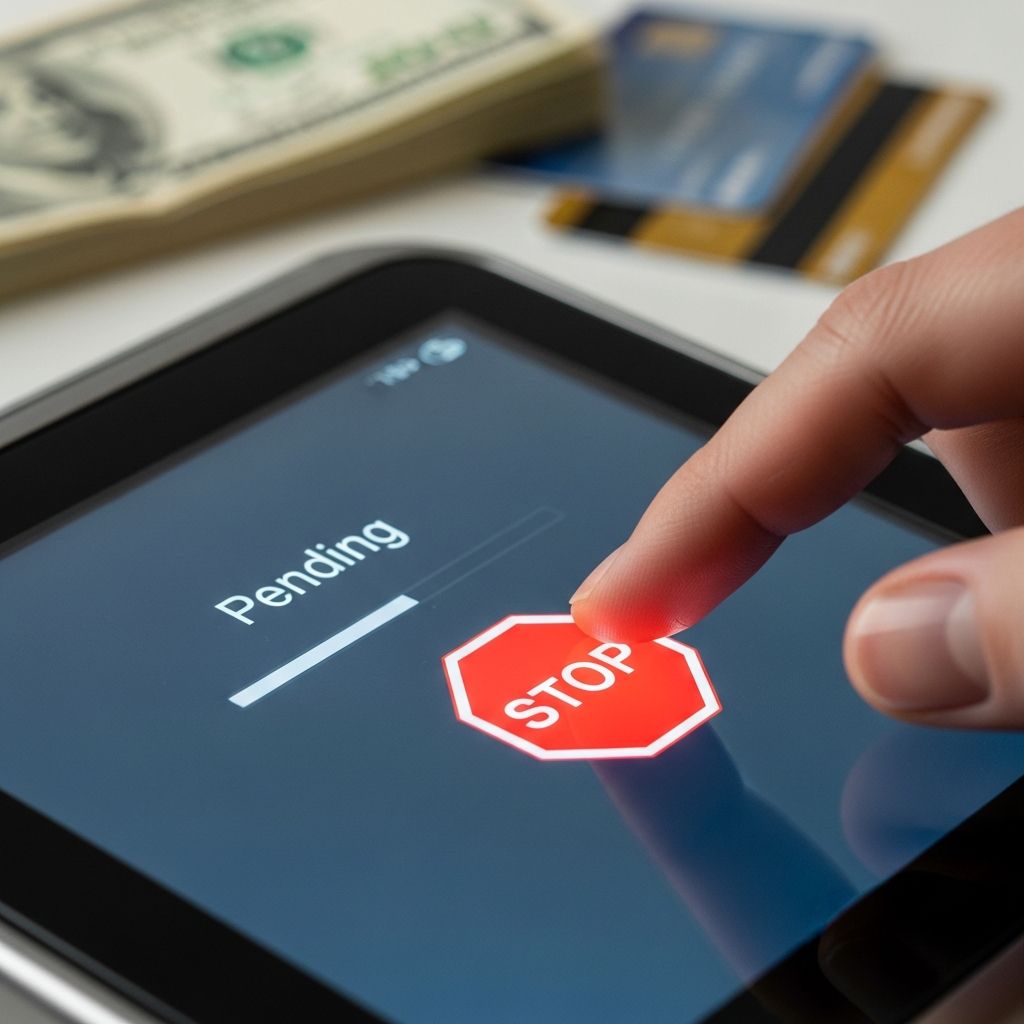
Seeing a mysterious or mistaken charge show up as pending on your account can be stressful. Whether it is a billing error, a subscription you no longer want, or a transaction you do not recognize at all, you usually have more options than simply waiting and hoping it disappears.
This guide explains, in plain language, how pending transactions work, when you can still stop them, and what to do if the payment has already posted. You will also learn how to respond differently to errors versus clear fraud, which agencies and laws protect you, and how to talk to your bank or the merchant effectively.
What Is a Pending Transaction?
A pending transaction is a payment that has been authorized but not yet fully processed by your bank or card issuer. The money has not definitively left your account, but your available balance is reduced to reflect the expected charge.
Pending activity appears with many types of payments, including:
- In-store or online credit card purchases
- Debit card payments and card-based ATM withdrawals
- Hotel and rental car holds
- Gas station pre-authorizations
- Peer-to-peer or digital wallet transfers (depending on the service)
Most card transactions move from “pending” to “posted” within a few days, although exact timing varies by network and merchant.
When You Might Want to Cancel a Pending Transaction
Not every pending charge is a problem. But there are several situations where acting fast can save you time, money, or both:
- Accidental purchase: You clicked the wrong item, double-submitted an order, or authorized the wrong amount.
- Incorrect billing: You were charged more than the advertised price, billed for something you did not receive, or see duplicate charges.
- Unwanted subscription: You signed up for a free trial or recurring billing and forgot to cancel before the next charge was initiated.
- Overdraft risk: A pending debit transaction could push your account negative and trigger overdraft or insufficient funds fees.
- Suspicious or clearly fraudulent activity: You spot a transaction you definitely did not authorize, or you have lost your card and suspect misuse.
Your strategy depends largely on whether the payment is a legitimate but mistaken charge or a fraudulent transaction.
Who to Contact First: Merchant vs. Bank
In many cases, only the merchant can remove or reverse a pending card charge before it posts to your account. However, your bank or card issuer is the right first stop if there is fraud, if the merchant is unresponsive, or if the payment is not tied to a card (for example, an ACH transfer).
| Scenario | Contact First | Reason |
|---|---|---|
| Wrong item, wrong amount, or changed your mind | Merchant | They can cancel or adjust the transaction before it is finalized. |
| Duplicate pending charge from the same merchant | Merchant, then bank if unresolved | The merchant can remove the extra authorization; your bank can step in if they do not. |
| Clearly fraudulent or unrecognized charge | Bank or card issuer | They can block the card, investigate, and apply fraud protections under law. |
| Bank transfer, check, or ACH payment you want to stop | Bank | A formal stop-payment order may be available for qualifying payments. |
| Subscription or recurring automatic payment | Merchant, then bank | Cancel with the service first; your bank can also block future debits in many cases. |
Step-by-Step: Trying to Cancel With the Merchant
If the transaction is legitimate but you want to reverse it, start with the merchant as quickly as possible:
- Locate the pending charge details in your online or mobile banking: merchant name, amount, date, and any order or reference numbers.
- Use the fastest contact method: phone, in-app chat, or a dedicated customer-service portal. Many retailers and service providers list support contact options on receipts and confirmation emails.
- Ask clearly for cancellation or reversal of the pending payment. Provide:
- Order or transaction ID
- Exact amount and date
- The reason you are requesting cancellation (wrong item, wrong amount, duplicate, changed your mind, etc.)
- Request written confirmation by email or message that the payment will be canceled or that a refund will be issued.
- Monitor your account for a few business days. The pending hold should either drop off or post followed by a refund or adjustment.
If the merchant refuses to correct an error, does not respond, or the payment posts despite your request, you can usually escalate by filing a billing dispute or chargeback with your card issuer under consumer protection rules.
How to Work With Your Bank or Card Issuer
Banks and credit card issuers have specific procedures for handling disputes, errors, and unauthorized transactions. These procedures are shaped by federal laws such as the Fair Credit Billing Act (FCBA) for credit cards and the Electronic Fund Transfer Act (EFTA) for electronic debit transfers in the United States.
Contacting Your Bank About a Pending Transaction
Each institution has its own tools, but the general process looks similar:
- Log in to your online or mobile banking and locate the pending transaction.
- Use the “dispute,” “report a problem,” or similar button if available, or call the number on the back of your card.
- Be prepared to describe:
- Whether the transaction is an error or suspected fraud
- What steps you have already taken with the merchant
- Any supporting documents: receipts, emails, chat transcripts, screenshots
- Follow instructions for any formal dispute or fraud claim forms the bank requires.
Some card issuers will not formally process a dispute until after a charge posts, but they can still help protect your account in the meantime, especially if fraud is involved.
Stopping a Bank Transfer, ACH Payment, or Check
If the pending payment is a transfer from your bank account rather than a card purchase (for example, a scheduled bill payment, electronic check, or ACH debit), your bank may offer a stop-payment order. According to guidance from major banks, this usually requires:
- Submitting a request by phone, in a branch, or through online banking before the payment is processed
- Providing the check number or transaction details
- Paying a fee in many cases
Stop-payment rules and timelines vary, so read your deposit account agreement carefully or ask a representative to explain your options.
Handling Fraud vs. Legitimate Errors
It is critical to distinguish true fraud from a normal billing disagreement, because the protections and timelines differ.
If You Suspect Fraud
Fraud means someone else used your card or account without your permission. In this situation, act immediately:
- Call your bank or card issuer right away and report the card lost or stolen, or flag the transaction as unauthorized.
- Ask to block the card and issue a replacement if card details are compromised.
- Review recent activity for any additional unauthorized charges and report them as well.
- Change your online banking and related passwords, and update any devices or apps where the card is stored.
For credit cards in the U.S., federal law generally limits your liability for unauthorized use to $50, and many major issuers voluntarily offer zero-liability policies. For debit cards and ATM transactions, liability can be higher if you delay reporting, so quick action is important.
If the Charge Is an Error, Not Fraud
In a billing dispute — for example, you were charged the wrong amount, or you never received what you paid for — the transaction is still considered authorized, but incorrect. In that case:
- Try to resolve the issue directly with the merchant first.
- If that fails, file a billing dispute with your credit card issuer within the required timeframe — often within 60 days of the statement date for the disputed charge under the FCBA.
- Submit documentation such as receipts, return confirmations, or written correspondence.
During a credit card billing dispute, you generally do not have to pay the contested amount while the issuer investigates, though you are usually required to pay undisputed portions of your bill.
Why Pending Transactions Cannot Always Be Canceled
People are often surprised that their bank cannot simply “delete” a pending authorization. There are several technical and contractual reasons for this:
- Merchant control of authorizations: For typical card purchases, the merchant’s payment processor initiates the authorization request and is responsible for either completing or reversing it.
- Payment network rules: Card networks and settlement systems follow established timelines and procedures, and banks must adhere to these rules.
- Holds vs. final amounts: Some businesses, like gas stations or hotels, place a temporary hold that may differ from the final charge, making early cancellation less straightforward.
- Risk of double credits: If a bank cancels a pending hold on its own and the merchant later completes the transaction, the system can generate conflicting entries or duplicate adjustments.
Because of these factors, your bank will often tell you to wait until the charge posts and then pursue a refund or dispute if necessary, even when you alerted them early.
Best Practices to Protect Yourself Going Forward
While you cannot avoid every issue, a few habits make pending-transaction problems less likely and easier to solve:
- Enable alerts for card and account activity so you see new pending transactions quickly.
- Keep digital copies of receipts and order confirmations for major purchases.
- Review statements monthly and compare them to your own records.
- Use credit instead of debit for online or high-risk purchases to benefit from stronger dispute protections.
- Read subscription terms carefully and cancel trials several days before renewal dates.
- Update merchants directly when you change or close a card used for recurring payments, and confirm cancellations in writing.
Frequently Asked Questions (FAQs)
Can I always cancel a pending transaction?
No. In many cases, only the merchant can remove a pending card authorization before it posts, and some payments, such as certain ACH transfers, may not be reversible once they reach a certain stage. If the transaction later posts and is incorrect or unauthorized, you can usually dispute it with your bank or card issuer.
How long do pending transactions usually take to clear?
Most card transactions clear within a few days, but the timeframe can range from the same day to about a week depending on the merchant, the payment network, and weekends or holidays. Hotel and rental car holds may remain pending longer because they are linked to your stay or rental period.
Will canceling a pending transaction hurt my credit score?
No. Pending authorizations themselves are not reported to credit bureaus. Only posted balances and your payment history affect your credit reports and scores, so resolving a pending charge will not directly hurt your credit.
What happens if a pending charge just disappears?
Sometimes a merchant does not complete the transaction or releases the hold, so the pending item simply drops off your account. When this happens, your available balance returns to normal. If you are still concerned — for example, because you never received goods or services — you can contact the merchant or your bank to confirm the final status.
Should I close my card if I see a suspicious pending transaction?
If there is suspected fraud, contact your bank or card issuer immediately. They may cancel the card and issue a replacement, or block additional activity while they investigate. Avoid closing credit accounts unnecessarily, as that can affect your credit utilization and length of credit history, but fraud-related closures are usually appropriate.
References
- Guide to Canceling a Pending Transaction — SoFi Bank, N.A. 2023-08-15. https://www.sofi.com/learn/content/how-to-cancel-a-pending-transaction/
- How to Cancel a Pending Credit Card Transaction — Bankrate. 2023-06-07. https://www.bankrate.com/credit-cards/advice/how-to-cancel-a-pending-credit-card-transaction/
- How to Cancel a Pending Credit Card Transaction — NerdWallet. 2022-11-18. https://www.nerdwallet.com/credit-cards/learn/how-to-cancel-a-pending-credit-card-transaction
- Stop Payment: How Does It Work? — JPMorgan Chase Bank, N.A. 2023-04-03. https://www.chase.com/personal/banking/education/basics/stop-payment
- Electronic Fund Transfers FAQs — Consumer Financial Protection Bureau (CFPB). 2021-06-25. https://www.consumerfinance.gov/compliance/compliance-resources/deposit-accounts-resources/electronic-fund-transfers-faqs/

Medha Deb is an editor with a master's degree in Applied Linguistics from the University of Hyderabad. She believes that her qualification has helped her develop a deep understanding of language and its application in various contexts. Medha specializes in the areas of beauty, health, sports, and wellness and is committed to ensuring that the content on the website is…