
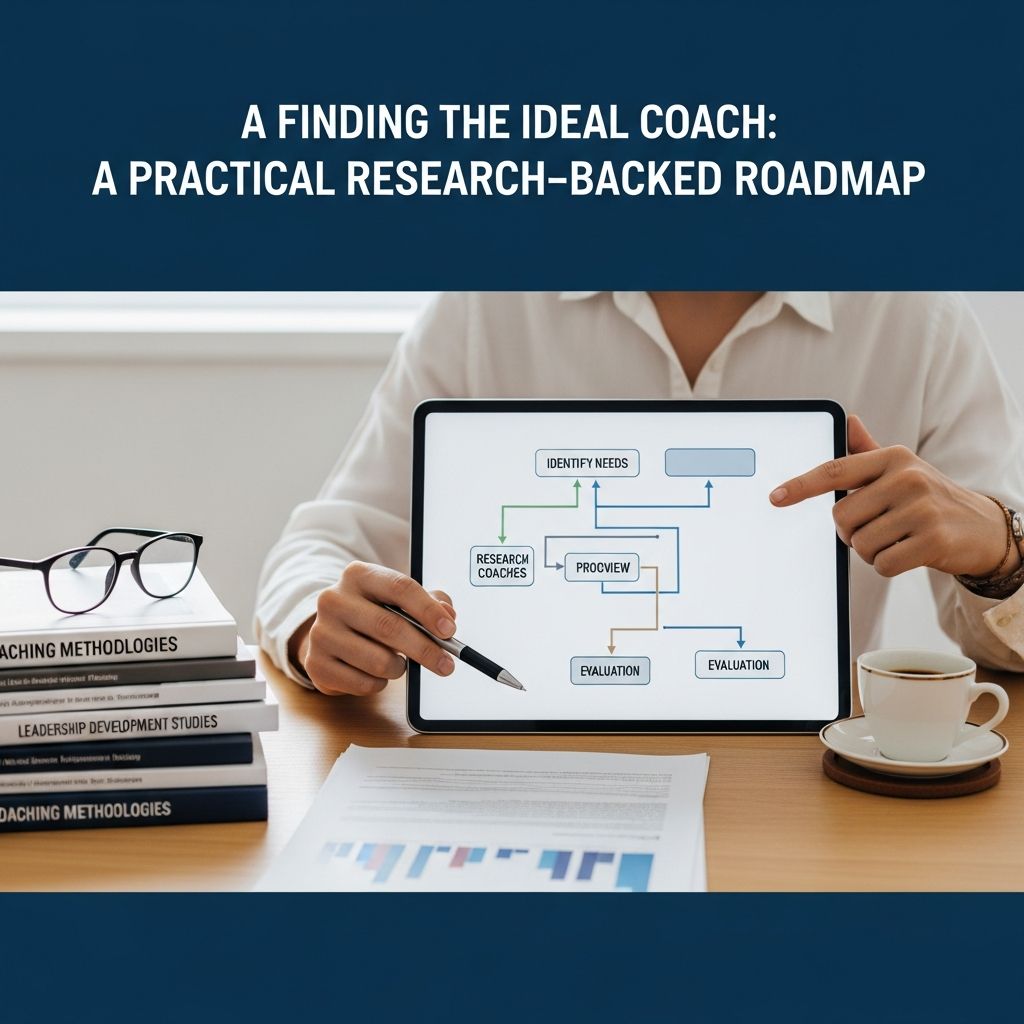
Coaching can accelerate your growth, sharpen your leadership, and improve your well-being at work, but only if you find a coach who truly fits your needs. This guide translates research and best practices into a practical roadmap you can follow to select the right coach with confidence.
Why the Right Coaching Match Matters
Coaching research consistently shows that relationship quality between coach and client is one of the strongest predictors of successful outcomes, not just the tools or models a coach uses. When the match is right, clients report gains in performance, self-awareness, and goal attainment across many contexts.
Choosing a coach is therefore less about finding a universally “best” expert and more about identifying someone who:
- Understands your goals and context
- Brings credible training and experience
- Works in a style that suits how you learn and change
- Creates a psychologically safe, trusted relationship
Step 1: Clarify What Success Looks Like for You
Before you look at coach profiles or ask for recommendations, define the change you want to create. A clear starting point makes it easier to evaluate who is equipped to help you.
Define your coaching outcomes
Write down up to five concrete outcomes you hope to see after working with a coach. Typical objectives include:
- Improved leadership effectiveness (e.g., influence, decision-making)
- Better people management (e.g., feedback, delegation, conflict skills)
- Career transitions (e.g., promotion, role change, new industry)
- Resilience and well-being (e.g., stress management, boundaries)
- Strategic thinking and business impact
Try to move from vague wishes (“be more confident”) to observable changes (“speak up in senior meetings with clear recommendations at least twice per session”). This level of clarity will later help you and your coach measure progress against your starting point.
Decide who is involved in defining goals
In many organizations, coaching is funded or sponsored by HR or a manager. Decide in advance how much input others will have in your goals:
- Individual-only goals – your agenda is private and self-directed
- Shared goals – you co-create outcomes with your manager or HR
- Hybrid – a few shared objectives plus personal ones you keep confidential
Being explicit here prevents misunderstandings about who the coaching ultimately serves.
Step 2: Define Your Practical Requirements
Once your goals are clearer, set the non-negotiable conditions that make coaching viable for you in day-to-day life.
Logistical preferences
- Format: virtual, in-person, or hybrid. Online coaching has become widely used and can be as effective as face-to-face when well structured.
- Session length: 45–60 minutes is common; senior executives may prefer 90 minutes for complex issues.
- Frequency: usually every 2–4 weeks, depending on intensity and budget.
- Time zone and scheduling: necessary windows given your work and life obligations.
- Language: the language in which you can most easily discuss nuanced emotions and dilemmas.
Budget and sponsorship
Clarify:
- Your total budget range
- Whether your organization will fund all or part of the engagement
- Expected duration (e.g., 3, 6, or 12 months)
Costs will vary significantly with coach seniority, specialty, and region. Being transparent about your budget early saves time for both you and potential coaches.
Identity and context preferences
Coaching often touches sensitive topics: power, bias, identity, and personal history. Some people feel safer and more understood with a coach who shares or deeply understands particular aspects of their identity or context, such as:
- Gender or gender identity
- Race, ethnicity, or cultural background
- Sexual orientation
- Industry or professional background (e.g., healthcare, tech, public sector)
These are legitimate criteria if they help you open up and do deeper work, especially on systemic or inclusion-related challenges.
Step 3: Decide What Type of Coach You Need
“Coach” is a broad term spanning different approaches. Matching type to your goals helps you avoid hiring a fantastic coach who is simply focused on the wrong thing.
| Type of professional | Primary focus | Best when you want to… |
|---|---|---|
| Executive / leadership coach | Performance, leadership behavior, strategic impact | Grow as a leader, navigate complex organizational dynamics |
| Career coach | Role choices, job search, career direction | Change roles, industries, or advance your career path |
| Performance or skills coach | Specific skill sets (e.g., presentations, feedback) | Quickly improve a defined behavior or capability |
| Well-being / resilience coach | Stress, energy, boundaries, sustainable work | Reduce burnout and increase resilience at work |
Some coaches span multiple categories, but nearly all have a primary area of emphasis. Look for alignment between their expertise and your top two or three goals.
Step 4: Shortlist Potential Coaches
With your goals and parameters set, you can begin to build a manageable shortlist of potential coaches.
Where to look
- Professional coaching bodies such as the International Coaching Federation (ICF) maintain directories of credentialed coaches.
- Your organization’s HR or leadership development team, which may already have vetted providers.
- Trusted referrals from colleagues, mentors, or your professional network.
- Reputable leadership or business schools that run coaching programs or recommend affiliated coaches.
Criteria for an initial screen
Use public information (bio, website, profiles) to filter down to 3–6 promising candidates. Assess:
- Stated specialties and typical client profiles
- Industry experience or familiarity with your level (e.g., first-time manager vs. C-suite)
- Geographic and time-zone compatibility
- Whether their written voice and philosophy resonate with you
Step 5: Verify Training, Credentials, and Experience
Coaching is not regulated in the same way as medicine or psychology, so formal credentials are not the only signal of quality—but they are meaningful, especially from reputable bodies.
What to look for in credentials
- Accredited coach training from recognized programs (for example, programs accredited by the International Coaching Federation or similar bodies).
- Professional certifications that require supervised practice, ethics commitments, and ongoing education.
- Relevant degrees in fields such as psychology, organizational behavior, or business, particularly for complex leadership or culture work.
Experience that matters
Experience is more than a number of years. Consider:
- How many years they have been coaching full time or near full time
- Typical client level (e.g., emerging leaders, mid-level, senior executives)
- Exposure to your sector or function if your context is highly specialized (e.g., healthcare, finance, academia)
- Examples of coaching outcomes similar to what you hope to achieve (without breaching their clients’ confidentiality)
Step 6: Understand Coaching Style and Methods
Research on coaching effectiveness emphasizes the role of evidence-based techniques and collaborative goal setting, not quick fixes or rigid formulas. Ask each coach to explain how they work in plain language.
Questions to explore their approach
- How do you typically begin a new coaching engagement?
- What frameworks or methods do you draw from?
- How do you balance structure (plans, assessments) with flexibility?
- How do you help clients measure progress over time?
Many effective coaches draw from positive psychology, adult development theory, and behavior change science, focusing on strengths, realistic goals, and practical experiments between sessions.
Signals of a sound, ethical approach
- They emphasize collaboration rather than promising to “fix” you
- They are clear about confidentiality boundaries, especially when sponsors are involved
- They can connect their methods to research or tested practice, not just personal opinion
- They discuss ethics and when they would refer someone to another professional (e.g., therapist) if needs fall outside coaching
Step 7: Use Chemistry Calls to Test the Fit
Most coaches offer introductory conversations—sometimes called chemistry calls or discovery sessions—before you commit. Treat these as structured interviews where you are also assessing your own reactions.
What to pay attention to during the conversation
- Psychological safety: Do you feel you can be honest about mistakes, fears, and ambitions without being judged?
- Listening quality: Do they interrupt or rush to advice, or do they listen deeply and ask thoughtful questions?
- Challenge vs. support: Do you sense they can both encourage and stretch you when necessary?
- Clarity: Do they explain their process, fees, and expectations transparently?
Questions you might ask
- What kinds of clients do you work with most often?
- How do you define a successful coaching engagement?
- What happens if we realize the fit is not right after a few sessions?
- How do you incorporate feedback from me or from organizational sponsors?
Take notes right after each call so you can later compare impressions while they are fresh rather than relying on memory.
Step 8: Compare Options and Decide
After speaking with your shortlisted coaches, review them against your criteria. It can help to create a simple comparison grid.
| Criteria | Coach A | Coach B | Coach C |
|---|---|---|---|
| Goal alignment | |||
| Relevant experience | |||
| Training / credentials | |||
| Chemistry and trust | |||
| Logistics & budget fit |
If you feel genuinely torn between two options, ask whether each would be open to a short, paid trial engagement (for example, one or two sessions) before you commit to a longer program. Use that experience to observe who helps you think, act, and feel differently in meaningful ways.
Step 9: Set Up the Relationship for Success
Once you choose a coach, invest in a strong launch. Research on coaching and behavior change highlights the importance of clear goals, regular feedback, and a collaborative working alliance.
Co-create the coaching contract
Your initial sessions should clarify:
- Shared goals and success measures
- Frequency and format of sessions, plus expectations for between-session work
- How and when progress updates will be shared with sponsors (if any)
- Ground rules for confidentiality, cancellations, and feedback
Agree on how you will track progress
Options include:
- Revisiting your original goals every few sessions
- Using short self-assessments or reflection questions
- Before-and-after feedback from key stakeholders, with your consent
Building in regular check-ins reduces the risk that coaching drifts off course or becomes an unstructured conversation without impact.
Step 10: Continually Evaluate the Fit
A good coaching relationship is dynamic. Your needs may change, and the initial plan might need adjusting.
Signs the coaching is working
- You are having new insights about yourself and your context
- You are experimenting with new behaviors between sessions
- Challenges feel more manageable, even if not solved overnight
- You feel both supported and constructively challenged
When to raise concerns
If any of the following persist, consider addressing them directly with your coach:
- You feel consistently judged or misunderstood
- Sessions feel repetitive, with little progress
- Your priorities have changed but coaching has not adjusted
- Agreed boundaries on confidentiality or roles feel unclear
Skilled coaches welcome feedback and can often reset the work with an open conversation. If, after that, the relationship still does not feel right, it is acceptable to conclude the engagement and look for someone better aligned to your current needs.
Frequently Asked Questions (FAQs)
How long does it usually take to see results from coaching?
Many clients start noticing shifts in perspective or behavior within a few sessions, while deeper, sustained changes often emerge over 3–6 months, depending on goals, session frequency, and the effort applied between meetings.
Is a coaching certification essential?
Certification from a reputable body is not the only marker of an effective coach, but it signals that the coach has completed formal training, follows a code of ethics, and invests in ongoing development, which many clients find reassuring.
What is the difference between coaching and therapy?
Coaching typically focuses on future-oriented goals and performance in work and life, while therapy often addresses mental health conditions, trauma, or emotional difficulties that impair daily functioning. Ethical coaches will refer you to clinical professionals when issues go beyond their scope.
Can my employer know what I discuss with my coach?
When an organization sponsors coaching, it is common to share high-level goals and periodic progress themes, but not the detailed content of sessions. Clear confidentiality agreements should be set at the start so all parties understand what will and will not be shared.
What if I choose a coach and later realize it’s not a good fit?
You can raise your concerns with your coach, adjust goals or ways of working, or end the engagement early if needed. Most coaches understand that fit is crucial and will support you in finding a better match if they are not the right person.
References
- The Complete Handbook of Coaching — Passmore, J., Peterson, D. B., & Freire, T. (Eds.). 2018-01-01. https://doi.org/10.4135/9781529714378
- Factors that Influence the Effectiveness of Executive Coaching Interventions in Organizations — Bozer, G., & Jones, R. J. Journal of Organizational Behavior. 2018-01-01. https://doi.org/10.1002/job.2278
- Coaching and Mentoring for Leadership Development in Civil Service — OECD. 2020-10-20. https://www.oecd.org/publications/coaching-and-mentoring-for-leadership-development-in-civil-service-7674172b-en.htm
- How to Find (and Choose) a Coach — Ed Batista. 2013-07-01. https://edbatista.com/2013/07/how-to-find-and-choose-a-coach.html
- 5 Ways to Choose the Best Career Coach — Jody Michael Associates. 2019-05-01. https://www.jodymichael.com/blog/5-ways-choose-best-career-coach/
- How to Choose the Right Coach: Key Skills and Qualifications to Look For — International Coaching Federation. 2023-06-15. https://coachingfederation.org/blog/how-to-choose-the-right-coach-key-skills-and-qualifications-to-look-for
- 3 Steps to Choosing Your Ideal Executive Coach — MEDI Leadership. 2022-09-01. https://medileadership.org/steps-to-choose-an-executive-coach/

- Integrated M.A. in Applied Linguistics, University of Hyderabad
- 5+ years in editorial, instructional, SEO, and research-based writing
Sneha is a relationships and lifestyle writer with a strong foundation in applied linguistics and certified training in relationship coaching. She brings over five years of writing experience to theskillvault, crafting thoughtful, research-driven content that empowers readers to build healthier relationships, boost emotional well-being, and embrace holistic living. Her writing and insights reflect the belief that beauty, happiness, and wellness…