
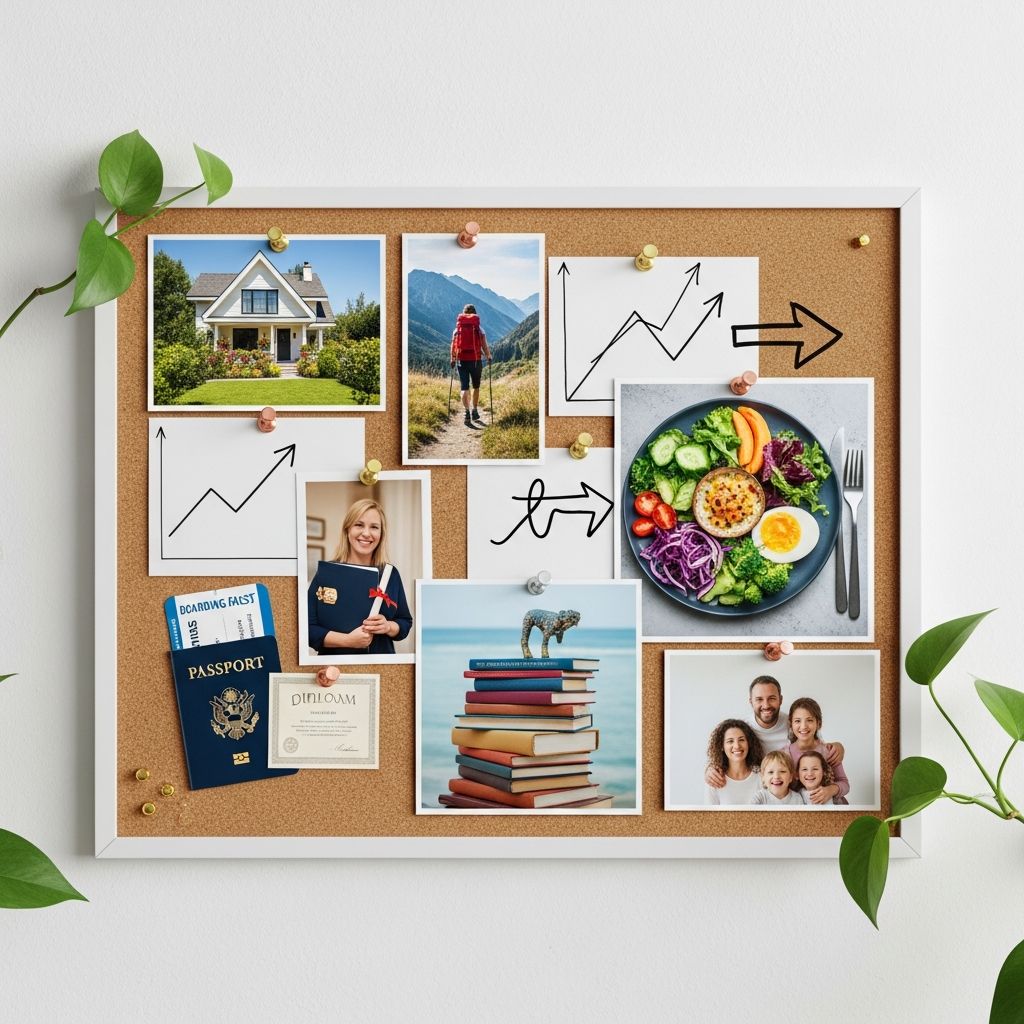
Vision boards are more than collages of attractive pictures. When they are grounded in clear goals and backed by daily habits, they become a practical tool for focusing attention, strengthening motivation, and translating long-term dreams into everyday action.
This guide explains how to design a vision board that is inspiring and actionable, drawing on insights from psychology and goal-setting research.
What a Vision Board Really Is (And Why It Matters)
A vision board is a visual representation of goals, values, and desired experiences, usually created from images, words, and symbols that remind you of the future you want to create.
Unlike a random mood board, an effective vision board is:
- Intentional – every image or phrase connects to a meaningful goal or value.
- Future-focused – it depicts the life you are working toward, not just what you already have.
- Action-linked – it points to choices, habits, and skills you can build, not only outcomes you hope will appear.
Research on visualization and goal-setting suggests that seeing your aims represented clearly can help maintain motivation and focus, especially when paired with specific plans and effort.
The Psychology Behind Vision Boards
Vision boards work best when they align with how your mind naturally processes goals and information.
1. Visualization and Mental Rehearsal
Studies in sports and performance psychology show that mentally rehearsing a desired outcome or skill can strengthen motivation and support learning when combined with practice. A vision board offers a quick, visual cue that helps you mentally connect with the outcomes you are pursuing.
2. Goal Clarity and Direction
Clear, specific goals are more likely to be achieved than vague intentions, according to decades of goal-setting research. Creating a vision board forces you to translate abstract wishes (“be happier”) into concrete images (e.g., having dinner with friends, taking a weekly nature walk) that represent what happiness looks like in your life.
3. Motivation, Meaning, and Well-being
Seeing meaningful goals in front of you can reinforce a sense of purpose, which is associated with higher well-being and better coping with stress. When you regularly view your board, you remind yourself why your daily efforts matter.
Clarify Your Intent: What Should Your Board Do For You?
Before you collect a single image, decide what role you want your board to play. Consider questions like:
- Do I want to focus on one major goal or create a holistic picture of my life?
- Is this board about the next 12–24 months, or a longer horizon?
- Do I need more motivation, more direction, or more balance?
Common themes you might choose for your vision board include:
- Career or business growth
- Health and well-being
- Finances and security
- Learning and creativity
- Relationships and community
- Personal meaning, spirituality, or purpose
Choosing Your Format: Physical, Digital, or Hybrid
Your format shapes how you will interact with your board day to day.
| Format | Strengths | Limitations | Best for |
|---|---|---|---|
| Physical board (poster, corkboard, canvas) | Tactile, immersive; can become a ritual to create and update. | Less portable; harder to duplicate or quickly rearrange. | People who like crafts and visual reminders in a fixed space. |
| Digital board (app, slideshow, desktop wallpaper) | Easy to edit, share, and back up; accessible on multiple devices. | Competes with digital distractions; may be glanced at briefly. | People who work online or travel often. |
| Hybrid (printed from a digital layout) | Combines flexibility of digital with presence of a physical board. | Takes a bit more setup time. | Anyone who wants both convenience and a visible display. |
Step-by-Step: From Ideas to a Vision Board That Moves You
The process of building your board can be as impactful as the finished product. It is a chance to slow down, reflect, and get honest about what you want.
Step 1: Reflect on Your Values and Priorities
Start by making space to think. You can journal, talk with a coach, or simply sit in quiet reflection. Helpful prompts include:
- What do I want to be proud of a year from now?
- What activities or relationships give me the most energy?
- What am I ready to let go of so I can make room for something new?
- If I could not fail, what would I attempt?
This step helps ensure your board reflects your own values, not external expectations.
Step 2: Translate Values into Specific Goals
Next, lightly define 3–8 goals your board will support. Using elements of the SMART framework (specific, measurable, achievable, relevant, time-bound) can make them more actionable.
For example:
- “Be healthier” becomes “Walk briskly for 30 minutes at least 5 days a week.”
- “Advance my career” becomes “Prepare and apply for two stretch roles by the end of the year.”
These goals will guide what images and words you choose.
Step 3: Gather Visuals and Words That Feel Alive
Look for images and text that evoke the feeling and identity behind your goals, not just the literal outcome. You can use:
- Photos from magazines, brochures, or old prints
- Digital images, icons, or graphics
- Short phrases, affirmations, or quotes that genuinely resonate
- Symbols or colors that represent specific values (e.g., green for growth)
Choose visuals that depict both:
- The result (e.g., giving a confident presentation)
- The process (e.g., studying, practicing, getting feedback)
Emphasizing process images can support persistence because they remind you that progress comes from repeated actions, not overnight change.
Step 4: Arrange Your Board with Intention
Lay your items out before attaching anything. Experiment with grouping and order:
- Cluster similar themes (health, relationships, work, etc.) together.
- Place your top 1–3 priorities at eye level or near the center.
- Leave some white space so the board feels calm, not chaotic.
- Add a short title or word at the top that captures your overall direction (e.g., “Growth”, “Courage”, or “Steady Progress”).
The goal is an arrangement that feels energizing and clear the moment you look at it.
Step 5: Connect Images to Concrete Actions
This is where many boards stop at inspiration. To make yours action-oriented, translate each image cluster into simple, repeatable behaviors.
You can write these directly on the board’s margins or in a separate note or digital document. For each major theme, ask:
- What is one small step I can take this week toward this picture?
- What recurring habit would support this vision?
- What resources, skills, or people could help me?
Linking visuals to specific behaviors makes it more likely you will move from dreaming to doing, in line with research showing that implementation intentions (“If situation X, then I will do Y”) can improve follow-through on goals.
Step 6: Place Your Board Where It Will Influence You
To have an effect, your board needs to be seen. Good locations include:
- Near your workspace or computer monitor
- By your bathroom mirror or wardrobe
- As a phone lock-screen or desktop background
Make it part of a brief daily ritual: look at the board, reconnect with your goals, and choose one specific action for the day that aligns with the vision.
Keeping Your Vision Board Relevant and Honest
Life changes, and your board should evolve with it. A static board can start to feel like a museum exhibit rather than a living tool.
Schedule Regular Check-Ins
Every 1–3 months, spend a few minutes reviewing your board:
- Which images still excite you?
- Which goals feel complete, changed, or no longer meaningful?
- Where have you made progress that deserves to be celebrated?
Remove or replace anything that feels outdated or forced. This helps your board remain aligned with your current values and circumstances.
Use Your Board to Support Resilience
When you encounter setbacks, your board can be more than a wish list; it can be a reminder of your strengths, support systems, and longer-term direction.
In difficult moments, try this simple sequence:
- Look at a part of the board that represents a core value (e.g., learning, kindness, persistence).
- Recall a time when you lived that value, even in a small way.
- Identify one value-based action you can still take today, despite the setback.
This approach is consistent with psychological research showing that reconnecting with personal values can buffer stress and support mental health.
Vision Boards at Work and in Teams
Vision boards are not limited to personal goals; they can also help teams clarify direction and boost engagement.
In a professional context, a shared vision board might focus on:
- What success looks like for the team or project
- How collaboration and communication should feel
- The kind of impact the team wants to have on clients or stakeholders
To keep it practical, pair the shared board with:
- Quarterly priorities and metrics
- Regular reflections on progress and learning
- Team rituals (e.g., starting meetings with a quick glance at the board)
Common Mistakes That Weaken a Vision Board
Being aware of typical pitfalls can help you design a more effective board from the start.
- Overcrowding – Too many images or goals can feel overwhelming and dilute your focus.
- Copying others – A board based on trends or social media aesthetics may not reflect your true priorities.
- Outcome-only focus – Pictures of end results with no reference to the process can create unrealistic expectations.
- Passive use – Creating the board but rarely looking at it, or not linking it to actions, limits its impact.
- Using it as a replacement for planning – Vision boards work best alongside concrete plans, schedules, and feedback, not instead of them.
Bringing It All Together: From Vision to Daily Practice
A powerful vision board sits at the intersection of three elements:
- Inspiration – compelling images and words that make your future feel exciting and meaningful.
- Clarity – clearly defined goals and values that guide what does and does not belong on the board.
- Action – small, consistent behaviors that move you toward what you see, supported by routines and reflection.
Used this way, your vision board becomes less about wishful thinking and more about cultivating a steady, purposeful path toward the life you want to build.
Frequently Asked Questions (FAQs)
Q: Do vision boards really work, or is it just wishful thinking?
A: Vision boards are not magic, but they can support motivation and focus when combined with clear goals, effort, and realistic planning. Research on visualization and goal-setting suggests that seeing your goals and reviewing them regularly can help you maintain direction and persistence, especially when you also plan specific steps to achieve them.
Q: How often should I update my vision board?
A: Review your board at least every few months. Update it when goals are completed, your priorities shift, or certain images no longer resonate. Treat it as a living document rather than a one-time craft project.
Q: Can I have more than one vision board?
A: Yes. Some people prefer one holistic board, while others create different boards for areas like career, health, or relationships. If you choose multiple boards, avoid overcomplicating things—keep each board focused and manageable.
Q: What if I am not a visual or artistic person?
A: You do not need artistic talent to benefit from a vision board. Simple images, words, or even color blocks can be effective if they are meaningful to you. Digital boards can also be easier if you are more comfortable with technology than with crafts.
Q: Is it better to focus on big dreams or small, realistic goals?
A: A balanced approach works best. Including larger dreams can keep you inspired, while depicting realistic, near-term goals and habits helps you stay grounded in what you can influence right now. Both can coexist on the same board if you make clear connections between them.
References
- Wellness Wednesday: Vision Boards — Rio Salado College. 2023-01-11. https://www.riosalado.edu/news/2023/wellness-wednesday-value-vision-boards
- What Is a Vision Board and Why Make One? — Psychology Today (Click Here for Happiness blog). 2021-03-29. https://www.psychologytoday.com/us/blog/click-here-happiness/202103/what-is-vision-board-and-why-make-one
- Vision Boards — Rio Salado College Counseling Services. 2023-01-11. https://www.riosalado.edu/news/2023/wellness-wednesday-value-vision-boards
- The Mental Health Benefits Of Vision Boards — Henry Ford Health. 2025-05-21. https://www.henryford.com/Blog/2025/05/Mental-Health-Benefits-Vision-Boards
- What is a Vision Board? Definition, Examples, Benefits — IdeaScale. 2023-08-10. https://ideascale.com/blog/vision-board/

Medha Deb is an editor with a master's degree in Applied Linguistics from the University of Hyderabad. She believes that her qualification has helped her develop a deep understanding of language and its application in various contexts. Medha specializes in the areas of beauty, health, sports, and wellness and is committed to ensuring that the content on the website is…