
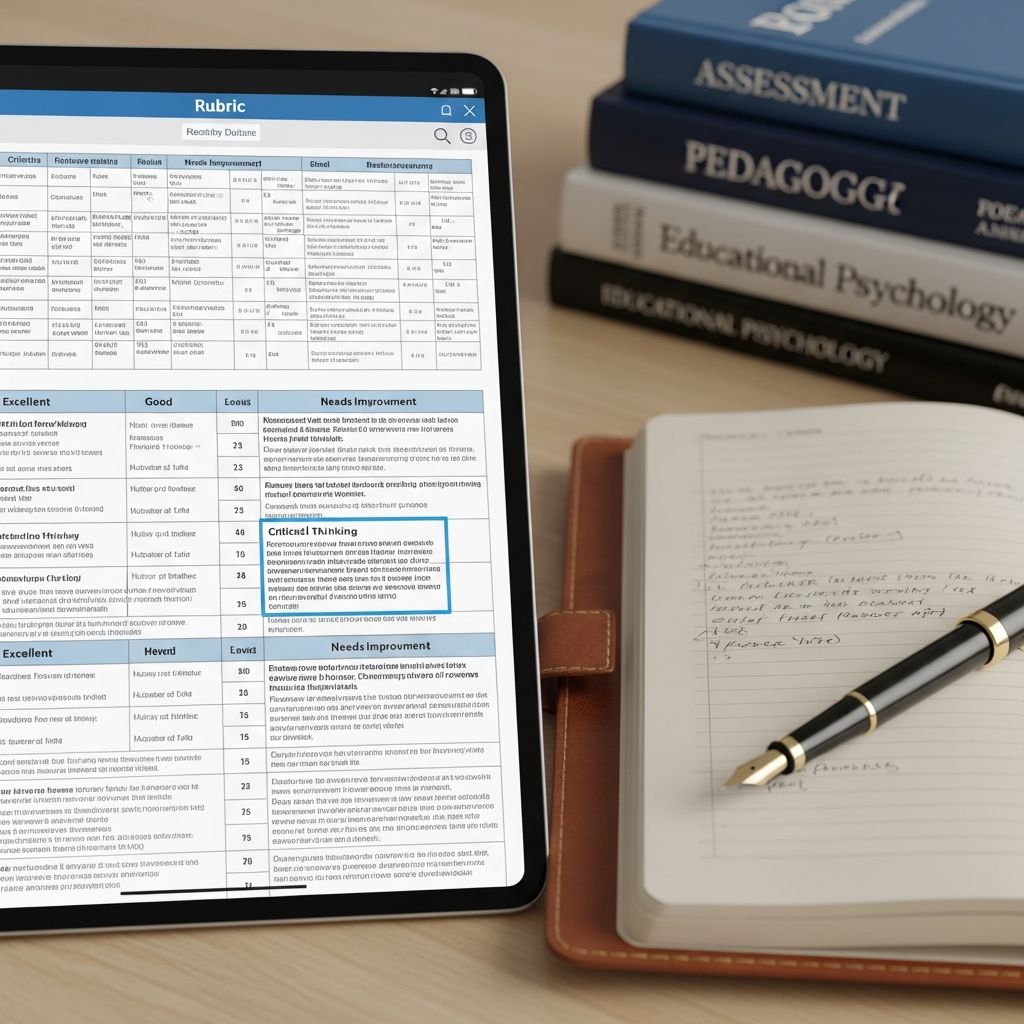
Rubrics serve as essential tools in modern education, offering structured frameworks to evaluate student work objectively and consistently. By breaking down complex assignments into measurable components, they promote transparency in grading, reduce subjectivity, and empower students with clear expectations.
Understanding the Core Purpose of Rubrics
At their essence, rubrics articulate specific expectations for assignments, delineating what constitutes high-quality work across key dimensions. They transform vague grading practices into precise, communicable standards, fostering alignment between instructor goals and student performance. This clarity not only streamlines assessment but also cultivates self-regulated learning as students internalize success criteria.
Educators benefit from rubrics by minimizing grading time and disputes, while students gain actionable insights for improvement. Research from university teaching centers emphasizes that well-crafted rubrics correlate with higher student achievement and satisfaction.
Key Types of Rubrics and When to Use Them
Rubrics come in three primary formats, each suited to different assessment needs:
- Analytic Rubrics: These feature a grid with criteria in rows and performance levels in columns, providing detailed, trait-specific feedback. Ideal for complex tasks like essays or projects requiring multifaceted evaluation.
- Holistic Rubrics: Offering a single score based on an overall impression, they suit quick assessments like speeches or simple responses where nuanced breakdown isn’t essential.
- Single-Point Rubrics: Centered on proficiency with open spaces for exceeding or falling short notes, they encourage personalized feedback while maintaining simplicity.
Selecting the right type depends on the assignment’s complexity, desired feedback depth, and time constraints. Analytic versions excel in formative settings, while holistic ones fit summative overviews.
Step-by-Step Guide to Building a Rubric
Creating a rubric begins with aligning it to learning objectives. Follow these structured steps for optimal results:
- Define Assignment Goals: Review objectives and identify 4-6 core traits, such as content depth, organization, and mechanics.
- Establish Performance Scale: Choose 3-5 levels, like Exemplary, Proficient, Developing, and Emerging, ensuring they reflect realistic student outcomes.
- Draft Descriptors: Start with the proficient level as an ‘acceptable but not exceptional’ benchmark, then adjust for higher and lower tiers using specific, observable language.
- Assign Weights and Points: Prioritize criteria by percentage or points to reflect importance, e.g., 40% for analysis in a research paper.
- Review and Refine: Test on sample work, seek peer input, and revise for clarity and fairness.
This process, recommended by institutions like NC State and Indiana University, ensures rubrics are both practical and pedagogically sound.
Essential Elements of High-Quality Rubric Descriptors
Effective descriptors distinguish performance levels through precise, parallel language. Avoid vague terms like ‘good’ or ‘adequate’; instead, specify behaviors:
| Performance Level | Organization Example |
|---|---|
| Exemplary | Seamless logical flow with sophisticated transitions enhancing coherence and engagement. |
| Proficient | Clear structure with effective transitions supporting readability. |
| Developing | Basic organization present, but transitions are inconsistent or abrupt. |
| Emerging | Lack of structure confuses the reader; no clear transitions. |
Such specificity, as outlined in Berkeley’s GSI guidelines, prevents overlap and promotes reliable scoring. Parallel phrasing across levels aids student comprehension and inter-rater consistency.
Leveraging Digital Tools for Rubric Creation
Modern educators can harness free online platforms to build and deploy rubrics efficiently. Tools like RubiStar and iRubric offer templates customizable for any subject, while Google Docs enables simple table-based designs transferable to LMS like Canvas or Moodle.[10]
Canvas’s built-in rubric feature allows point assignment and direct integration into assignments, automating grade calculation.[10] QuickRubric provides a fast, modern interface for instant creation and sharing. These tools reduce setup time, allowing focus on content refinement.
Integrating AI to Accelerate Rubric Development
Generative AI emerges as a game-changer, drafting initial rubrics from detailed prompts specifying type, criteria, and levels. For instance, input an assignment description and request an analytic rubric with weighted content and style criteria. Always revise AI outputs to align with institutional guidelines and specific needs, treating them as starting points rather than finals.
NC State advises clear prompts to optimize results, ensuring AI-generated drafts incorporate desired performance labels and distinctions. This approach saves hours while maintaining educator oversight.
Best Practices for Implementation and Student Engagement
To maximize impact, share rubrics early, provide exemplars at varying levels, and incorporate self/peer review opportunities. Cornell University stresses starting small—one rubric per course—to build proficiency.
- Align criteria with essential questions and higher-order skills like impact analysis.
- Calibrate with colleagues for unbiased language.
- Use rubrics formatively to guide revisions before final submission.
Students practicing with rubrics develop metacognitive skills, better understanding quality benchmarks.
Common Pitfalls and How to Avoid Them
Steer clear of overloaded criteria (limit to 6-8), subjective jargon, or unbalanced scales. Edutopia highlights ensuring criteria match task demands, including processes like research alongside products. Pilot testing reveals ambiguities, refining descriptors for equity.
Frequently Asked Questions (FAQs)
What is the ideal number of performance levels in a rubric?
Three to five levels strike a balance between nuance and simplicity; too many complicate scoring, while fewer lack discrimination.
Can rubrics be used for non-traditional assignments?
Yes, adapt for presentations (eye contact, content), group projects (collaboration), or creative work (originality, technique).
How do single-point rubrics differ from traditional ones?
They focus on proficiency with blank columns for tailored feedback on strengths and areas for growth, promoting dialogue over rigid scores.
Should rubrics include point values?
For summative grading, yes; weight by importance. Holistic rubrics may use ranges.
Are rubrics suitable for elementary students?
Absolutely—simplified versions with visuals build assessment literacy from early grades.
Real-World Applications Across Disciplines
In STEM, rubrics evaluate lab reports on methodology and data analysis; in humanities, they assess argumentative depth and source integration. Adaptable frameworks ensure versatility, from K-12 to higher education.
Case studies from teaching centers show rubrics reducing grade disputes by 30-50% and improving performance on revisions. Integrating them into peer review amplifies collaborative learning.
References
- Rubric Best Practices, Examples, and Templates — NC State University Teaching Resources. 2023. https://teaching-resources.delta.ncsu.edu/rubric_best-practices-examples-templates/
- Rubric Creation and Use — Indiana University Center for Innovative Teaching & Learning. 2023. https://citl.indiana.edu/teaching-resources/assessing-student-learning/rubric-creation-use/index.html
- Steps for Creating a Rubric — UC Berkeley GSI Teaching & Resource Center. 2023. https://gsi.berkeley.edu/gsi-guide-contents/grading-intro/grading-rubrics/rubrics-steps/
- Create a Rubric using Google Docs — Brandman University. 2023. https://sites.google.com/a/mail.brandman.edu/edsu-533-classroom-tutorial/create-a-rubric-using-google-docs
- Creating Effective Rubrics — YouTube (CTL at UofA). 2023. https://www.youtube.com/watch?v=z2VkENHqSGg
- Using Rubrics — Cornell University Center for Teaching Innovation. 2023. https://teaching.cornell.edu/teaching-resources/assessing-student-learning/using-rubrics

- Integrated M.A. in Applied Linguistics, University of Hyderabad
- 5+ years in editorial, instructional, SEO, and research-based writing
Sneha is a relationships and lifestyle writer with a strong foundation in applied linguistics and certified training in relationship coaching. She brings over five years of writing experience to theskillvault, crafting thoughtful, research-driven content that empowers readers to build healthier relationships, boost emotional well-being, and embrace holistic living. Her writing and insights reflect the belief that beauty, happiness, and wellness…