
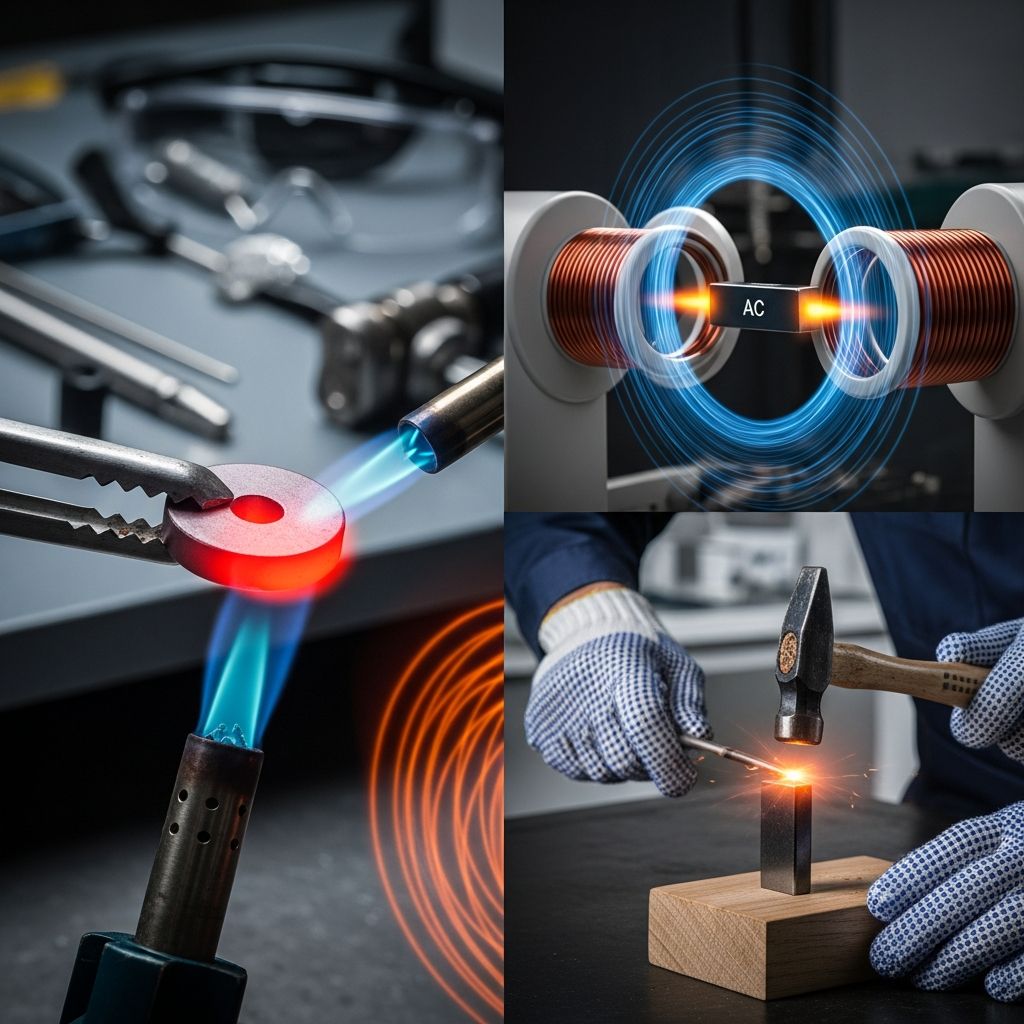
Magnets power countless devices from hard drives to electric motors, but there are times when their magnetic properties need to be neutralized. Whether you’re working in a workshop, conducting experiments, or troubleshooting equipment, knowing how to demagnetize materials is essential. This process disrupts the orderly alignment of magnetic domains—tiny regions within ferromagnetic materials like iron and steel that act like miniature magnets. When these domains point randomly, the net magnetic field drops to zero.
Understanding demagnetization begins with grasping why magnets lose strength. Factors like extreme temperatures, oscillating fields, or mechanical stress can realign domains chaotically. Common materials such as neodymium, alnico, and ferrite each respond differently due to their Curie temperatures—the point where thermal energy overcomes magnetic alignment—and coercive forces, which measure resistance to demagnetization.
Core Principles of Magnetic Domains and Loss
Magnetic domains form when electron spins align in ferromagnetic substances, creating north-south poles. In a strong magnet, billions of these domains synchronize for powerful fields. Demagnetization reverses this by introducing chaos: heat jumbles spins, alternating currents flip polarities rapidly, and shocks physically misalign domains.
For instance, iron’s Curie point sits at 770°C, where atomic vibrations destroy domain order. Below this, materials retain potential magnetism; above it, they become paramagnetic until cooled. Stronger rare-earth magnets like neodymium require higher fields or temperatures, often exceeding 300°C, but heating risks permanent material degradation.
Thermal Demagnetization: Heating to Curie Point
The most straightforward method involves raising the material’s temperature beyond its Curie point. This technique suits scrap metal, tools, or failed magnets but demands caution due to high heats involved.
- Identify Curie temperatures: Iron: 770°C; Steel variants: 700-900°C; Neodymium: 310-400°C depending on grade.
- Equipment needed: Propane torch, furnace, or heat gun; tongs; protective gear.
- Process: Secure the item with tongs, heat uniformly until glowing dull red (verify with pyrometer if precise), then cool slowly in air, away from fields.
Slow cooling prevents re-alignment from residual fields. This method excels for bulk steel but can warp precision parts or melt coatings on modern magnets. Safety is paramount: use gloves, eye protection, and ventilation to avoid fumes.
| Material | Curie Point (°C) | Best Heating Method | Post-Process Notes |
|---|---|---|---|
| Iron | 770 | Torch to dull red | Cool slowly |
| Steel | 700-900 | Furnace | Uniform heating |
| Neodymium | 310-400 | Controlled oven | May weaken permanently |
| Alnico | 800-850 | High-temp kiln | High coercivity |
Thermal methods guarantee results for most ferromagnetics but are energy-intensive and hazardous for home use.
Electromagnetic Demagnetization with Alternating Fields
Alternating current (AC) generates oscillating fields that progressively weaken domain alignment without heat. This is the go-to for workshops demagnetizing screwdrivers, wrenches, or assembly parts.
AC fields cycle polarity 50-60 times per second (standard mains frequency), randomizing domains as strength decays. Professional demagnetizers amplify this with coils tuned to material coercivity.
- Acquire a demagnetizer coil, soldering gun trigger, or AC solenoid.
- Power on to establish field.
- Position item inside or adjacent, then withdraw slowly (inches per second) to a distance where field drops below coercivity threshold.
- Test with compass or ferrous test piece.
- Repeat if residual magnetism persists.
For larger items, tunnel demagnetizers encase workpieces in cascading fields. Pulse demagnetizers ramp fields to peak then decay monotonically, ideal for static components. This non-thermal approach preserves material integrity, making it superior for tools.
Mechanical Shock: Hammers, Drops, and Vibrations
Physical jolts jar domains out of sync, a crude but accessible method. Dropping a magnet from height or hammering it scatters alignments via induced eddy currents and stress.
- Simple drop test: Elevate 1-2 meters onto concrete; repeat 5-10 times.
- Hammer taps: Firm strikes on anvil; avoid crushing.
- Vibration: Prolonged shaking on vibrator table for industrial scale.
Effectiveness varies: weak for high-coercivity neodymium, better for soft iron. It’s temporary for some applications but risks structural damage. Combine with AC for hybrids.
Advanced Tools and Professional Systems
Industrial demagnetizers employ sophisticated tech: multi-axis coils, high-frequency pulses (kHz ranges), or knockdown methods saturating then nulling fields. For permanent magnets, fields must exceed 1-5 Tesla—beyond home setups.
Neodymium demands specialized yokes or ovens; post-demagnetization, remagnetizing yields 5-10% loss due to micro-damage. CRT degaussers exemplify consumer versions, pulsing fields to purify screens.
Safety Protocols and Best Practices
Demagnetization involves risks: burns, shocks, flying debris. Always:
- Wear PPE: gloves, goggles, aprons.
- Work in ventilated areas.
- Isolate from pacemakers (fields can interfere).
- Test residuals to confirm zero field.
- Dispose magnetized waste properly—fields attract hazards.
Environmentally, avoid overheating to minimize emissions; recycle demagnetized scrap.
Applications Across Industries
Workshops demagnetize tools to prevent chip pickup; manufacturing ensures precision machining; electronics clears HDDs securely; labs reset samples. Aerospace demands ultra-low residuals (<1 gauss) via certified tunnels.
Frequently Asked Questions (FAQs)
Can all magnets be fully demagnetized?
Yes, but high-coercivity types like neodymium need intense fields or heat; full reversal to zero is possible with proper equipment.
Is heating the safest home method?
No, AC fields are safer as they avoid burns; heat suits disposable items only.
Does demagnetization damage materials permanently?
Often not—most remagnetize well, but repeated heat cycles degrade rare-earths slightly.
How do I test if demagnetization succeeded?
Use a compass, gaussmeter, or pick up paperclips; no attraction means success.
Can I demagnetize without tools?
Yes, via heat or drops, but results are inconsistent compared to AC devices.
Reversibility: Remagnetizing After Demagnetization
Post-demagnetization, stroking with strong magnets or DC coils realigns domains. For tools, run perpendicular to shaft then align for magnetization. Industrial saturators restore full strength.
In summary, choose methods by material, scale, and precision: heat for bulk, AC for finesse, shocks for quick fixes. Mastering these empowers safe, effective magnetism control.
References
- Magnet Academy: Demagnetizing — National High Magnetic Field Laboratory. 2023-05-15. https://nationalmaglab.org/magnet-academy/plan-a-lesson/demagnetizing/
- Demagnetisation Technology — Maurer Magnetic AG. 2024-02-10. https://maurermagnetic.com/en/demagnetizing/technology/demagnetisation-technology/
- How to Demagnetize Metal with Simple Tools — ArcCaptain. 2023-11-20. https://www.arccaptain.com/blogs/news/how-to-demagnetize-metal
- Demagnetizing Magnets and Other Things (Video Transcript) — YouTube (GreatScott!). 2022-08-12. https://www.youtube.com/watch?v=mGK8oYdEqyE
- How Can a Magnet Be Demagnetized? — IMA Magnets. 2024-01-05. https://imamagnets.com/en/blog/how-can-magnet-be-demagnetized/

Medha Deb is an editor with a master's degree in Applied Linguistics from the University of Hyderabad. She believes that her qualification has helped her develop a deep understanding of language and its application in various contexts. Medha specializes in the areas of beauty, health, sports, and wellness and is committed to ensuring that the content on the website is…