
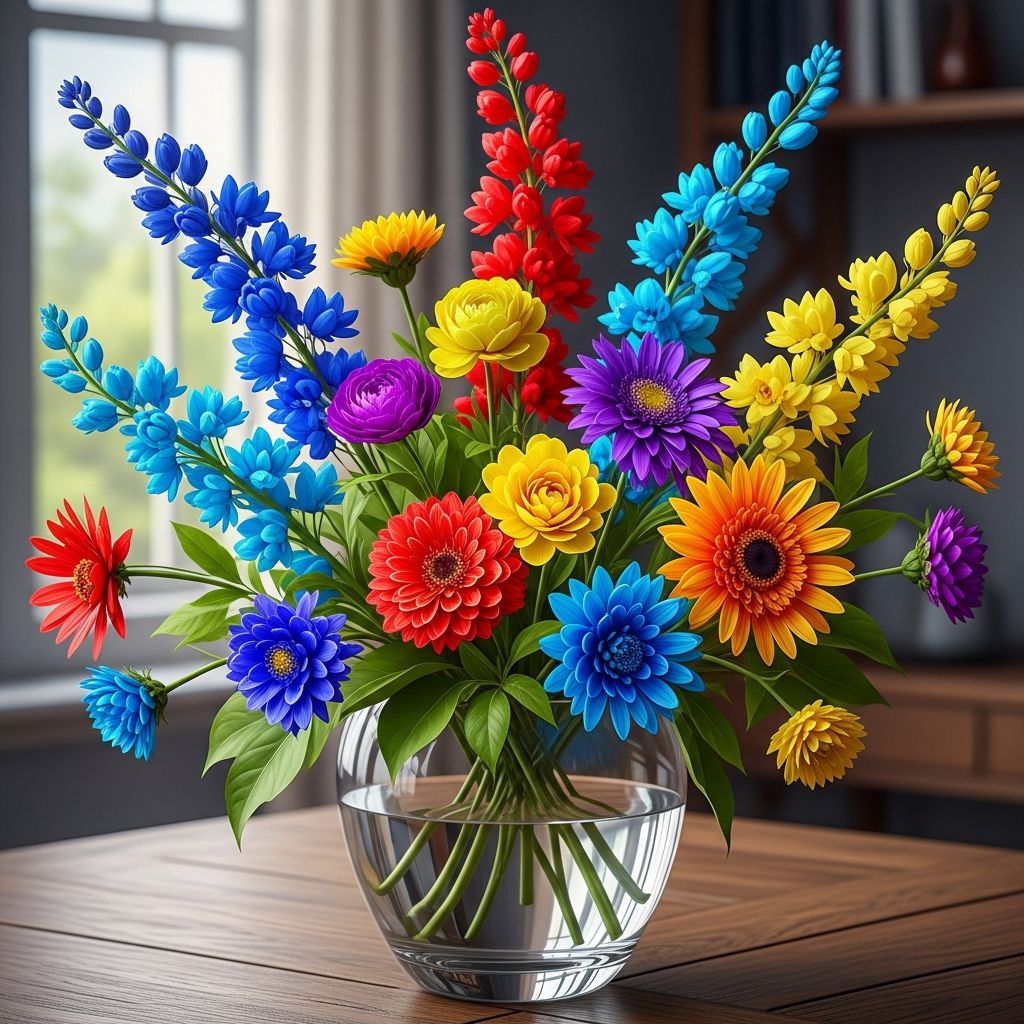
Transforming plain white flowers into a spectrum of colors offers a captivating blend of art and science. This process leverages **capillary action**, where water and dye travel up the plant’s vascular system, tinting petals naturally. Ideal for educational projects or decorative displays, these experiments reveal plant biology in action while yielding beautiful results.
Understanding the Science Behind Colored Blooms
The key principle is **capillary action**, a phenomenon where liquids move through narrow spaces without gravity’s aid. In flowers, this occurs in the xylem, tiny tubes that transport water from roots to petals. When you place stems in dyed water, the color ascends, gradually infusing the blooms.
- Xylem transport: Acts like straws sucking up colored liquid.
- Time factor: Visible changes in 24-48 hours, full color in days.
- Flower choice: White carnations, roses, or daisies work best due to lack of pigment.
This experiment demonstrates osmosis and adhesion, core concepts in botany. According to the National Science Teaching Association, such activities engage students in observing real-world physics and biology.
Essential Materials for Your Flower Dyeing Project
Gather these common items to start:
| Item | Purpose | Notes |
|---|---|---|
| White flowers (carnations, roses) | Base for coloring | Fresh-cut, long stems preferred |
| Food coloring (assorted colors) | Dye source | 20-30 drops per cup for vibrancy |
| Clean glass vases or jars | Water containers | One per color, 4-8 oz capacity |
| Warm water | Solution base | Accelerates dye uptake |
| Scissors | Stem prep | Sharp cut at 45-degree angle |
| Optional: Sugar or vinegar | Nutrient boost | 1 tsp sugar or 1 tbsp vinegar per cup |
These supplies ensure safe, effective results without specialized equipment.
Step-by-Step Guide to Basic Single-Color Flowers
Follow this straightforward method for uniform color:
- Prepare vases: Fill each with 4-6 oz warm water. Add 20 drops food coloring. Stir well.
- Cut stems: Slice 1-2 inches off flower stems underwater at a slant to prevent air bubbles.
- Place flowers: Submerge cut ends immediately in colored water. Position in light, away from direct sun.
- Observe changes: Check petals after 12 hours for streaks, full color by day 2-3.
- Refresh solution: Change water daily to sustain the process.
Expect carnations to show color fastest due to wide vascular bundles.
Advanced Technique: Crafting Rainbow Multi-Color Blooms
For striking multicolored effects, split the stem:
- Select flower: Choose sturdy types like carnations or chrysanthemums.
- Split stem: Carefully cut vertically 4-6 inches up from base, creating 3-5 equal sections. Use tape to stabilize if needed.
- Dye setup: Prepare separate vases with distinct colors (red, blue, yellow).
- Immerse splits: Place each stem segment in a different vase. Secure with clay or weights.
- Monitor progress: Stripes emerge within hours, blending into rainbows over days.
This variation highlights color separation, mimicking chromatography experiments used in labs.
Best Flowers and Optimal Conditions for Success
Not all flowers dye equally. Here’s a comparison:
| Flower Type | Dye Speed | Color Intensity | Best Use |
|---|---|---|---|
| Carnations | Fast (24 hrs) | High | Single/multi-color |
| Roses | Medium (48 hrs) | Medium | Elegant displays |
| Daisies | Slow (72 hrs) | Low | Simple projects |
| Queen Anne’s Lace | Fast | High | Lacy effects |
Maintain room temperature (65-75°F), indirect light, and fresh cuts. Avoid cold water, which slows absorption.
Creative Variations and Fun Extensions
Elevate your project:
- Gradient effects: Start with clear water, transition to dye midway.
- Layered dyeing: Move flowers between colors after partial uptake.
- Natural dyes: Use beet juice (pink), turmeric (yellow), or spinach (green).
- Bouquet arrangements: Combine single and multi-color flowers for centerpieces.
- Preservation: Air-dry dyed flowers for lasting decor.
These twists encourage experimentation and deeper scientific inquiry.
Troubleshooting Common Issues
Encounter problems? Address them:
- No color uptake: Recut stems underwater; ensure fresh flowers.
- Fading color: Add more dye or sugar to feed the plant.
- Wilting: Use warmer water with vinegar to mimic cut flower food.
- Uneven dyeing: Split stems more evenly or choose vascular-rich flowers.
Patience is key—results improve with practice.
Educational Value for Classrooms and Families
This craft doubles as a lesson in plant physiology. Students can journal observations, measure color progression, or hypothesize outcomes. Aligns with NGSS standards for matter transport in organisms. Families bond over watching nature’s “magic” unfold, sparking discussions on everyday science.
Safety Guidelines and Eco-Friendly Tips
Family-safe: Food coloring is non-toxic. Supervise cuts to avoid slips. Dispose of dyed water down drains—biodegradable. Opt for organic flowers to minimize pesticides.
Frequently Asked Questions (FAQs)
What flowers work best for coloring?
White carnations and roses absorb dye quickest due to prominent xylem.
How long until colors appear?
Petals show streaks in 12-24 hours, full vibrancy in 2-5 days depending on flower type.
Can I use colored flowers as a base?
Possible but results blend unpredictably; white bases yield purest hues.
Why use warm water?
Warmth speeds capillary action by reducing water viscosity.
Do dyed flowers stay alive longer?
No, but additives like sugar extend vase life similarly to plain water.
References
- Capillary Action in Plants — U.S. Department of Education. 2023-05-15. https://www.ed.gov/science-education-resources
- Plant Physiology: Xylem Transport — National Science Foundation. 2024-02-10. https://www.nsf.gov/pubs/2024/nsf24005
- Botany Experiments for K-12 — Smithsonian Institution. 2022-11-20. https://naturalhistory.si.edu/education
- Next Generation Science Standards: Matter and Energy — National Research Council. 2013-04-01 (authoritative standard). https://www.nextgenscience.org
- Capillary Action Demonstration Guide — Royal Society of Chemistry. 2025-01-12. https://edu.rsc.org/resources

- Integrated M.A. in Applied Linguistics, University of Hyderabad
- 5+ years in editorial, instructional, SEO, and research-based writing
Sneha is a relationships and lifestyle writer with a strong foundation in applied linguistics and certified training in relationship coaching. She brings over five years of writing experience to theskillvault, crafting thoughtful, research-driven content that empowers readers to build healthier relationships, boost emotional well-being, and embrace holistic living. Her writing and insights reflect the belief that beauty, happiness, and wellness…