
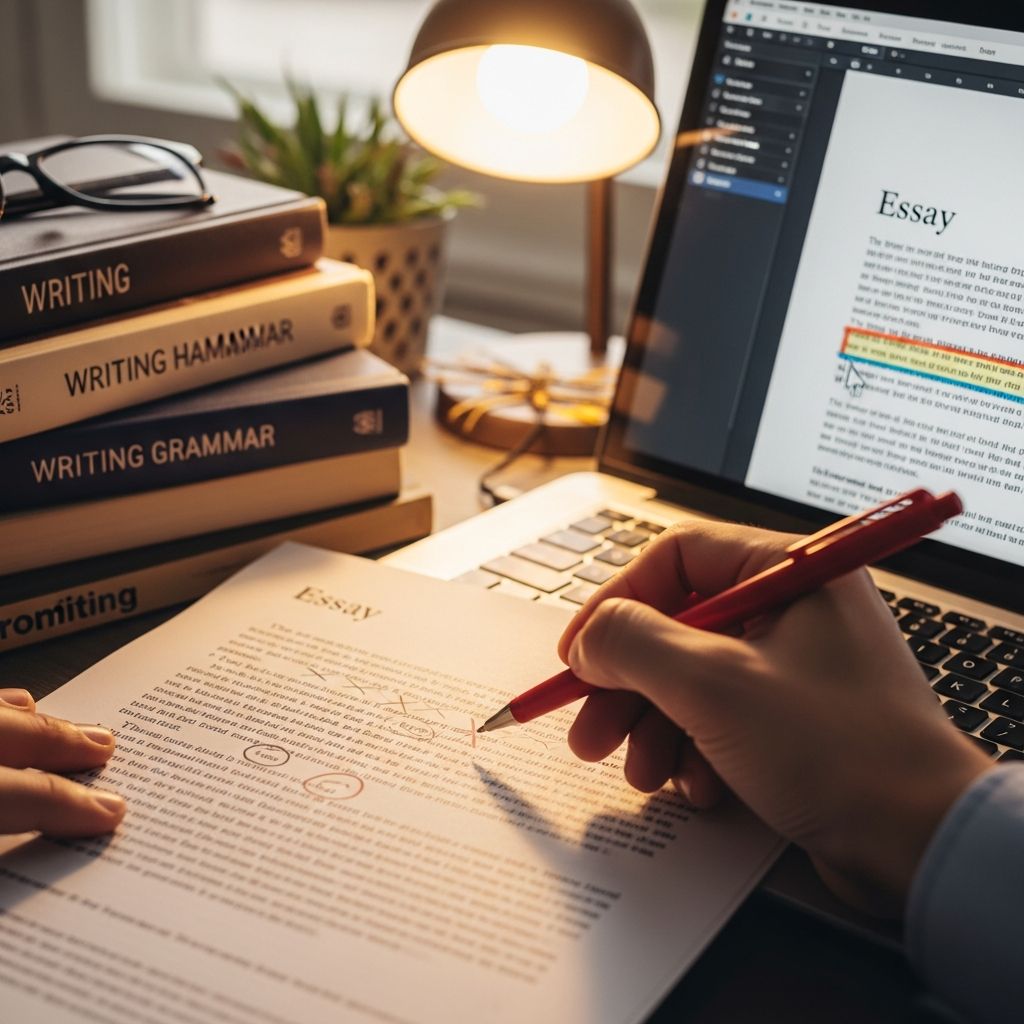
Editing transforms a rough essay draft into a compelling, error-free piece that captivates readers and earns high marks. This detailed guide outlines a systematic approach to revision, drawing on established academic practices to ensure your work shines with precision and professionalism.
Understanding the Editing Process
Essay editing goes beyond fixing typos; it involves multiple layers of refinement to enhance overall quality. Start by recognizing that effective editing requires distance from your initial writing—step away for at least a day to gain fresh perspective. This separation allows objective evaluation of content, structure, and style.
Professional editors divide the process into distinct phases: global revisions for big-picture elements, sentence-level improvements for clarity, and final proofreading for mechanics. Allocate time proportionally: 40% for structure, 30% for style, and 30% for details to optimize efficiency.
Phase 1: Evaluate Global Structure and Argument
Begin with a high-level review to assess if your essay achieves its purpose. Read the entire piece without interruptions to gauge coherence and logical progression. Ask: Does the thesis statement clearly guide the reader? Do paragraphs build a unified argument?
- Thesis Strength: Ensure your central claim is specific, arguable, and previewed early. A weak thesis like “Social media is popular” becomes powerful as “Social media algorithms exacerbate anxiety in young adults by prioritizing sensational content.”
- Paragraph Unity: Each body paragraph must advance the thesis with a focused topic sentence, evidence, and analysis. Eliminate digressions that dilute focus.
- Transitions: Use phrases like “Furthermore,” “In contrast,” or “This evidence suggests” to link ideas seamlessly.
Create a reverse outline: number paragraphs and summarize each in one sentence, then rearrange if needed for better flow. This technique reveals gaps or redundancies early.
Phase 2: Refine Content and Evidence
With structure solid, scrutinize content depth. Verify that every claim is supported by credible evidence—statistics, quotes, or examples—from reliable sources. Remove unsubstantiated opinions to bolster credibility.
| Weak Evidence Example | Improved Version |
|---|---|
| “Many people think climate change is real.” | “NASA data shows global temperatures rose 1.1°C since 1880, confirming human-induced climate change.” |
| “Exercise is good.” | “A 2023 WHO study links 150 minutes of weekly exercise to 30% reduced heart disease risk.” |
Cut “little darlings”—cherished but irrelevant phrases. If a section doesn’t serve the thesis, excise it ruthlessly to tighten the narrative. Aim for conciseness: target 10-20% word reduction without losing meaning.
Phase 3: Enhance Sentence Flow and Clarity
Shift to micro-level edits for readability. Vary sentence length to create rhythm—mix short, punchy sentences with longer, complex ones. Read aloud to detect awkward phrasing or run-ons.
- Active Voice Priority: Change “Mistakes were made by the team” to “The team made mistakes” for directness.
- Word Precision: Replace vague terms (“things,” “stuff”) with specifics. Eliminate redundancies like “free gift” or “advance warning.”
- Parallel Structure: In lists, maintain consistency: “Reading, writing, and to edit” becomes “reading, writing, and editing.”
Tools like built-in spellcheckers assist, but manual review catches nuanced issues. Focus on audience: simplify jargon for general readers while retaining technical accuracy for experts.
Phase 4: Master Proofreading Techniques
The final polish targets mechanics. Proofread backwards—from last sentence to first—to isolate errors without context distraction. Check formatting: consistent headings, citations (APA, MLA, etc.), margins, and font.
- Scan for spelling: Use tools but verify homophones (their/there).
- Grammar audit: Fix fragments, comma splices, subject-verb agreement.
- Punctuation precision: Ensure semicolons link related clauses; em-dashes add emphasis.
- Citation consistency: Cross-check references against in-text mentions.
Multiple passes prevent oversight— one for spelling, another for grammar. Time allocation: 20-30% of total editing.
Common Editing Pitfalls and Solutions
Avoid these traps that undermine even strong drafts:
- Over-Focusing on Details Early: Prioritize content over commas; fix structure first.
- Skipping Breaks: Fresh eyes spot issues fatigue misses.
- Ignoring Feedback: Share drafts with peers for blind spots.
- Rushing Proofreading: Rushed scans miss 50% of errors; slow down.
Solution: Adopt a checklist mindset. Print your essay for tactile review—digital fatigue reduces accuracy.
Leveraging Tools and External Input
Combine human judgment with aids. Grammarly flags basics; Hemingway App highlights complex sentences. For academics, Purdue OWL offers style guides.
Seek beta readers: peers or tutors provide unbiased views. Pose targeted questions: “Is the argument persuasive? Any confusing sections?” Incorporate selectively to preserve voice.
Time Management for Effective Editing
Editing demands 50-100% of drafting time. Break into sessions: Day 1 structure, Day 2 content, Day 3 polish. For deadlines, use the 3-2-1 method: 3 full reads (global, line, proof), 2 tool checks, 1 aloud read.
| Essay Length | Recommended Editing Time |
|---|---|
| 500 words | 1-2 hours |
| 1500 words | 4-6 hours |
| 3000+ words | 8-12 hours (over days) |
Advanced Strategies for Standout Essays
Elevate beyond basics: Analyze rhetoric—does ethos, pathos, logos balance? Quantify impact: “This policy reduced emissions by 25%, per EPA data.” End with forward-looking implications.
For creative essays, ensure narrative arc: engaging hook, rising action, resolution. Test readability with Flesch score (aim 60-70 for academic work).
Frequently Asked Questions (FAQs)
How long should I wait before editing?
Wait 24-48 hours minimum for objectivity; longer for complex pieces.
Is Grammarly enough for editing?
No—it’s a starting point; manual review ensures context-aware fixes.
Should I edit on screen or paper?
Both: Screen for structure, paper for details to engage different senses.
How do I cut words without losing meaning?
Eliminate adverbs, redundancies, passive voice; use strong verbs.
What’s the difference between revising and editing?
Revising reshapes content/ideas; editing refines language and mechanics.
Final Thoughts on Polished Writing
Consistent practice hones editing skills, turning good essays into exceptional ones. Embrace iteration—pros revise 5-10 times. Your revised essay will communicate ideas forcefully, impress evaluators, and showcase mastery.
References
- Steps for Revising Your Paper — Purdue OWL. 2023. https://owl.purdue.edu/owl/general_writing/the_writing_process/proofreading/steps_for_revising.html
- Revising and Editing — Syracuse University Center for Fellowship & Scholarship Advising. 2024-01-15. https://nationalscholarships.syr.edu/student-resources/student-resources/revising-and-editing/
- How to Revise and Edit Your Academic Writing — Sarah Dobson. 2023-05-20. https://www.sarahdobson.co/sarah-dobson-tips/how-to-revise-and-edit-your-academic-writing
- How to Edit an Essay: A Step-by-Step Guide — Peterson’s. 2024. https://www.petersons.com/blog/how-to-edit-an-essay-a-step-by-step-guide-to-perfecting-your-paper/
- How to Edit an Essay Quickly and Effectively — NerdPapers. 2024-02-10. https://nerdpapers.com/blog/how-to-edit-an-essay

Medha Deb is an editor with a master's degree in Applied Linguistics from the University of Hyderabad. She believes that her qualification has helped her develop a deep understanding of language and its application in various contexts. Medha specializes in the areas of beauty, health, sports, and wellness and is committed to ensuring that the content on the website is…