
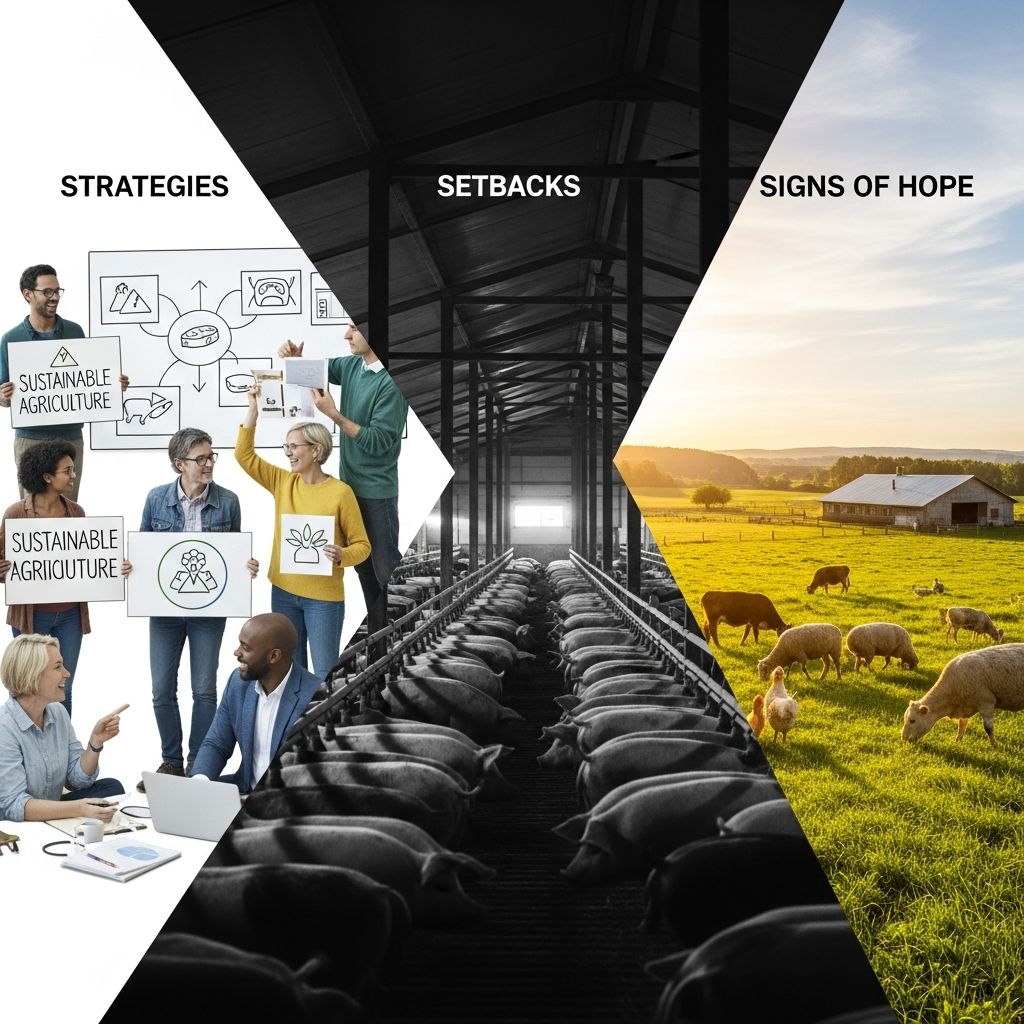
Factory farming inflicts suffering on tens of billions of animals each year, while also driving pollution, antimicrobial resistance, and risky pandemics. Yet the last two decades have seen remarkable progress in advocacy, policy, and technology aimed at transforming this system. Drawing inspiration from Lewis Bollard’s work and broader research, this article surveys the most promising levers for change and how individuals can meaningfully contribute.
The Scale and Nature of Factory-Farm Suffering
To understand why ending factory farming matters, it helps to grasp its scale and the specific harms it creates.
- Staggering numbers: More than 80–90 billion land animals are slaughtered annually worldwide for food, the vast majority in intensive systems.
- Confinement and deprivation: Many chickens, pigs, and fish are kept in crowded environments with little space to move, express natural behaviors, or avoid aggression.
- Painful procedures: Beak trimming, tail docking, and castration often occur without adequate pain relief.
- Health and disease risks: High stocking densities and poor ventilation facilitate respiratory disease, injuries, and chronic stress.
- Environmental burdens: Manure lagoons, greenhouse gas emissions, and water contamination disproportionately affect low-income and rural communities.
These harms are not inevitable consequences of eating; they are design features of a system optimized to minimize production costs rather than suffering.
Why Incremental Reform Still Matters
Some advocates worry that incremental reforms, such as banning cages or improving slaughter conditions, might entrench factory farming by making it appear more humane. Historical and empirical evidence, however, suggests that incremental wins often build momentum for deeper change.
- Reforms create legal precedents and political coalitions that can be expanded later.
- They increase production costs for the worst systems, making plant-based or higher-welfare options relatively more competitive.
- They normalize the idea that animals are moral patients whose suffering warrants legal attention, which can shift public attitudes.
An effective strategy rarely chooses between abolition and reform; it uses near-term reforms as stepping stones toward a fundamentally different food system.
Seven High-Leverage Strategies to Reduce Factory-Farm Suffering
Drawing on philanthropic and academic analysis, many experts converge on a set of especially promising interventions for reducing animal suffering at scale.
| Strategy | Primary Mechanism | Typical Time Horizon |
|---|---|---|
| Corporate welfare campaigns | Shift company policies away from the worst practices | Short to medium term |
| Legislation and litigation | Codify and enforce welfare standards | Medium to long term |
| Alternative proteins | Offer appealing non-animal substitutes | Medium to long term |
| Movement-building and global expansion | Grow advocacy capacity in neglected regions | Long term |
| Welfare-focused R&D and standards | Improve conditions where animals are still farmed | Short to medium term |
| Public awareness and norm change | Shift consumer and voter attitudes | Long term |
| Strategic philanthropy and careers | Channel talent and funding to high-impact work | All horizons |
1. Corporate Welfare Commitments
Corporate campaigns target major food companies—retailers, restaurants, and manufacturers—to adopt minimum welfare standards for animals in their supply chains.
Common reforms include:
- Cage-free egg commitments that eliminate battery cages for laying hens.
- Group housing for pigs instead of individual gestation crates.
- Broiler chicken standards that address stocking density, genetics, and environmental enrichment.
Because a small number of multinational firms control enormous supply chains, each successful commitment can directly improve conditions for millions of animals per year. Follow-up work is then required to monitor compliance and close loopholes.
2. Policy Reform, Ballot Initiatives, and Court Cases
Law and public policy can lock in welfare gains and expand them across regions.
- Ballot measures and referenda can set minimum space requirements or ban specific practices, such as extreme confinement or forced molting.
- National and regional regulations can align trade rules, mandate reporting, or require welfare audits.
- Litigation can defend existing laws against industry challenges or require agencies to enforce neglected statutes.
Policy victories are often hard-won, facing intense lobbying from agricultural interests, but they can catalyze change far beyond the jurisdiction that first acts.
3. Alternative Proteins and Food Innovation
Another path to ending factory farming is to make animal-free foods so attractive that they outcompete conventional meat and eggs.
- Plant-based meat and dairy offer familiar formats (e.g., burgers, nuggets, milks) with lower direct animal impact and, in many cases, lower greenhouse gas emissions.
- Cultivated meat (cell-based) seeks to grow animal flesh directly from cells rather than whole animals, though it remains at an early commercial stage.
- Fermentation-derived proteins use microbes to produce eggs, dairy, or fats with high efficiency.
Governments are beginning to fund R&D and create strategic plans for plant-based and cultivated foods, signaling a shift from niche products to core parts of food policy.
4. Building a Global Movement, Especially in Emerging Economies
Most current animal-welfare advocacy resources are concentrated in North America and Western Europe, while animal product consumption is growing fastest in Asia, Latin America, and parts of Africa.
High-impact work includes:
- Supporting local organizations in countries where industrial farming is expanding.
- Translating and adapting welfare standards for regional conditions and species mixes.
- Training advocates in campaign strategy, research, and communications.
Strengthening advocacy in these regions can prevent some of the worst practices from becoming entrenched as the default production model.
5. Welfare-Focused Research and Standards
Rigorous measurement of animal welfare is central to comparing interventions and prioritizing limited resources.
- Projects that quantify welfare across housing systems, breeds, and management practices help identify where reforms most reduce suffering.
- Scientific studies on pain, stress, and behavior among different species inform minimum standards and certification schemes.
- Welfare assessments also inform corporate scorecards and public accountability tools.
This evidence-based approach aligns with a broader trend in public policy toward impact evaluation and cost-effectiveness analysis.
6. Public Awareness and Cultural Norms
Surveys consistently show that many people oppose the worst abuses of factory farming, yet do not know how common those abuses are.
Key tactics include:
- Investigations and documentaries that reveal normally hidden conditions.
- Media coverage that connects animal welfare to public health, climate, and environmental justice.
- Behavioral nudges such as default-vegetarian catering or plant-forward menus in institutions.
Norm change is often slow and nonlinear, but over time it can redefine what consumers expect and what politicians consider acceptable policy.
7. Philanthropy and High-Impact Careers
Ending factory farming requires people and money. Directed well, both can have disproportionate impact.
- Strategic philanthropy supports evidence-based organizations, especially in neglected regions or research areas.
- Careers in advocacy span campaigning, policy, research, communications, and operations within NGOs and think tanks.
- Government, academia, and industry also offer roles where individuals can influence standards, regulations, and R&D priorities.
Career choice is particularly leveraged in emerging fields like alternative proteins, where early technical and policy expertise can shape entire sectors for decades.
How AI and Technology Could Reshape Factory Farming
Artificial intelligence and automation are expanding in livestock operations, offering both opportunities and serious risks.
Potential Benefits
- Welfare monitoring: Computer vision and sensors can detect injuries, lameness, or abnormal behaviors earlier than human observation alone.
- Precision feeding and ventilation: Data-driven systems can reduce hunger, thermal stress, and disease burden.
- Antibiotic stewardship: Improved disease detection and biosecurity may lower reliance on routine antibiotics, a major contributor to antimicrobial resistance.
Serious Risks
- Scaling cruelty: If welfare is not a design goal, AI tools may simply optimize for higher stocking densities and faster growth.
- Further opacity: Automated facilities could be even harder to access or document, deepening information asymmetries between corporations and the public.
- Lock-in effects: Large capital investments in AI-enabled intensive systems may slow transition to alternative models.
Advocates and regulators therefore face a double task: promoting technologies that genuinely improve welfare while resisting those that only increase production efficiency at animals’ expense.
Moral Weights and Prioritizing Across Species
Effective altruists and welfare researchers have attempted to compare the capacity for suffering and wellbeing across species to guide resource allocation.
Although estimates are uncertain, this work informs questions such as:
- How should we weigh fish or insects relative to mammals and birds in cost-effectiveness calculations?
- Do certain reforms, like reducing painful slaughter practices, have outsized benefits relative to their cost?
- When funding is limited, should we prioritize species with the largest numbers, the worst conditions, or the highest credence of sentience?
While moral weights cannot deliver precise answers, they encourage more transparent reasoning about difficult trade-offs and highlight neglected groups such as farmed fish or shrimps, which are produced in enormous quantities.
Interactions Between Climate Policy and Animal Welfare
Efforts to combat climate change and efforts to end factory farming often overlap but are not perfectly aligned.
- Synergies: Reducing beef and dairy consumption can significantly lower greenhouse gas emissions, land use, and deforestation.
- Trade-offs: Some climate policies might unintentionally encourage shifts from ruminants to intensively raised chickens or fish, which may worsen total animal suffering even as emissions fall.
- Joint framing: Highlighting benefits for animals, climate, and public health can broaden coalitions behind plant-based diets and alternative proteins.
Effective advocacy therefore seeks climate strategies that are both emissions-efficient and welfare-aware, rather than treating these goals as interchangeable.
Caring for Advocates: Emotional Sustainability
Working closely with severe, large-scale suffering can take a psychological toll.
Common challenges include:
- Chronic grief and anger from exposure to investigations and data on suffering.
- Burnout from long hours and a sense that progress is always too slow.
- Internal conflicts within movements that can sap morale.
Organizations and individuals are experimenting with:
- Peer support groups and mentoring.
- Clear boundaries around exposure to graphic material.
- Institutional policies that prioritize rest, reflection, and professional development.
Building a resilient movement means taking the wellbeing of advocates seriously, not as an afterthought but as a core strategic concern.
How You Can Help: Practical Steps for Individuals
No single action will end factory farming, but many small, strategic contributions can add up to major change.
1. Align Your Diet with Your Values
- Shift toward plant-based meals when possible.
- If consuming animal products, prefer higher-welfare options and avoid the worst systems, such as caged eggs or veal from confined calves.
- Use your choices to signal demand for plant-based and humane options in restaurants and supermarkets.
2. Support Effective Organizations
- Donate to evidence-based NGOs working on corporate campaigns, policy, or global movement-building.
- Consider recurring donations to give organizations more predictable budget planning.
- Stay informed about which groups are demonstrating clear, measurable impact.
3. Consider a High-Impact Career
Depending on your skills and interests, impactful paths might include:
- Campaigning, communications, or research roles at animal protection organizations.
- Scientific or engineering positions in alternative protein companies or research labs.
- Public service roles in agencies that regulate food, agriculture, or trade.
- Academic work in animal welfare science, economics, or ethics.
4. Use Your Voice
- Share reliable information about factory farming with friends, family, or on social media.
- Contact companies you buy from to ask about their welfare policies and implementation.
- Engage with policymakers through public consultations, hearings, and elections to prioritize animal welfare.
Frequently Asked Questions (FAQs)
Q1: Is ending factory farming realistic in my lifetime?
A: The complete elimination of factory farming is uncertain, but substantial reductions in suffering are realistically achievable within decades through reforms, alternative proteins, and changing norms. Historical shifts in other industries considered entrenched—such as certain forms of child labor—suggest large moral and institutional changes can occur faster than expected once momentum builds.
Q2: Does buying higher-welfare or organic meat really help?
A: Higher-welfare standards generally reduce some of the worst forms of confinement and may improve health and behavior outcomes, though they are not a complete solution. From a harm-reduction perspective, switching from products sourced from the most intensive systems to credible higher-welfare options can significantly reduce an individual’s contribution to suffering while broader reforms advance.
Q3: Aren’t plant-based alternatives highly processed and unhealthy?
A: Processed plant-based meats are not health foods by default, but many have favorable nutrient profiles compared with conventional meat—such as lower saturated fat and zero cholesterol—when consumed in moderation as part of a balanced diet. Whole-food plant proteins (like beans, lentils, and tofu) remain excellent low-processed options for those prioritizing health.
Q4: What about small family farms—are they part of the problem?
A: Small and pasture-based farms typically impose far less suffering per animal than intensive confinement systems, though practices vary widely. The central moral and strategic concern is industrial-scale systems that treat animals as interchangeable units, not necessarily all forms of animal agriculture. Many advocates see a transition toward plant-rich diets, alternative proteins, and genuinely high-welfare farming as complementary goals.
Q5: If governments acted responsibly, would advocacy still be necessary?
A: Yes. Democratic institutions frequently respond to organized interests with concentrated benefits, such as industry lobbies, rather than diffuse public concern. Advocacy, research, and public engagement are what shift political incentives and supply policymakers with specific, implementable reforms. Without continual civic pressure and evidence, welfare standards risk stagnation or rollback.
References
- Farm animal welfare: past, present and future — Donald M. Broom. 2014-01-01. https://doi.org/10.1080/00071668.2013.848367
- Antimicrobial resistance: global report on surveillance — World Health Organization. 2014-04-30. https://www.who.int/publications/i/item/9789241564748
- Livestock’s Long Shadow: Environmental Issues and Options — Food and Agriculture Organization of the United Nations. 2006-11-29. https://www.fao.org/3/a0701e/a0701e.pdf
- World Agriculture: Towards 2030/2050 – The 2012 Revision — Food and Agriculture Organization of the United Nations. 2012-06-01. https://www.fao.org/3/ap106e/ap106e.pdf

- Integrated M.A. in Applied Linguistics, University of Hyderabad
- 5+ years in editorial, instructional, SEO, and research-based writing
Sneha is a relationships and lifestyle writer with a strong foundation in applied linguistics and certified training in relationship coaching. She brings over five years of writing experience to theskillvault, crafting thoughtful, research-driven content that empowers readers to build healthier relationships, boost emotional well-being, and embrace holistic living. Her writing and insights reflect the belief that beauty, happiness, and wellness…