
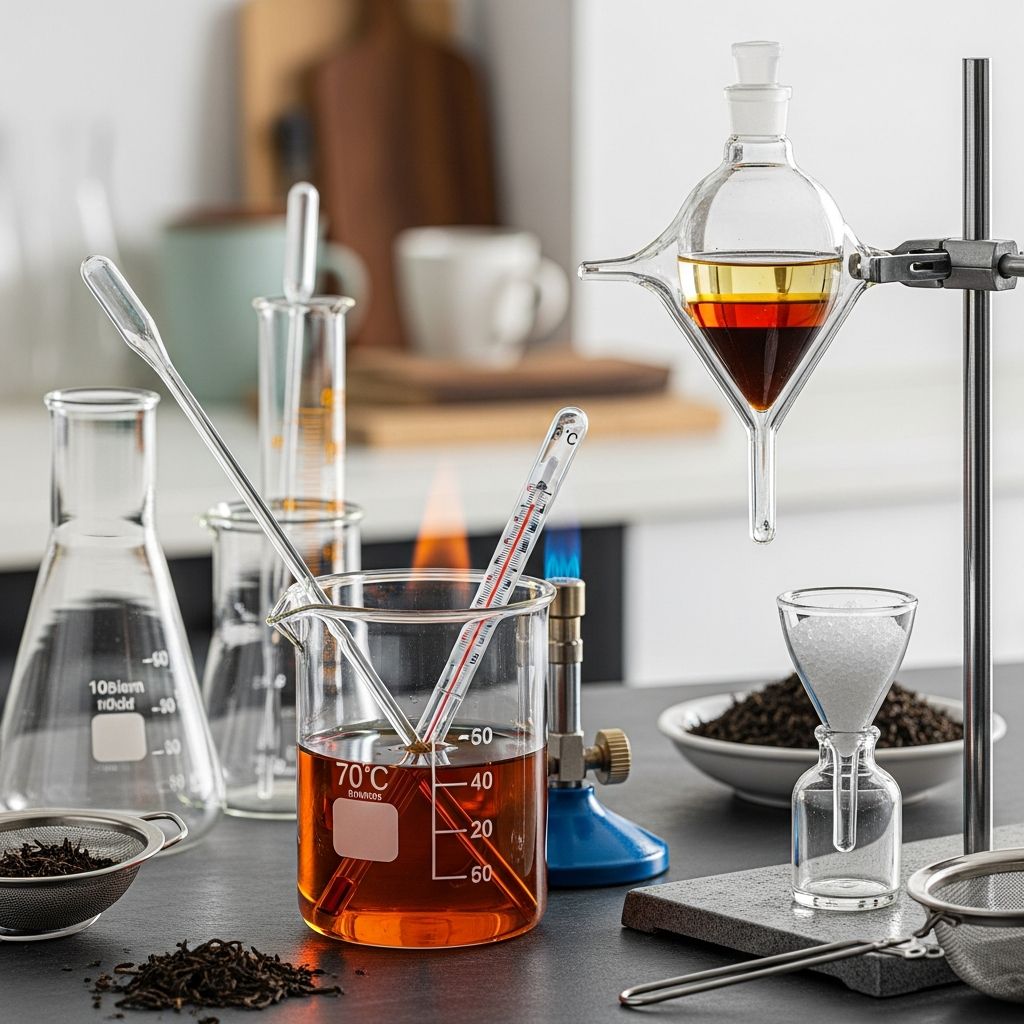
Caffeine, a natural stimulant found in tea leaves, can be isolated using straightforward chemical extraction techniques suitable for home or classroom settings. This process leverages solubility differences to separate caffeine from other tea components like tannins.
The Science Behind Caffeine Isolation
Caffeine (C8H10N4O2) is an alkaloid that dissolves readily in hot water but prefers organic solvents like dichloromethane (DCM) over water due to its moderate polarity. Tea leaves contain 2-5% caffeine by dry weight, alongside tannins, flavonoids, and catechins that must be removed for pure isolation.
The extraction relies on solid-liquid extraction to dissolve caffeine into aqueous solution, followed by liquid-liquid extraction using an immiscible solvent. Sodium carbonate neutralizes acidic tannins, converting them to water-soluble salts and preventing their co-extraction.
Gathering Materials and Equipment
Before starting, assemble these essentials:
- 5-6 tea bags (black tea yields ~50-100mg caffeine total)
- 200-300mL distilled water
- 10g sodium carbonate (washing soda)
- 45-60mL dichloromethane (DCM) or alternative solvent
- Anhydrous calcium chloride or magnesium sulfate (drying agent)
- 95% ethanol for recrystallization
- Beakers, separatory funnel, filter paper, hot plate, vacuum filtration setup
Safety note: DCM is volatile and a suspected carcinogen; work in a fume hood or well-ventilated area. Wear gloves, goggles, and avoid skin contact.
Step-by-Step Extraction Procedure
Phase 1: Preparing the Tea Infusion
Boil 200mL water in a beaker. Add 5-6 tea bags and 5-6g sodium carbonate. Simmer for 10-15 minutes, stirring occasionally. The base deprotonates tannins (pKa ~10), forming soluble sodium tannates.
Squeeze tea bags to maximize yield, then cool to room temperature. Filter through vacuum or gravity filtration to remove solids. This crude extract contains caffeine, salts, and residual tannins.
Phase 2: Solvent Extraction
Transfer the cooled extract (~150mL) to a separatory funnel. Add 15mL DCM and shake gently for 2 minutes, venting frequently to release pressure. Allow layers to separate: DCM (denser) forms the bottom layer, pulling caffeine due to its higher solubility (140mg/mL in DCM vs. 20mg/mL in water at 25°C).
Drain the DCM layer into a clean flask. Repeat extraction twice more with fresh 15mL DCM portions, combining organic layers. This achieves >90% caffeine recovery.
Phase 3: Drying and Concentration
Add anhydrous calcium chloride to the combined DCM extracts (~45mL). Swirl until clear (dries by absorbing water). Filter into a round-bottom flask.
Evaporate DCM using a rotary evaporator or gentle heating in a fume hood (boiling point 40°C). Residue is crude caffeine, a yellowish oil or powder (~50mg expected).
Purifying Crude Caffeine
Crude product contains impurities like chlorophyll and oils. Dissolve in minimal hot 95% ethanol (~1mL), then cool in an ice bath to recrystallize. White needles form as caffeine precipitates (melting point 238°C).
Vacuum filter crystals, wash with ice-cold ethanol, and air-dry. Yield: 30-60mg pure caffeine (60-80% recovery from crude).
Yield Optimization Table
| Factor | Effect on Yield | Optimization Tip |
|---|---|---|
| Tea Quality | Black tea > Green tea | Use fresh, high-caffeine brands |
| Boil Time | 10-15 min optimal | Avoid over-boiling (degrades caffeine) |
| Extractions | 3x DCM best | More passes increase recovery |
| Drying Agent | CaCl2 superior | Pre-dry to prevent clumping |
Safety Protocols and Precautions
Key risks include DCM inhalation (TLV 50ppm), flammability, and base splashes. Neutralize wastes: aqueous with acid, organic via evaporation and charcoal. Dispose per local regulations. Not for consumption—lab-grade only.
- Perform extractions in fume hood
- No open flames near solvents
- Label all containers
- Have spill kit and eyewash nearby
Advanced Variations and Alternatives
For safer home demos, use supercritical CO2 (industrial method) or water-only decaffeination, though yields drop. Acid-base extraction isolates caffeine as freebase: protonate with HCl, extract tannins, basify, then solvent pull.
Soxhlet extraction for exhaustive recovery: cycle hot solvent through tea leaves for hours. Yields up to 95% but requires specialized glassware.
Applications of Extracted Caffeine
Pure caffeine demonstrates alkaloid chemistry, stimulants’ effects (blocks adenosine receptors), and extraction principles used in pharma (e.g., analgesics). Compare purity via TLC or melting point.
Frequently Asked Questions (FAQs)
What is the expected yield from 6 tea bags?
Around 50-100mg crude, 30-70mg pure, depending on tea quality and technique.
Can I use acetone instead of DCM?
Acetone is miscible with water, reducing selectivity. DCM is ideal for partitioning.
Is this safe for school projects?
Yes, with supervision, ventilation, and gloves. Skip DCM for younger students; use demos only.
How do I confirm it’s caffeine?
Melting point 235-238°C; white, odorless crystals soluble in chloroform.
Why add sodium carbonate?
To salt out tannins, keeping them aqueous while caffeine favors organic phase.
Troubleshooting Common Issues
- Emulsion formation: Add brine (sat. NaCl) to break
- Low yield: Ensure full extraction cycles, dry thoroughly
- Green impurities: Extra petroleum ether wash pre-recrystallization
- No crystals: Seed with pure caffeine or scratch flask
References
- Extraction of Caffeine — ARC Journals. 2019-09-01. https://www.arcjournals.org/pdfs/ijarcs/v6-i9/2.pdf
- How to extract Caffeine from Tea (Classic DCM Method) — NileRed (YouTube). 2015-01-15. https://www.youtube.com/watch?v=RIbff5iD0GQ
- DIY: Taking the Caffeine Out of Tea — The Open University. 2023-06-12. https://www.open.edu/openlearn/science-maths-technology/science/chemistry/diy-taking-the-caffeine-out-tea
- Extraction of Caffeine From Tea Leaves — Chemistry LibreTexts (Bennington College). 2022-08-20. https://chem.libretexts.org/Courses/Bennington_College/Chemistry_-_An_Integrated_Approach_(Bullock)/Chapter_9:_Laboratory_Exercises/Extraction_of_Caffeine_From_Tea_Leaves
- Isolation of Natural Caffeine From Lipton Black Tea — IOMCWorld. 2021-03-15. https://www.iomcworld.com/open-access/isolation-of-natural-caffeine-from-lipton-black-tea-through-acidbaseliquidliquid-extraction-approach-its-medical-signifi.pdf

- Integrated M.A. in Applied Linguistics, University of Hyderabad
- 5+ years in editorial, instructional, SEO, and research-based writing
Sneha is a relationships and lifestyle writer with a strong foundation in applied linguistics and certified training in relationship coaching. She brings over five years of writing experience to theskillvault, crafting thoughtful, research-driven content that empowers readers to build healthier relationships, boost emotional well-being, and embrace holistic living. Her writing and insights reflect the belief that beauty, happiness, and wellness…