
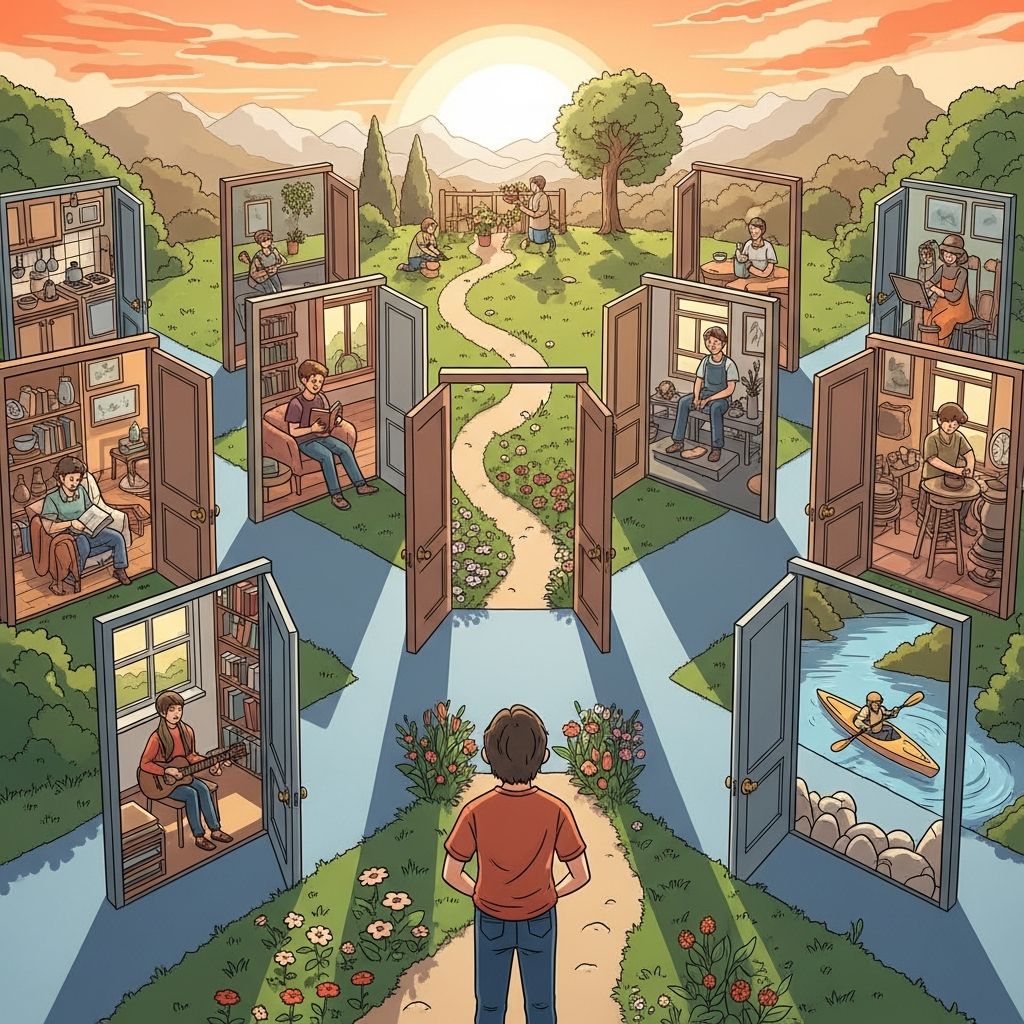
Finding a hobby as an adult can feel oddly difficult. Work, family, and responsibilities take up most of your time, and when you finally get a break, you may not know what you actually enjoy anymore. This guide walks you through a clear, research-informed process to uncover hobbies that fit your personality, schedule, and long-term well-being.
Why Hobbies Matter More Than You Think
Before you start searching for a new interest, it helps to understand why hobbies are worth protecting space for in your life. Far from being a luxury, meaningful leisure activities are closely tied to your mental and physical health.
- Better mental well-being: Research across more than 90,000 older adults in 16 countries found that people with hobbies report higher health, happiness, and life satisfaction, and fewer symptoms of depression.
- Lower stress: Studies show that enjoyable activities, including creative and artistic hobbies, can reduce cortisol, the body’s stress hormone, and create a sense of relaxation and pleasure.
- Improved overall health: Regular engagement in leisure activities supports the immune, endocrine, and nervous systems and is linked to lower risk of heart disease, stroke, and some chronic conditions.
- Greater life satisfaction and resilience: A scoping review of hobby research found that hobbies can increase happiness, build resilience, enhance self-esteem, and improve social relationships.
In short, a well-chosen hobby is more than a pastime. It is a protective factor for your mind, body, and relationships.
Step 1: Define What You Want Your Hobby to Do for You
You will have an easier time choosing a sustainable hobby if you first decide what role you want it to play in your life. Different goals will point you toward different types of activities.
Clarify your main intention
Ask yourself which of these outcomes feels most important right now:
- Stress relief and relaxation (you feel wired, anxious, or burnt out)
- Social connection (you feel lonely or want to meet new people)
- Physical health (you want more movement but hate the gym)
- Creativity and self-expression (you feel stuck or uninspired)
- Skill building and challenge (you miss learning or growth)
Research suggests that engaging regularly in enjoyable leisure activities is associated with better psychological functioning, including more positive mood and less stress. Being intentional about why you are picking a hobby helps you choose something that truly supports your well-being instead of just filling time.
Match goals to hobby types (Quick guide)
| Primary Goal | Helpful Hobby Features | Example Directions to Explore |
|---|---|---|
| Reduce stress | Low pressure, repetitive, soothing, no strict deadlines | Drawing, knitting, casual gaming, gardening, leisurely walking |
| Meet people | Group-based, classes, clubs, team activities | Community choir, recreational sports, book clubs, cooking classes |
| Improve fitness | Rhythmic movement, scalable intensity, enjoyable setting | Dancing, hiking, cycling, martial arts, swimming |
| Boost creativity | Open-ended, experimental, expressive | Painting, creative writing, photography, music, crafts |
| Challenge your mind | Problem-solving, learning curve, mastery over time | Languages, chess, coding, woodworking, instrument practice |
Step 2: Audit Your Life for Clues About Your Interests
Instead of starting from a blank page, mine your existing life for hints about what you already enjoy or are naturally curious about.
Look backward: What did you once love?
Think back to childhood, adolescence, or earlier phases of your adult life. Often, your younger self experimented more freely.
- What did you do for fun when no one was telling you what to do?
- Which school subjects, clubs, or activities did you genuinely look forward to?
- Were you drawn toward more active, artistic, social, or solitary pursuits?
These memories do not need to translate directly into the same activities today; they simply highlight patterns. For example, if you loved building things, you might enjoy woodworking or DIY projects now. If you devoured novels, you might like a book club or creative writing.
Look at your present: Where does your attention naturally go?
Notice what you gravitate toward in your spare moments:
- What topics dominate your search history or your saved videos?
- What kinds of articles or podcasts do you consume without forcing yourself?
- When friends talk about their interests, which ones make you feel a spark of curiosity or envy?
That spontaneous curiosity is a strong indicator that a related hobby could feel rewarding and sustainable.
Step 3: Factor In Your Energy, Budget, and Environment
A good hobby is not just interesting; it is also realistic for your current life. Considering constraints early prevents you from choosing something you cannot maintain.
Energy and personality fit
Ask yourself:
- Do you feel drained or energized after being around people?
- Do you recharge through quiet time or through shared experiences?
- Are you currently more mentally exhausted or physically restless?
If work already demands constant social interaction, you may enjoy a hobby that gives you solitude and autonomy. If you feel isolated, a group-based activity can address loneliness and improve mood, as social contact is linked to better mental health outcomes.
Time and money realities
Map out what is feasible right now:
- Time: How many hours per week can you realistically dedicate? 30 minutes counts.
- Budget: Do you need something mostly free, or can you invest in gear, lessons, or memberships?
- Location: Are there local classes, parks, or community centers you can access easily?
Many low-cost or free options exist: library programs, community sports leagues, local hobby groups, and online tutorials. Even brief, low-cost activities can meaningfully improve well-being when done regularly.
Step 4: Experiment With Low-Commitment “Mini Trials”
Instead of trying to mentally pick the perfect hobby, treat this like a series of small experiments. Your goal is data, not immediate passion.
Design 30–60 minute trials
Choose two to four potential activities and give each a short, low-pressure test run. For each one, answer three questions afterward:
- How did I feel before and after? More relaxed, more energized, more connected?
- Did time pass quickly or slowly? Enjoyable hobbies often create a sense of absorption.
- Would I willingly do this again next week? Not for productivity, but for its own sake.
Psychologists call this absorbed, enjoyable state flow, and it is linked to increased well-being and life satisfaction. Your trial activities do not need to be perfect; you are just looking for hints of that feeling.
Examples of mini trials
- Attend a one-time drop-in fitness or dance class.
- Try a beginner tutorial for drawing, coding, or music online.
- Borrow a “how-to” book from the library and attempt one small project.
- Join a friend for their favorite hobby and simply observe or lightly participate.
This approach keeps stakes low while giving you real-world feedback about what you enjoy, rather than relying only on imagination.
Step 5: Choose One Hobby to Nurture for 30 Days
After a few experiments, pick one activity that felt promising rather than trying to pursue many at once. Commitment, not variety, is what teaches you whether something can grow into a genuine passion.
Set tiny, clear commitments
For the first month, keep your hobby goals intentionally small. For example:
- “I will spend 20 minutes, three times a week, practicing guitar.”
- “I will go for a 30-minute walk in nature twice per week.”
- “I will attend my local pottery studio every Saturday morning.”
Research indicates that even short, regular engagement in enjoyable activities can improve mood and reduce perceived stress. Consistency matters more than intensity at this stage.
Track how it is affecting you
Once a week, briefly note:
- Your stress levels before and after the activity
- Any changes in sleep, focus, or mood over the week
- Whether you feel more connected, confident, or energized
Hobbies that support mental health often help you feel calmer and more fulfilled in everyday life, not just during the activity itself.
Step 6: Adjust the Difficulty So It Stays Enjoyable
A hobby will only become a long-term part of your life if it remains both engaging and manageable. Too easy, and you get bored; too hard, and you give up.
Watch for two common traps
- Perfectionism: You expect fast progress and feel discouraged when you are not immediately “good” at it.
- Overloading: You sign up for intensive classes or buy expensive gear before you know if the hobby fits.
Hobbies are one area where it is especially valuable to allow yourself to be a beginner. Research on resilience suggests that struggling through new challenges and persisting can build confidence that spills over into other areas of life.
Use the “right level of challenge” rule
Adjust your activity so that it feels:
- A little bit challenging (you have to pay attention and try)
- But not overwhelming (you still feel capable of making progress)
If you are consistently frustrated, scale down: try easier pieces, shorter sessions, or more guidance. If you are bored, increase the challenge slightly with new skills, longer projects, or group participation.
Step 7: Add Social and Environmental Boosters
Once you know you like an activity, enhancing the context around it can dramatically increase both enjoyment and health benefits.
Consider the social dimension
Hobbies that involve other people can improve social support, reduce loneliness, and enhance life satisfaction. You can:
- Join a local club, class, or online community related to your hobby.
- Invite a friend, partner, or colleague to join you occasionally.
- Attend meetups, workshops, or events to connect with others who share your interest.
Leverage nature and environment
Spending time outdoors has been linked to improved mood and reduced stress, and as little as two hours per week in nature can provide meaningful benefits. If possible, you can:
- Take your practice outside (sketching in a park, reading under a tree, walking trails).
- Pick hobbies that naturally involve green spaces, such as gardening or hiking.
- Use calming physical spaces at home for indoor hobbies: good lighting, comfortable seating, minimal distractions.
Step 8: Let Your Hobby Evolve Over Time
Your first choice does not need to be your “forever” passion. Interests evolve as your life circumstances, energy, and priorities change. What matters is maintaining a habit of intentional leisure.
Know when to pivot
It may be time to adjust or switch your hobby if:
- You consistently dread doing it, even after adjusting the difficulty.
- It begins to feel like unpaid work rather than something you choose.
- It harms your sleep, finances, or relationships.
Research shows that engaging in a variety of enjoyable activities is linked to better psychological and physical functioning. Exploring new hobbies over time is not a failure; it is part of a healthy, adaptive lifestyle.
Examples of Hobbies by Personality and Goal
If you are still unsure where to begin, use this list as a starting point. Mix and match based on your energy level, social needs, and priorities.
If you are mostly introverted and mentally tired
- Gentle crafts: knitting, origami, hand-lettering
- Solo creative work: journaling, digital art, photography
- Relaxed learning: language apps, online courses taken at your own pace
If you crave movement and fresh air
- Walking or running clubs
- Hiking, nature photography, birdwatching
- Cycling or recreational sports in local leagues
If you want more connection and community
- Book clubs or film discussion groups at your library
- Community choirs, bands, or theater groups
- Volunteer-based activities: mentoring, environmental cleanups, community gardens
If you want to challenge your brain
- Strategy games or puzzles (chess, sudoku, board games)
- Coding, electronics, or robotics tinkering
- Learning an instrument, advanced cooking, or complex crafts
Frequently Asked Questions (FAQs)
Q: How many hobbies should I have?
You do not need a specific number. Research suggests that having leisure activities you enjoy is beneficial, and having more than one can add variety and support different aspects of health. Start with one you can maintain consistently, then add others if you have the time and energy.
Q: What if I do not feel passionate about anything yet?
Passion often develops after spending time on an activity, not before. Focus on mild curiosity rather than instant excitement. Use short experiments to see what feels interesting or calming, then give one activity 30 days of consistent, low-pressure practice.
Q: Can watching TV or scrolling social media count as a hobby?
Passive entertainment can be relaxing in moderation, but research on hobbies typically focuses on more active, engaged pursuits that involve learning, creativity, socializing, or movement. Try balancing passive downtime with at least one activity that asks you to participate rather than just consume.
Q: I have very little free time. Is a hobby still realistic?
Yes. Even brief, regular engagement in enjoyable activities can reduce stress and improve mood. Start with 10–20 minutes once or twice a week. Choose hobbies that fit naturally into your existing routines, such as walking during lunch, sketching for a few minutes in the evening, or reading before bed.
Q: Should my hobby make money or advance my career?
A hobby does not need to be productive or profitable to be valuable. In fact, research highlights the mental health benefits of activities done purely for enjoyment and relaxation. If turning a hobby into a side job adds pressure and reduces joy, it may undermine the very benefits you are seeking.
References
- Health Benefits of Hobbies — WebMD. 2022-03-18. https://www.webmd.com/balance/health-benefits-of-hobbies
- 5 reasons you should pick up a new hobby — Baylor Scott & White Health. 2021-07-07. https://www.bswhealth.com/blog/5-reasons-you-should-pick-up-a-new-hobby
- 3 proven health benefits of having a hobby — UCLA Health. 2023-09-15. https://www.uclahealth.org/news/article/3-proven-health-benefits-having-hobby
- Exploring the Impact of Hobbies on Mental Health and Well-Being — Psychiatric Quarterly (Taylor & Francis). 2025-01-02. https://www.tandfonline.com/doi/full/10.1080/01612840.2025.2512006
- Association of Enjoyable Leisure Activities With Psychological and Physical Well-Being — Psychosomatic Medicine (PMC). 2010-05-01. https://www.ncbi.nlm.nih.gov/pmc/articles/PMC2863117/
- What Are the Benefits of Hobbies? — Healthline. 2021-06-18. https://www.healthline.com/health/5-benefits-of-hobbies

Medha Deb is an editor with a master's degree in Applied Linguistics from the University of Hyderabad. She believes that her qualification has helped her develop a deep understanding of language and its application in various contexts. Medha specializes in the areas of beauty, health, sports, and wellness and is committed to ensuring that the content on the website is…