
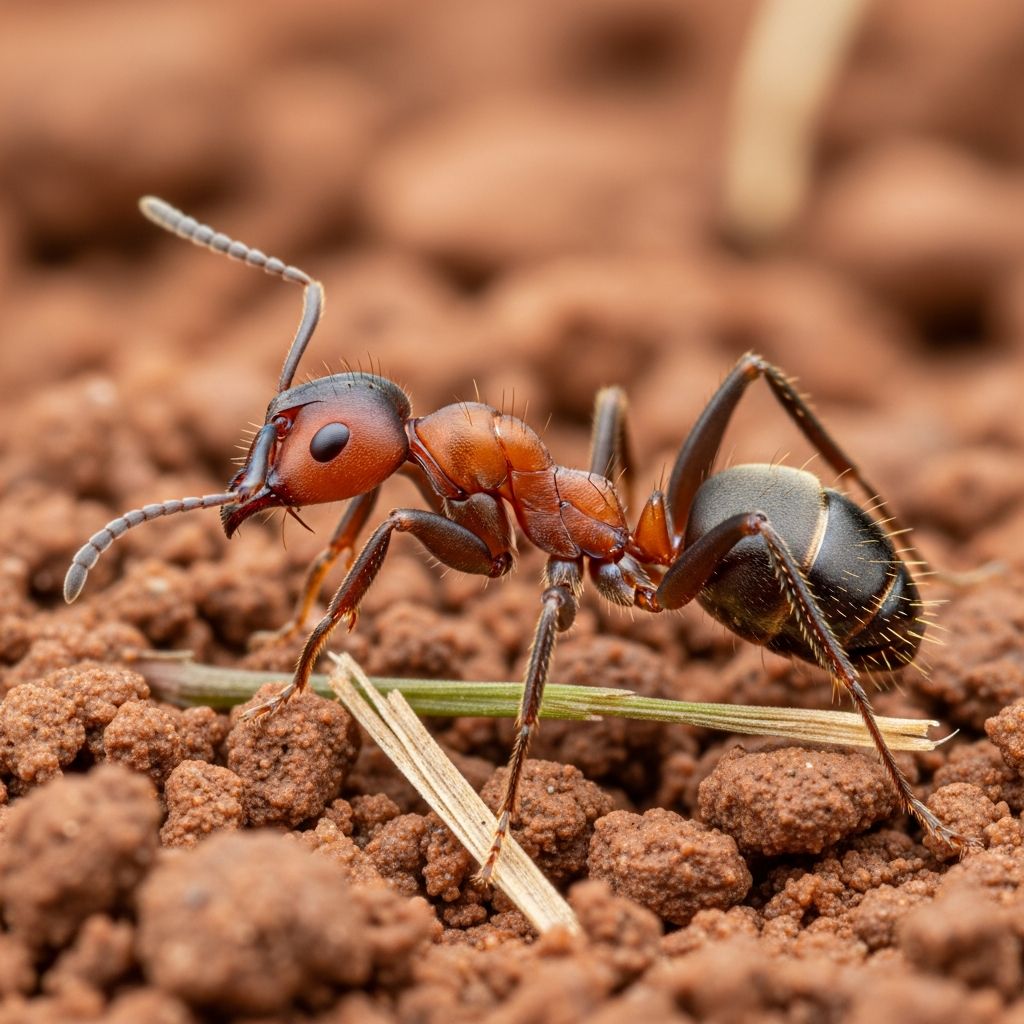
Fire ants represent a significant challenge in many regions, particularly due to their invasive nature and aggressive defense mechanisms. Recognizing them early allows for timely intervention to safeguard people, pets, and landscapes. This guide draws on established characteristics to help distinguish fire ants from similar species.
Physical Characteristics of Fire Ants
Fire ants exhibit distinct features that set them apart from other ant varieties. Workers display polymorphism, meaning they vary greatly in size from about 1/16 to 1/4 inch long, unlike many ants that maintain uniform dimensions.
The body typically features a reddish-brown head and thorax transitioning to a darker black abdomen, though slight color variations occur. Males, known as swarmers, appear entirely black. A key identifier is the two-segmented pedicel, resembling twin bumps on the waist between thorax and abdomen, paired with a spine-free thorax and antennae comprising 10 segments ending in a two-segmented club.
Equipped with powerful mandibles for biting and a venomous stinger, these ants deliver a potent defense. The venom induces a burning sensation, leading to characteristic pustules.
- Size variation: 1/16–1/4 inch (polymorphic workers)
- Color: Reddish-brown head/thorax, black gaster
- Waist: Two prominent nodes
- Antennae: 10 segments + 2-segmented club
- Stinger: Present for venom injection
Types of Fire Ants and Their Variations
Several fire ant species pose threats, with the red imported fire ant (RIFA, Solenopsis invicta) being the most prevalent invasive type in the U.S., originating from South America in the 1930s. Black imported fire ants (BIFA, Solenopsis richteri) and hybrids also exist, sharing core traits like the two-segmented waist and 10-segmented antennae.
Color differences aid preliminary ID: RIFA shows a dark gaster against lighter red body parts; BIFA has a darker form with a golden gaster patch outlined sharply; hybrids blur these lines. Workers progress from small minims to larger majors as colonies mature.
| Type | Color Pattern | Key Notes |
|---|---|---|
| Red Imported (RIFA) | Reddish-brown head/thorax, black abdomen | Most aggressive invasive; U.S. dominant |
| Black Imported (BIFA) | Darker body, golden gaster patch | Less common; similar traits |
| Hybrid (HIFA) | Hazy gaster patch | Requires lab confirmation |
Recognizing Fire Ant Nests and Mounds
Distinct mound structures often provide the first clue to fire ant presence. These ground-nesters construct fluffy, dome-shaped piles of soil, typically lacking a central entry hole—ants access via underground tunnels.
Mounds favor sunny, open spots like lawns, pastures, fields, and edges of driveways or sidewalks that retain heat. Sizes range from a few inches in turf to 18 inches tall in undisturbed areas, expanding post-rain. Inside, white brood (eggs, larvae, pupae) appears when dug into.
- Open, sunny soils preferred
- Dome or flat disturbed patches
- No visible central opening
- Common near heat-retaining structures
Behavioral Traits and Activity Patterns
Fire ants thrive in warm conditions, peaking active between 65°F and 90°F, and shun extreme heat, darkness, or shade. Aggression defines them: disturbing a mound prompts hundreds of workers to swarm vertically up grass or objects, biting and stinging repeatedly.
Colonies house thousands to hundreds of thousands, with queens potentially spawning satellites nearby if undisturbed. They favor vibrations, attacking footsteps near nests.
Health and Property Risks from Fire Ants
Bites start with a mandible grip, followed by stings causing intense burning and itchy pustules lasting days—unique to their venom. Risks escalate for allergic individuals, pets, livestock, and children; rare fatalities occur.
Property damage includes unsightly, equipment-hazardous mounds thinning turf, plus crop threats from related species like harvesters.
Distinguishing Fire Ants from Similar Species
Confusion arises with uniform-sized red ants, harvester ants (seed-eaters with small mounds), big-headed ants (oversized heads under debris), or Argentine ants (multi-queen swarms). Fire ants uniquely swarm aggressively upward and form pustules.
| Feature | Fire Ants | Look-Alikes |
|---|---|---|
| Size | Variable (polymorphic) | Uniform |
| Mound Opening | None (tunnels) | Central hole often |
| Response to Disturbance | Aggressive vertical swarm | Less aggressive |
| Sting Effect | Burning pustule | Painful but no pustule |
Common Habitats and Spread Patterns
Infesting roughly one-fourth of the U.S., fire ants target residential lawns, garden beds, utility pits, roadsides, and croplands. Nests adapt: dome in moist soil, flat in dry. Spread via queens starting new colonies nearby.
Steps for Confirming Fire Ant Presence
1. Locate fluffy mounds post-rain.
2. Disturb gently; watch for reddish swarms climbing vertically.
3. Check for size variation and two-node waist (magnifier helpful).
4. Note sting pustules if bitten.
5. Consult extension services for unsure cases.
Frequently Asked Questions (FAQs)
Are all red ants fire ants?
No, fire ants have specific traits like polymorphism and two-waist nodes; many red ants lack these.
What do fire ant mounds look like?
Fluffy, dome-shaped without central holes, in sunny spots; tunnels provide access.
How painful are fire ant stings?
Very—burning pain leads to white pustules lasting a week; seek medical help if severe.
Where do fire ants nest most often?
Lawns, pastures, driveways, and open fields; prefer sun and heat.
Can fire ants be in shaded areas?
Rarely; they avoid shade and thrive in 65–90°F open sunlight.
Prevention Tips for Fire Ant Infestations
Maintain vigilant yard inspections, especially after rains. Avoid disturbing mounds casually. Professional assessments aid in large areas. Early detection curtails spread.
References
- How to Identify and Control Fire Ants — Scotts Miracle-Gro. 2023. https://scottsmiraclegro.com/en-us/learn/home-patio/how-to-identify-control-fire-ants.html
- Identify and Control Fire Ants — GardenTech. 2023. https://www.gardentech.com/insects/fire-ants
- What Do Fire Ants Look Like? | How to Identify Fire Ants — Orkin. 2023. https://www.orkin.com/pests/ants/fire-ants/fire-ant-identification-what-does-a-fire-ant-look-like
- How can I tell if I have fire ants? — Texas A&M AgriLife Extension (fireant.tamu.edu). 2024-01-15. https://fireant.tamu.edu/manage/how-can-i-tell-if-i-have-fire-ants/
- Identification | Fire Ants in Tennessee — University of Tennessee (fireants.tennessee.edu). 2023. https://fireants.tennessee.edu/about-fire-ants/identification/
- How to identify fire ants and nests — Fire Ants Australia (official gov site). 2024. https://www.fireants.org.au/look/nests

Medha Deb is an editor with a master's degree in Applied Linguistics from the University of Hyderabad. She believes that her qualification has helped her develop a deep understanding of language and its application in various contexts. Medha specializes in the areas of beauty, health, sports, and wellness and is committed to ensuring that the content on the website is…