
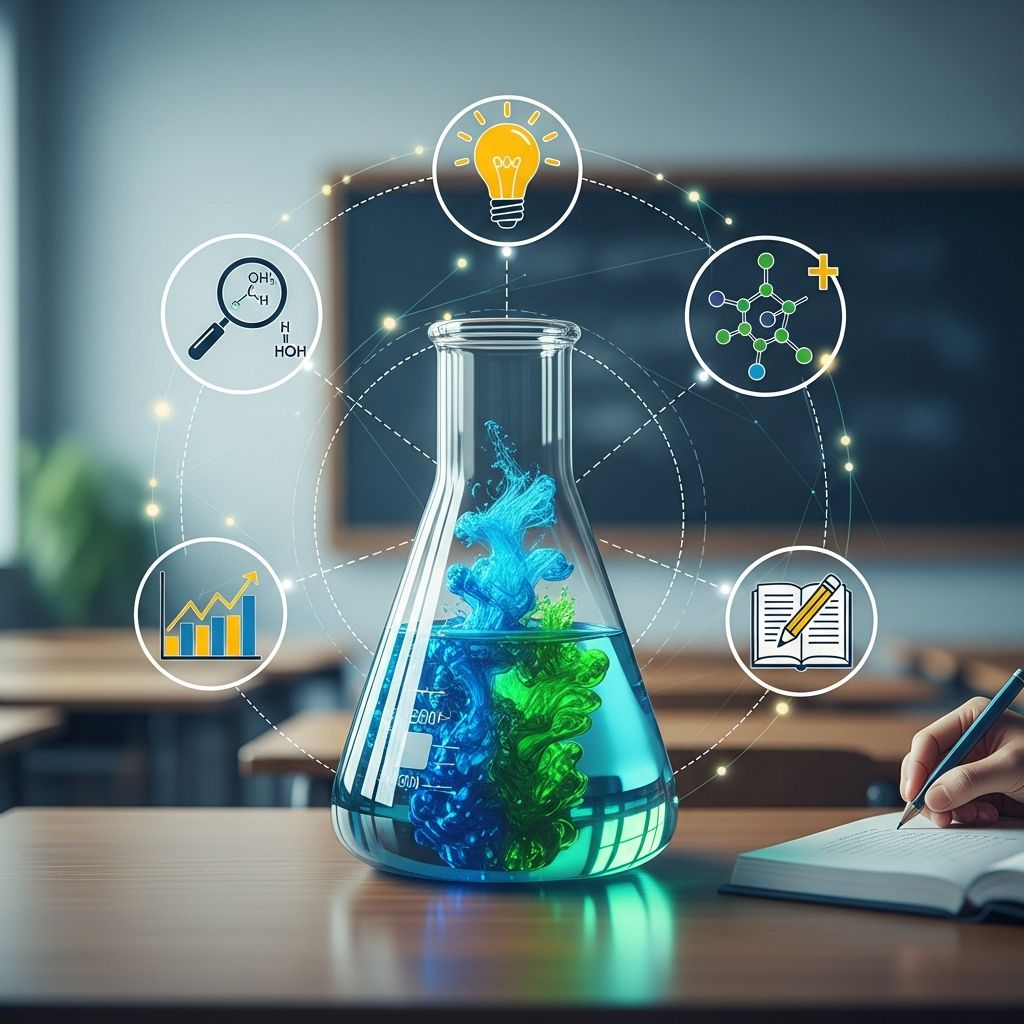
Chemistry often challenges students due to its blend of abstract theory, mathematical problem-solving, and hands-on experimentation. If your grades are slipping, recognize that recovery is possible with targeted adjustments to your approach. This article outlines a comprehensive roadmap, drawing from proven academic strategies to rebuild your foundation, enhance retention, and foster a growth mindset for sustained improvement.
Assess Your Current Situation Honestly
The first step in reversing poor performance is a candid self-evaluation. Identify specific pain points: Are you missing foundational knowledge from prerequisites like algebra or basic physics? Do exams reveal weaknesses in calculations, conceptual understanding, or application? Track your recent quiz and test scores to pinpoint patterns, such as consistent errors in stoichiometry or confusion with equilibrium principles.
Review your syllabus and past assignments. Note attendance records, homework completion rates, and lab participation. Poor attendance correlates strongly with lower grades, as lectures build sequentially on prior material. Create a simple table to log these insights:
| Area | Performance (1-10) | Specific Issues | Action Plan |
|---|---|---|---|
| Conceptual Knowledge | 4 | Struggling with bonding theories | Review textbook chapters 5-7 daily |
| Problem-Solving | 3 | Unit conversion errors | Practice 20 problems/week |
| Lab Skills | 6 | Inaccurate measurements | Attend extra lab sessions |
| Exam Prep | 2 | Time management | Simulate timed tests |
This diagnostic table empowers you to prioritize efforts where they matter most, transforming vague frustration into a clear path forward.
Master the Fundamentals Before Advancing
Chemistry’s layered nature means gaps in basics amplify later difficulties. Prioritize core concepts like atomic structure, periodic trends, chemical bonding, stoichiometry, thermodynamics, and equilibrium—these underpin nearly every topic. Dedicate initial recovery time to these, using university resources like practice problem sets from chemistry departments.
Break down the periodic table into manageable groups: start with alkali metals, halogens, and noble gases. Employ mnemonics or apps for memorization, aiming for proficiency in predicting reactivity and properties. For math integration, ensure fluency in algebra, ratios, unit conversions, and graphing, as these are non-negotiable for quantitative problems. If rusty, allocate 30 minutes daily to targeted drills until operations feel intuitive.
Implement Active and Spaced Study Techniques
Passive reading yields minimal retention; chemistry demands active engagement. Space study sessions over days rather than cramming—daily one-hour blocks outperform marathon sessions. Before lectures, preview readings and warm-up problems to prime your brain for key ideas.
During study time:
- Take detailed notes, rewriting them post-lecture to reinforce understanding.
- Create flashcards for definitions, reactions, nomenclature, and structures—writing cements memory equivalent to multiple readings.
- Solve problems extensively: aim for every textbook exercise, plus online supplements. If stuck beyond 15 minutes, consult the index before help.
- Teach concepts aloud or to a peer; mastery means explaining to others.
Connect topics: How does this week’s kinetics relate to prior equilibrium? Visualizing the ‘big picture’ prevents siloed learning. Apply principles to daily life, like calculating pool pH or baking reactions, to build intuition.
Optimize Your Daily Routine for Peak Performance
Success hinges on habits beyond studying. Attend every lecture and lab—absences compound missed context. Prioritize sleep; fatigue impairs problem-solving more than partial wakefulness. Maintain a positive attitude: view challenges as growth opportunities, not threats.
Organize materials meticulously: color-code notes by topic, maintain a dedicated binder, and use digital tools for tracking deadlines. Form study groups of 3-4 peers for collaborative problem-solving—discussing independently then collectively uncovers blind spots. Select groups with complementary strengths, meeting 2-3 times weekly.
Track progress weekly via self-quizzes. If midterm grades lag, consider tutoring or dropping if recovery seems untenable, but persevere with a plan.
Excel in Laboratory Work and Hands-On Learning
Labs bridge theory and practice, yet many falter here due to inexperience. Approach experiments as discovery: hypothesize, observe, analyze errors without self-judgment. Master techniques like pipetting, titration, and spectroscopy through repetition.
Post-lab, reflect: What went awry? How does this validate classroom kinetics? Labs enhance 3D thinking for molecular geometry. If possible, volunteer for extra sessions to build confidence. High lab scores buffer weaker lecture grades, proving holistic competence.
Leverage Support Networks and Resources
Don’t isolate—seek help proactively. Visit instructors during office hours for concept clarification or big-picture guidance. Professors appreciate motivated students and offer tailored advice.
Utilize tutoring centers, study guides, and peer mentors. Academic success centers provide chemistry-specific workshops. Explore online databases, molecular modeling software, and university email lists for resources. Build faculty relationships for research opportunities, enriching resumes.
For internships, pursue summer placements post-recovery; they contextualize academics and open career doors.
Cultivate Resilience and Long-Term Mindset
Chemistry rewards persistence. Embrace mistakes as data points: log errors in a ‘lessons journal’ to track patterns. Foster curiosity—question ‘why’ and ‘how’ to ignite intrinsic motivation. Science demands discipline but yields profound rewards.
Balance with self-care: exercise, nutrition, and breaks prevent burnout. Celebrate small wins, like mastering a problem set, to sustain momentum. With consistent effort, failing grades transform into competence and confidence.
Frequently Asked Questions (FAQs)
Q: How quickly can I improve my chemistry grades?
A: Noticeable gains often emerge in 2-4 weeks with daily active practice, but full recovery may take a semester. Consistency trumps intensity.
Q: What if I’m weak in math?
A: Review algebra and conversions daily; use tutors. Math underpins 70% of problems—strengthen it early.
Q: Is studying alone or in groups better?
A: Combine both: solo for deep practice, groups for discussion and teaching reinforcement.
Q: Should I drop if failing mid-semester?
A: Assess after honest evaluation; drop if gaps are insurmountable, but pivot with a recovery plan first.
Q: How do I prepare for chemistry exams?
A: Practice timed full-length tests, rework missed problems, and focus on weak areas via flashcards.
Q: Are labs really that important?
A: Yes—they demonstrate applied knowledge and often weigh heavily in final grades.
(Word count: 1678)
References
- Tips for Success in Science — California State University San Marcos, Chemistry and Biochemistry. Accessed 2026. https://www.csusm.edu/chemistry/tips.html
- How to Excel in Chemistry — University of Wisconsin Chemistry Learning Center. Accessed 2026. https://clc.chem.wisc.edu/how-to-excel-in-chemistry/
- How to Succeed in Chemistry — University of Tennessee at Chattanooga, Gretchen E. Potts, Ph.D. Accessed 2026. https://blog.utc.edu/gretchen-potts/how-to-succeed-in-chemistry/
- Tips for a Successful Chemistry Career — Central Michigan University. 2023. https://www.cmich.edu/blog/all-things-higher-ed/tips-for-a-successful-chemistry-career
- How to Study Chemistry — Northern Arizona University Academic Success Centers. Accessed 2026. https://in.nau.edu/academic-success-centers/how-to-study-chemistry/
- Study Tips for Chemistry — Stanford University Chemistry Department. Accessed 2026. https://chemistry.stanford.edu/outreach/chemical-education/student-success/study-tips-chemistry

- Integrated M.A. in Applied Linguistics, University of Hyderabad
- 5+ years in editorial, instructional, SEO, and research-based writing
Sneha is a relationships and lifestyle writer with a strong foundation in applied linguistics and certified training in relationship coaching. She brings over five years of writing experience to theskillvault, crafting thoughtful, research-driven content that empowers readers to build healthier relationships, boost emotional well-being, and embrace holistic living. Her writing and insights reflect the belief that beauty, happiness, and wellness…