
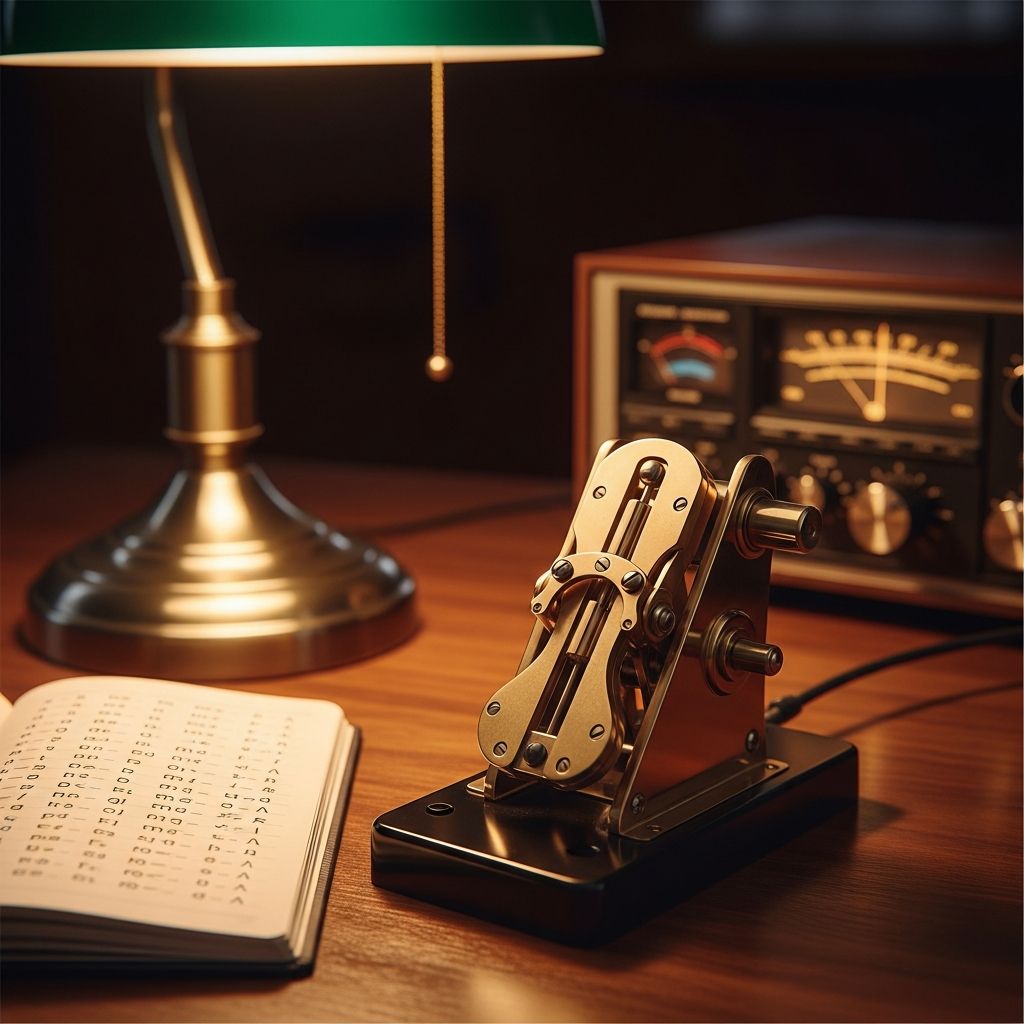
Morse code, a system of dots and dashes representing letters, numbers, and symbols, remains a vital skill for amateur radio operators, emergency communicators, and history buffs. Developed in the 1830s by Samuel Morse and Alfred Vail, it enables reliable transmission over simple equipment. This guide provides original strategies inspired by proven methods to help you acquire proficiency swiftly and enjoyably.
Understanding the Foundations of Morse Code
At its core, Morse code—also known as Continuous Wave (CW)—uses short signals (dots or ‘dits’) and long signals (dashes or ‘dahs’) separated by pauses. Letters are unique rhythm patterns: for example, ‘A’ is dot-dash, while ‘B’ is dash-dot-dot-dot. Numbers and punctuation follow similar principles, totaling about 40 characters to master.
Unlike visual memorization, effective learning treats Morse as an auditory language. Focus on the sound pattern of each character rather than counting dits and dahs, mimicking how native speakers recognize words by rhythm. This builds Instant Character Recognition (ICR), essential for speeds beyond 10 words per minute (WPM).
| Character | Morse Pattern | Sound Rhythm |
|---|---|---|
| A | .- | Short-long |
| B | -… | Long-short-short-short |
| E | . | Short |
| T | – | Long |
| 1 | .—- | Short-long-long-long-long |
Use this table as a starting reference, but transition quickly to audio practice to internalize rhythms.
Step-by-Step Learning Pathway
Begin with structured progression to avoid overwhelm. Divide learning into phases: familiarization, recognition, transmission, and fluency.
Phase 1: Build Familiarity (Days 1-2)
- Write the full alphabet and numbers by hand on paper, associating each with a mnemonic phrase. For ‘E’ (.), think ‘Easy as a single beep’; for ‘Q’ (–.-), ‘Queen’s quick query’.
- Listen to each character at 30 WPM character speed (fast dits/dahs, slow spacing) using free tools. Repeat until patterns stick without visual aid.
- Practice 15 minutes twice daily: morning review, evening reinforcement.
Phase 2: Recognition Drills (Days 3-7)
- Use apps like Morse Mania or web trainers (e.g., Morse Code Ninja) that introduce 4-6 characters at a time in smart sequences, prioritizing high-frequency letters like E, T, A.
- Aim for 70-90% accuracy before advancing. Say characters aloud during 1-second pauses between transmissions.
- Test with simple words: encode ‘HELLO’ and decode from audio.
Phase 3: Sending Practice (Week 2)
- Acquire a straight key or paddle (build a simple one from household items like a clothespin and buzzer for tactile feedback).
- Mimic received sounds: send ‘A’ as short-long rhythm without looking. Record yourself and compare.
- Pair with a partner: one sends random letters, the other copies on paper.
Phase 4: Fluency Building (Ongoing)
- Practice head-copying (writing without visual cues) at increasing speeds. Target 15-20 WPM for basic conversations.
- Join online slow-speed nets or simulators for real messages.
Many achieve alphabet mastery in 4-10 hours of focused effort using these methods.
Top Tools and Resources for Success
Leverage digital aids designed for engagement and retention.
- Morse Code Ninja: Incremental courses with audio lessons. Progress by accuracy thresholds; emphasizes sound over visuals.
- CW Communicator (CwCom): Free software for sending/receiving practice. Customizable speeds and Koch method integration.
- Morse Mania App: Gamified learning by sound at high character speeds. Introduces characters in frequency order.
- Google Morse Trainer: Interactive web tool with fun feedback to maintain motivation.
- Ace Centre Morse Trainer: Accessible for all devices, supports custom input.
Combine apps with physical keys for muscle memory. Avoid lookup charts post-familiarization—they hinder auditory processing.
Proven Techniques from Experts
Learners report success with these hacks:
- Mnemonic Sentences: Craft phrases matching rhythms, e.g., ‘Bees And Ants Dance’ for B (-…), A (.-), D (-..).
- Chunking: Group similar patterns (all shorts: E, I, S, H; all longs: M, O).
- Daily Micro-Sessions: 15 minutes x2 daily outperforms marathon sessions, leveraging spaced repetition.
- No Counting: Hear the whole pattern as a unique ‘word’ in a new language.
Amateur radio operators stress practicing transmission early: imperfect sending is better than none.
Real-World Applications and Benefits
Beyond hobby, Morse code shines in:
- Amateur Radio (Ham): CW mode penetrates poor conditions; no license required for basic practice.
- Emergencies: Low-power signals reach far; used in aviation, maritime signaling.
- Brain Training: Improves auditory processing, focus, and pattern recognition.
- Fun Projects: Build telegraphs, encode messages, or join global CW communities.
With ICR at 25+ WPM, converse worldwide using minimal gear.
Frequently Asked Questions (FAQs)
What is the fastest way to learn Morse code?
The quickest method combines audio apps like Morse Mania at 30 WPM character speed with daily 15-minute sessions, achieving basics in under 10 minutes per some reports, full alphabet in hours.
Do I need equipment to start?
No—web/apps suffice initially. A simple key enhances sending practice but isn’t essential.
How long until I can send messages?
1-2 weeks of consistent practice yields conversational speed (10-15 WPM).
Is Morse code still relevant today?
Yes, for ham radio, survival signaling, and as a cognitive skill. FCC dropped it from licenses, but enthusiasts thrive.
Common beginner mistakes to avoid?
Counting dits/dahs instead of listening to rhythms; visual overkill; irregular practice.
Advanced Tips for Lifelong Proficiency
Once basic, elevate with:
- Koch Method: Learn at target speed (20 WPM) with 2-character sets, expanding gradually.
- QRQ Clubs: Chase high-speed clubs for motivation.
- Logbooks: Track progress, review weak characters.
Consistency trumps intensity—practice daily.
References
- How to Learn Morse Code — Instructables. Accessed 2026. https://www.instructables.com/How-to-Learn-Morse-Code/
- How I learned MORSE CODE IN 10 MINUTES — YouTube (Felbify). Accessed 2026. https://www.youtube.com/watch?v=QAd2Weqz1fk
- Learn – Morse Code Ninja — morsecode.ninja. Accessed 2026. https://morsecode.ninja/learn/
- The Easy Way to Start Morse Code! — YouTube (Ham Radio Duo). Accessed 2026. https://www.youtube.com/watch?v=nwoVBsIRW4o
- Learn Morse Code — Ace Centre. Accessed 2026. https://morse-learn.acecentre.net
- Morse – Learn – Google — Google. Accessed 2026. https://morse.withgoogle.com/learn

Medha Deb is an editor with a master's degree in Applied Linguistics from the University of Hyderabad. She believes that her qualification has helped her develop a deep understanding of language and its application in various contexts. Medha specializes in the areas of beauty, health, sports, and wellness and is committed to ensuring that the content on the website is…