
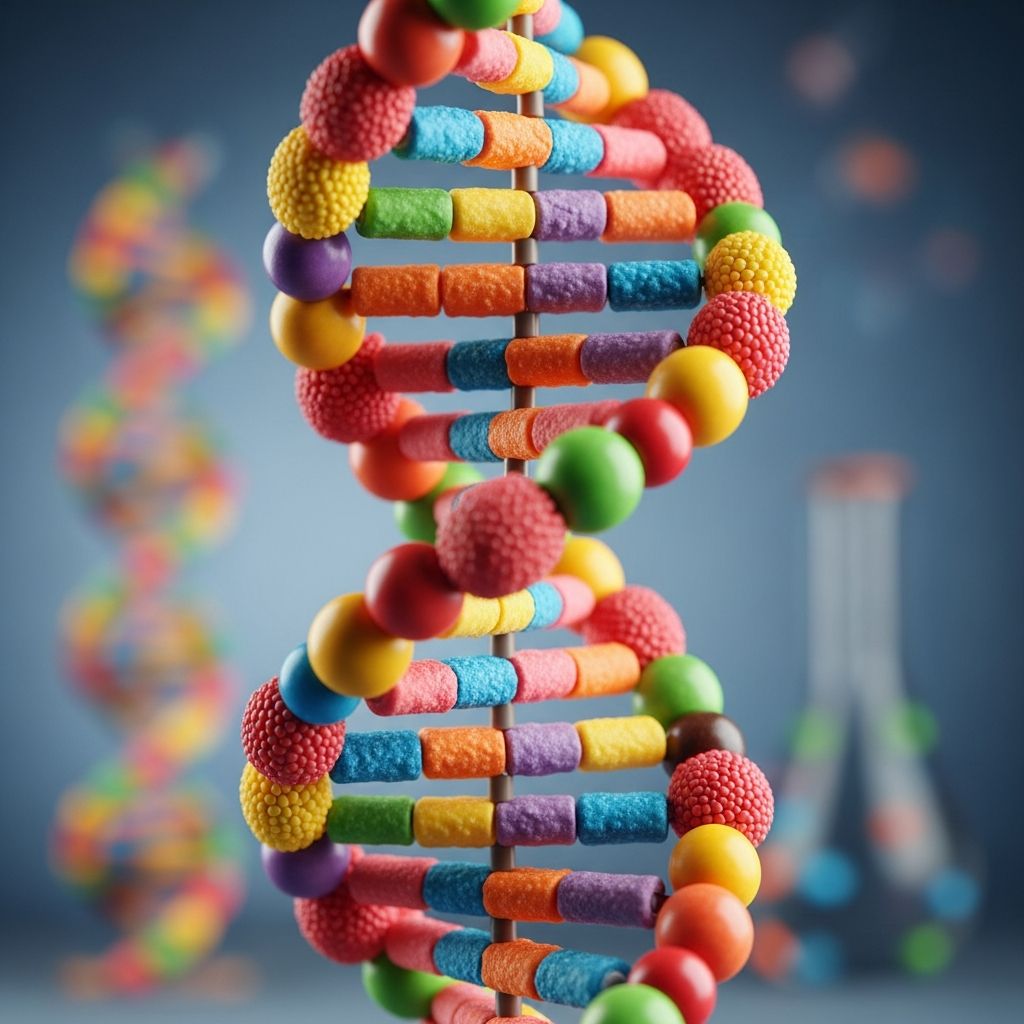
Constructing a DNA model from everyday candies transforms abstract molecular biology into a tangible, delicious experience. This activity lets learners visualize the iconic double helix, understand nucleotide pairing, and even simulate replication—all while enjoying a treat.
Why Candy Makes the Perfect DNA Builder
Candy replicates DNA’s key features effectively: long strands mimic the sugar-phosphate backbone, while colorful soft candies represent the four nitrogenous bases. This approach engages senses, making complex concepts memorable for students aged 8 and up.
The double helix, discovered by James Watson and Francis Crick in 1953, consists of two intertwined strands connected by base pairs. Adenine (A) bonds with thymine (T), and cytosine (C) with guanine (G), forming the rungs of a twisted ladder. Hands-on models reinforce these rules better than diagrams alone.
Gathering Your Edible Supplies
Assemble these simple items, available at most grocery stores:
- Long candy ropes (e.g., Twizzlers or licorice): 4-6 pieces for backbones.
- Soft, multi-colored candies (e.g., gummy bears, jelly tots, or gumdrops): At least 40 pieces in four distinct colors.
- Toothpicks or cocktail sticks: 20-30 for connecting bases.
- Small bowls: Four for sorting candies by color.
- Plate or tray: For assembly.
- Optional: Scissors for trimming ropes, paper towels for cleanup.
Choose soft candies that toothpicks pierce easily; avoid hard varieties like midget gems to prevent breakage.
Assigning Colors to Nucleotides
Sort candies into four groups and label them:
| Color | Nucleotide | Pairs With |
|---|---|---|
| Yellow | Adenine (A) | Thymine (T) |
| Red | Thymine (T) | Adenine (A) |
| Green | Cytosine (C) | Guanine (G) |
| Orange | Guanine (G) | Cytosine (C) |
This coding helps remember base-pairing rules: A-T and C-G form weak hydrogen bonds, holding the strands together.
Step-by-Step Construction Guide
Prepare the backbone strands. Cut two equal lengths of licorice (about 12 inches each) to form parallel sugar-phosphate chains.
Create base pairs. For each toothpick, skewer one pair: yellow A with red T, or green C with orange G. Make 10-15 pairs, alternating types for variety (e.g., A-T, C-G, T-A, G-C).
Build the ladder. Insert toothpicks horizontally between the two licorice strands, spacing evenly (about 1 inch apart). Alternate pairs to mimic real DNA sequences.
Twist into a helix. Gently rotate the ladder ends in opposite directions to form the spiral double helix shape. Secure if needed with tape at ends.
Label your model. Use small flags on toothpicks to mark A, T, C, G for clarity.
Your model now represents a segment of DNA! Real DNA is microscopic—2 nanometers wide—but stretches incredibly long if uncoiled.
Mastering the Double Helix Twist
The helix shape stabilizes DNA, protecting bases inside while backbones face outward. When twisting your model, observe how rungs angle inward, replicating the 34-angstrom turn every 10 base pairs. If it unravels, re-space toothpicks evenly.
Extending the Fun: Simulate DNA Replication
DNA copies itself before cell division. Demonstrate this:
- Unzip the helix. Carefully cut toothpicks between paired candies, separating into two single strands.
- Rebuild strands. Using spare candies and new toothpicks, pair matching bases on each original strand (A with new T, etc.).
- Form new helices. Attach fresh licorice backbones to complete two identical double helices.
This mirrors semi-conservative replication, where each new molecule retains one original strand.
Safety Tips for a Sweet Experiment
- Supervise children with toothpicks to avoid pokes.
- Remove all toothpicks before eating.
- Allergies? Check labels for nuts, gluten, or gelatin.
- Work on a protected surface; candies get sticky.
Educational Extensions and Variations
Scale it up: Build a larger model with more pairs to show millions of base pairs in genes.
Compare structures: Contrast with RNA models (uses uracil instead of thymine; single-stranded).
Gene sequencing: Write a ‘code’ on paper first, then replicate it in candy to show mutations (swap a base).
Cross-disciplinary: Link to math (count base pairs), art (design colorful sequences), or nutrition (discuss candy ingredients).
For classrooms, pair with DNA extraction from strawberries using dish soap and salt.
Common Mistakes and Fixes
| Issue | Solution |
|---|---|
| Ladders too floppy | Use longer toothpicks; space closer. |
| Hard to twist | Shorten strands; fewer pairs first. |
| Incorrect pairing | Double-check A-T, C-G rules. |
| Candy breaks | Soften in warm hands; choose gummies. |
Frequently Asked Questions
What ages is this activity best for?
Grades 3-8 (ages 8-14), but adaptable for younger with help or older with replication extensions.
Can I use alternatives to candy?
Yes: Pipe cleaners for backbones, clay for bases, or beads on string for reusable models.
How accurate is this model scientifically?
It simplifies scale and bond angles but accurately shows base pairing and helix form.
How long does it take?
20-30 minutes assembly; 45+ with replication.
Is it edible after?
Yes, toothpick-free! But supervise consumption.
Real-World DNA Connections
Understanding DNA structure enables PCR testing, gene editing like CRISPR, and forensics. Your candy model introduces these biotechnology marvels playfully.
Fun fact: Human DNA contains 3 billion base pairs, uncoiling to 6 feet per cell—enough to reach the sun and back multiple times if all cells stretched out!
References
- DNA Structure and Function — National Human Genome Research Institute (NHGRI), U.S. National Library of Medicine. 2023-05-15. https://www.genome.gov/genetics-glossary/DNA
- Have Your DNA and Eat It Too — Learn.Genetics, University of Utah. 2024-01-10. https://teach.genetics.utah.edu/content/dna/Have-Your-DNA-and-Eat-It-Too.pdf
- Molecular Structure of Nucleic Acids — Nature Journal (Watson & Crick original paper). 1953-04-25 (historical authority for structure). https://www.nature.com/articles/171737a0
- DNA Replication Mechanism — Khan Academy (peer-reviewed educational resource). 2025-02-20. https://www.khanacademy.org/science/ap-biology/gene-expression-and-regulation/replication/a/molecular-mechanism-of-dna-replication
- Edible DNA Models for Education — National MagLab, Florida State University. 2023-11-08. https://nationalmaglab.org/magnet-academy/try-this-at-home/candy-dna/

Medha Deb is an editor with a master's degree in Applied Linguistics from the University of Hyderabad. She believes that her qualification has helped her develop a deep understanding of language and its application in various contexts. Medha specializes in the areas of beauty, health, sports, and wellness and is committed to ensuring that the content on the website is…