
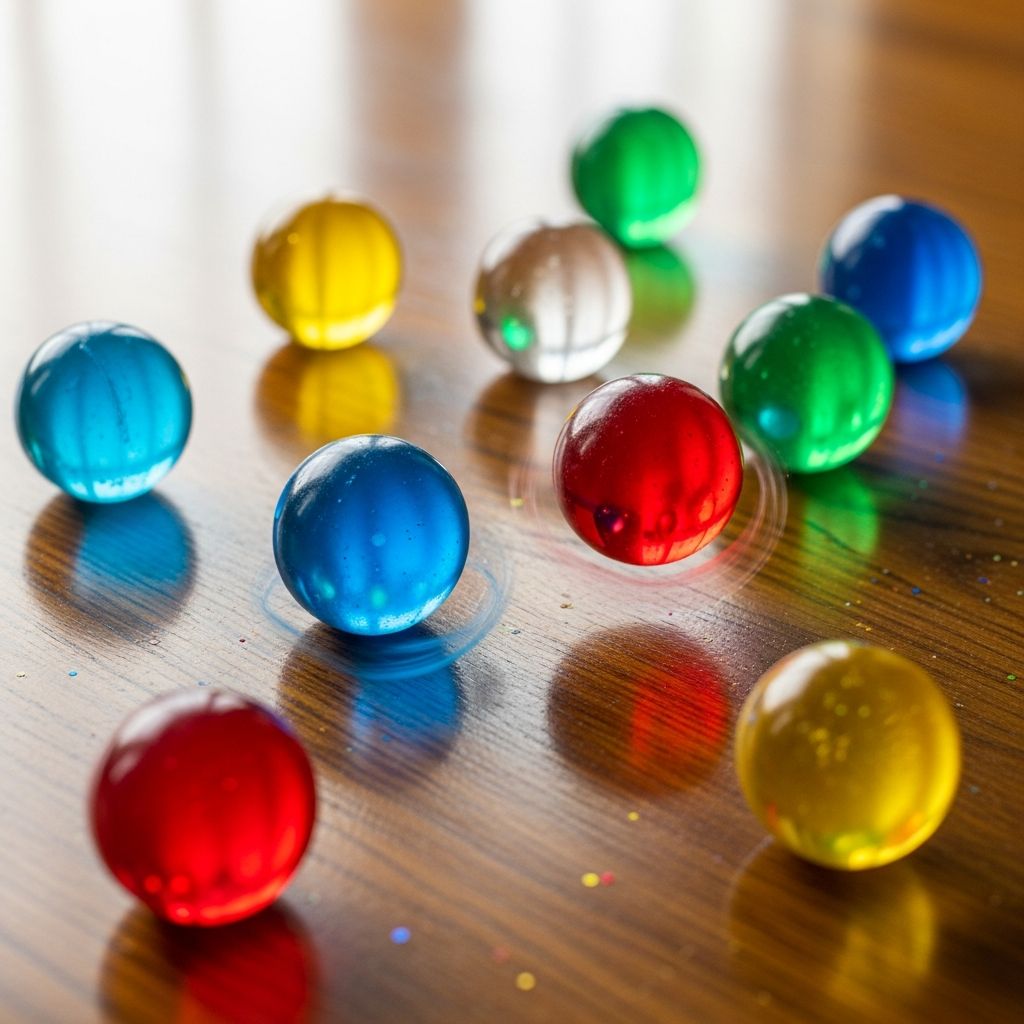
Creating bouncy balls from everyday materials offers a thrilling way to blend creativity with scientific discovery. These DIY projects transform basic kitchen staples into resilient, springy spheres that captivate children and adults alike. By mixing glue, borax, and cornstarch, you trigger a fascinating chemical process called cross-linking, where long molecular chains interconnect to form a rubbery polymer. This activity not only yields playable toys but also illustrates core principles of polymer chemistry, making it ideal for home learning or classroom demonstrations.
Understanding the Magic of Polymers
Polymers are giant molecules composed of repeating smaller units called monomers. In bouncy balls, the glue acts as the primary polymer base, consisting of polyvinyl acetate chains. Borax, or sodium tetraborate, serves as a cross-linking agent, forming bridges between these chains to create elasticity and bounce. Cornstarch adds structure, helping the mixture solidify into a cohesive ball. This reaction is a classic example of non-Newtonian fluids turning into solids under specific conditions, demonstrating how everyday substances exhibit advanced material behaviors.
The beauty lies in the hands-on transformation: a sticky liquid rapidly becomes moldable dough, then a durable orb capable of rebounding from surfaces. Such experiments highlight how chemists engineer materials like tires, elastics, and sports equipment.
Gathering Your Essential Supplies
Assembling materials is straightforward, requiring items commonly found in households or easily purchased. Here’s a comprehensive list for multiple batches:
- White school glue (Elmer’s or similar, about 4-8 oz)
- Borax powder (laundry aisle, 1-2 teaspoons)
- Cornstarch (1/4 cup or more)
- Warm water (1/2 cup)
- Food coloring (optional, for vibrant hues)
- Measuring spoons (teaspoon and tablespoon)
- Small bowls or disposable cups (2-4)
- Stirring sticks or spoons
- Paper towels or newspaper for cleanup
- Ziplock bags for storage
- Ruler or measuring tape for bounce tests
These supplies support the base recipe and variations, ensuring you’re equipped for experimentation.
Mastering the Basic Bouncy Ball Recipe
Follow these steps precisely for reliable results. Adult supervision is recommended, especially for younger children handling borax.
- Prepare the Borax Activator: In a small cup, dissolve 1/2 teaspoon borax in 2 tablespoons warm water. Stir vigorously until fully dissolved. Add 1-2 drops food coloring for tinted solution. This creates the cross-linking agent.
- Mix the Ball Base: In another cup, combine 1 tablespoon white glue and 1 tablespoon cornstarch. Do not stir yet. Add 1/2 teaspoon of the borax solution directly on top.
- Initial Reaction: Wait 10-15 seconds. The mixture will begin to gel as cross-links form. Stir gently until uniform, but stop when it thickens too much to mix.
- Mold and Knead: Remove the blob with clean hands. Knead for 1-2 minutes. It starts sticky but firms up, becoming smooth and bouncy. If too sticky, dust with cornstarch.
- Test and Store: Bounce on a hard surface. Store in a sealed bag to prevent drying. Balls last days to weeks.
Your first ball should rebound 6-12 inches when dropped from knee height, depending on ratios.
Advanced Variations for Bounce Optimization
Experimentation elevates this from craft to science inquiry. Tweak ratios to observe property changes:
| Recipe Variation | Glue (Tbsp) | Cornstarch (Tbsp) | Borax Solution (Tsp) | Expected Properties |
|---|---|---|---|---|
| Super Bouncy | 1 | 1 | 0.75 | High rebound, firm |
| Stretchy Slime Ball | 1 | 1.5 | 0.25 | Flexible, low bounce |
| Gooey Mega Ball | 2 | 0.5 | 0.5 | Large, sticky, moderate bounce |
| No Cornstarch Test | 1 | 0 | 0.5 | Runny, poor shape |
Test each by dropping from 30 cm and measuring rebound height. More borax increases cross-links for better bounce; extra cornstarch enhances durability but reduces elasticity. Document results in a chart to identify optimal formulas.
Scientific Principles in Action
This reaction exemplifies polymerization, where borax ions (borate) react with glue’s hydroxyl groups, creating a network of interconnected chains. This tetrahedral structure traps air and provides resilience, akin to commercial rubber balls. Variables like temperature affect dissolution—warmer water speeds reactions—and pH influences cross-link density. Comparing to slime (glue + borax only) reveals cornstarch’s role in rigidity.
Educators note this aligns with NGSS standards for matter properties and chemical reactions, fostering inquiry skills.
Safety Guidelines and Best Practices
Prioritize safety for enjoyable experiments:
- Borax Handling: Mild irritant; avoid ingestion, eye contact. Use gloves if sensitive. Rinse spills immediately.
- Supervision: Children under 8 need adults for mixing.
- Cleanup: Wash hands post-kneading. Dispose excess in trash, not drains.
- Allergies: Test small amounts if skin-sensitive.
- Storage: Keep away from pets; dry balls become brittle.
With precautions, risks are minimal, promoting safe STEM exploration.
Fun Extensions and Challenges
- Color Swirls: Layer differently colored mixtures before kneading.
- Bounce Olympics: Compete for highest rebound; graph data.
- Microscope View: Examine dried ball texture under magnification.
- Eco-Twist: Try starch-based glues for biodegradable versions.
- Scale Up: Double recipe for larger playground balls.
These build critical thinking, turning play into profound learning.
Frequently Asked Questions (FAQs)
Why doesn’t my ball bounce well?
Insufficient borax or excess water weakens cross-links. Add more activator incrementally and knead longer.
Can I use colored glue?
Yes, but white yields purest colors. Test for compatibility.
How long do bouncy balls last?
Stored properly, 1-2 weeks. Exposure to air dries them out.
Is borax safe for kids?
In small quantities with supervision, yes. It’s a common cleaner but avoid ingestion.
What if I don’t have cornstarch?
Balls form but lack structure, becoming gooey slime instead.
Why This Experiment Matters
Bouncy ball making demystifies chemistry, showing how molecular manipulation creates functional materials. It sparks curiosity in STEM fields, where polymers underpin innovations like medical devices and sustainable plastics. Families report enhanced bonding and learning retention from such activities. Share your creations online with #HomemadeBouncyBalls for community inspiration.
References
- Bouncing Polymer Ball – Science Experiments for Kids — CuriOdyssey. Accessed 2026. https://curiodyssey.org/learn-explore/science-experiments-for-kids/bouncing-polymer-ball/
- Bouncy Ball Polymerization Reaction Protocol — SERC, Carleton College. Accessed 2026. https://serc.carleton.edu/download/files/460136/bouncy_ball_polymerization_protocol_resources.pdf
- Test Out Different Recipes to Create Your Own Bouncy Balls — Discovery Place. Accessed 2026. https://discoveryplace.org/stay-at-home-science/articles/test-out-different-recipes-to-create-your-own-bouncy-balls/

Medha Deb is an editor with a master's degree in Applied Linguistics from the University of Hyderabad. She believes that her qualification has helped her develop a deep understanding of language and its application in various contexts. Medha specializes in the areas of beauty, health, sports, and wellness and is committed to ensuring that the content on the website is…