
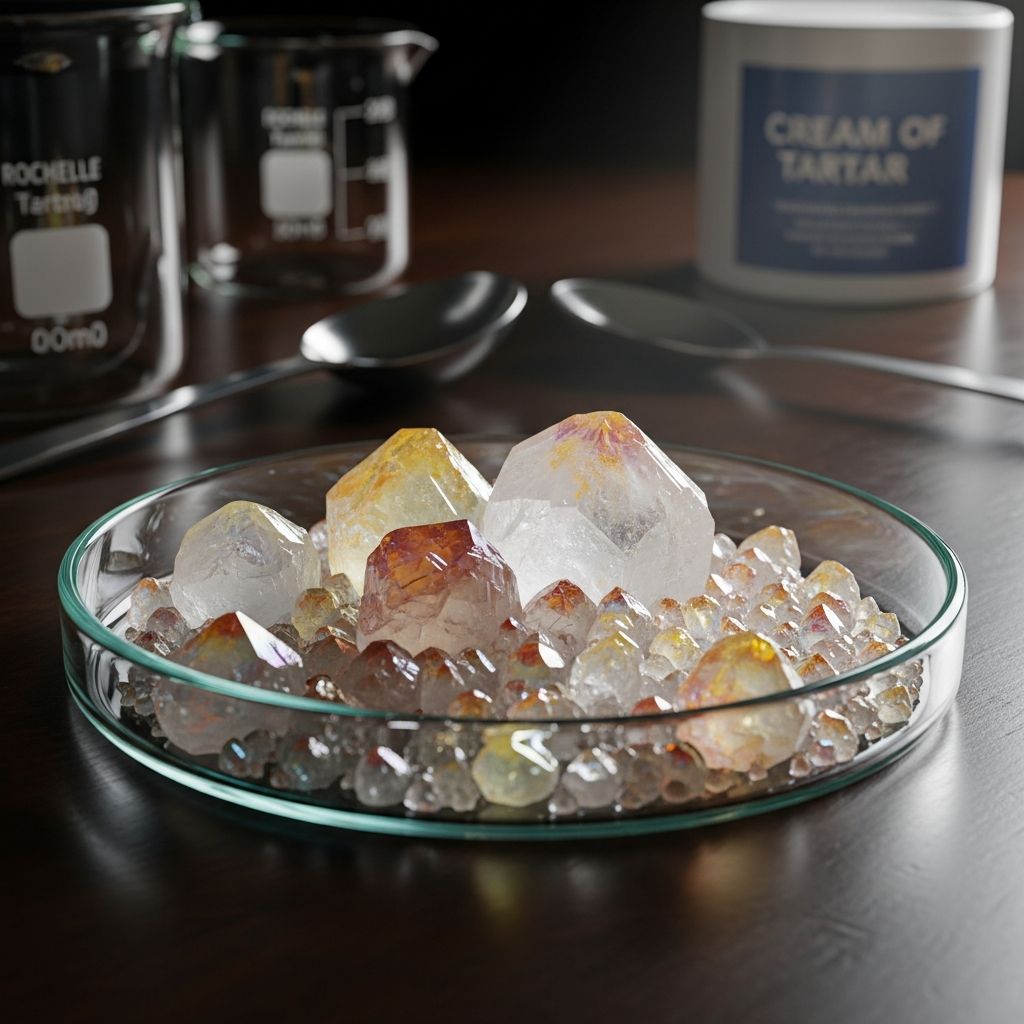
Rochelle salt, scientifically known as potassium sodium tartrate tetrahydrate, is a remarkable compound prized for its piezoelectric properties, which allow it to generate electricity under mechanical stress. This guide provides an original, detailed exploration of how to synthesize it safely in a home setting using accessible materials. Whether you’re a student, hobbyist, or educator, these methods draw from established chemical principles to yield clear, well-formed crystals suitable for experiments.
Understanding Rochelle Salt and Its Unique Properties
Rochelle salt derives its name from the French city of La Rochelle, where it was first identified in the 17th century. Chemically, it forms through the reaction of potassium bitartrate (cream of tartar) with a sodium source like bicarbonate or carbonate, producing the double salt KNaC4H4O6·4H2O. This compound’s crystal structure enables it to deform under pressure, creating voltage—a key feature for microphones, sensors, and DIY electronics projects.
Beyond piezoelectrics, Rochelle salt has historical uses in food as a stabilizer and in medicine as a laxative. Its high solubility in water, especially when hot, makes crystallization straightforward, but purity matters for optimal results. Impure starting materials can lead to off-colors or irregular shapes, so selecting food-grade reagents is essential.
Gathering Essential Materials and Equipment
To embark on this synthesis, assemble these items, most of which are pantry staples:
- Cream of tartar (potassium bitartrate): 100-200g, food-grade from grocery stores.
- Baking soda (sodium bicarbonate): 100g, or convert to washing soda (sodium carbonate) by heating.
- Distilled water: 100-300ml to minimize impurities.
- Heat source: Stove, hot plate, or double boiler for controlled heating.
- Glassware: Beakers (250-600ml), stirring rod, funnel, filter paper.
- Safety gear: Gloves, goggles, apron to protect against splashes and heat.
- Optional: pH strips, scale for precision, refrigerator for faster cooling.
A digital scale accurate to 0.1g ensures stoichiometric balance, improving yield. For advanced users, phenolphthalein indicator helps monitor neutralization.
Core Chemical Reactions Behind the Synthesis
The formation of Rochelle salt hinges on acid-base neutralization. Cream of tartar acts as a weak acid, reacting with a base to form the tartrate salt. Key reactions include:
- With baking soda: KC4H5O6 + NaHCO3 → KNaC4H4O6 + CO2 + H2O
- With washing soda: 2KC4H5O6 + Na2CO3 → 2KNaC4H4O6 + CO2 + H2O
- With sodium hydroxide: KC4H5O6 + NaOH → KNaC4H4O6 + H2O
These produce effervescence from CO2 gas, signaling completion when bubbling ceases and the solution clears. Solubility peaks at higher temperatures—up to 200g per 100g water at 45°C—facilitating dissolution followed by cooling-induced crystallization.
Step-by-Step Method 1: Baking Soda Approach
This beginner-friendly technique uses common baking soda, ideal for small batches.
- Dissolve 100g cream of tartar in 100ml distilled water in a 250ml beaker. Heat gently to 70°C in a water bath until mostly dissolved.
- Slowly add 50-60g baking soda in portions, stirring continuously. Expect vigorous fizzing as CO2 evolves.
- Maintain 70°C, adding soda until bubbling stops and no solids remain—a clear solution indicates completion.
- Filter hot through filter paper into a clean dish to remove residue.
- Cool slowly at room temperature or refrigerate overnight. Crystals form as solubility drops.
- Decant liquid, rinse crystals with ice-cold water, and air-dry on filter paper.
Yield: Approximately 80-100g of Rochelle salt. For purer crystals, recrystallize by redissolving in minimal hot water and cooling.
Step-by-Step Method 2: Washing Soda for Higher Purity
Washing soda yields cleaner products due to its anhydrous nature. First, prepare it:
- Bake 100g baking soda at 200°C for 1 hour to form Na2CO3.
- Suspend 125g cream of tartar in 150ml water, heat to simmer.
- Add 40g washing soda gradually with stirring until effervescence ends.
- Filter while hot, then evaporate partially before refrigerating.
This method, observed in lab settings, produces larger crystals after 2 hours of cooling.
Advanced Technique: Precise Stoichiometric Synthesis
For lab-grade results, use exact molar ratios with purity checks.
| Reagent | Amount (for 1 mole) | Purity Adjustment |
|---|---|---|
| L-Tartaric acid | 151g | Test with vinegar titration |
| Potassium hydroxide | 56g | Dissolve in cold water |
| Sodium source | Variable | Monitor pH to neutrality |
Add KOH dropwise to tartaric acid solution until no precipitate forms, filter, and crystallize. This maximizes yield but requires a pH meter.
Safety Protocols and Best Practices
While household-friendly, handle with care:
- Work in a ventilated area to avoid inhaling CO2 or fumes.
- Use tongs or pads for hot glassware to prevent burns.
- Avoid skin contact with bases; rinse immediately if splashed.
- Supervise children and dispose of waste per local regulations.
- Store crystals in airtight containers to prevent moisture absorption.
Common pitfalls: Overheating decomposes the product; insufficient base leaves unreacted acid.
Testing Your Rochelle Salt Crystals
Verify piezoelectricity by sandwiching a crystal between foil electrodes and squeezing—attach to a multimeter for microvolt readings. Larger crystals (1-2cm) perform best. For science fairs, build a simple microphone or sensor.
Applications and Fun Projects
Rochelle salt powers vintage crystal phones and modern DIY piezo devices. Experiment with crystal radios or pressure sensors. Historically, it stabilized meringues and treated constipation.
Frequently Asked Questions (FAQs)
What is the easiest way to make Rochelle salt?
Use cream of tartar and baking soda heated in water; filter and cool for crystals.
Why do my crystals look impure?
Impure reagents or incomplete reactions cause discoloration—use distilled water and excess base.
Can I scale up the recipe?
Yes, maintain ratios; larger volumes need slower heating to avoid bumping.
Is Rochelle salt edible?
Pure forms are, but home-synthesized may contain impurities—use food-grade only.
How long do crystals last?
Indefinitely if dry; humidity dissolves them.
Troubleshooting Common Issues
- No crystals form: Solution too dilute—evaporate more or seed with a small crystal.
- Small crystals: Cool rapidly in ice bath.
- Colored product: Impurities; recrystallize multiple times.
Patience and iteration refine results. Multiple boils and filtrations purify residue effectively.
References
- Make Rochelle Salt — Instructables. 2015-01-15. https://www.instructables.com/Make-Rochelle-Salt/
- Crystals: Make Rochelle Salt Science Project — Home Science Tools Learning Center. 2023-05-10. https://learning-center.homesciencetools.com/article/how-to-make-rochelle-salt-science-project/
- Basic question about forming Rochelle Salt — ScienceMadness Discussion Board. 2007-11-20. http://www.sciencemadness.org/talk/viewthread.php?tid=18876

- Integrated M.A. in Applied Linguistics, University of Hyderabad
- 5+ years in editorial, instructional, SEO, and research-based writing
Sneha is a relationships and lifestyle writer with a strong foundation in applied linguistics and certified training in relationship coaching. She brings over five years of writing experience to theskillvault, crafting thoughtful, research-driven content that empowers readers to build healthier relationships, boost emotional well-being, and embrace holistic living. Her writing and insights reflect the belief that beauty, happiness, and wellness…