
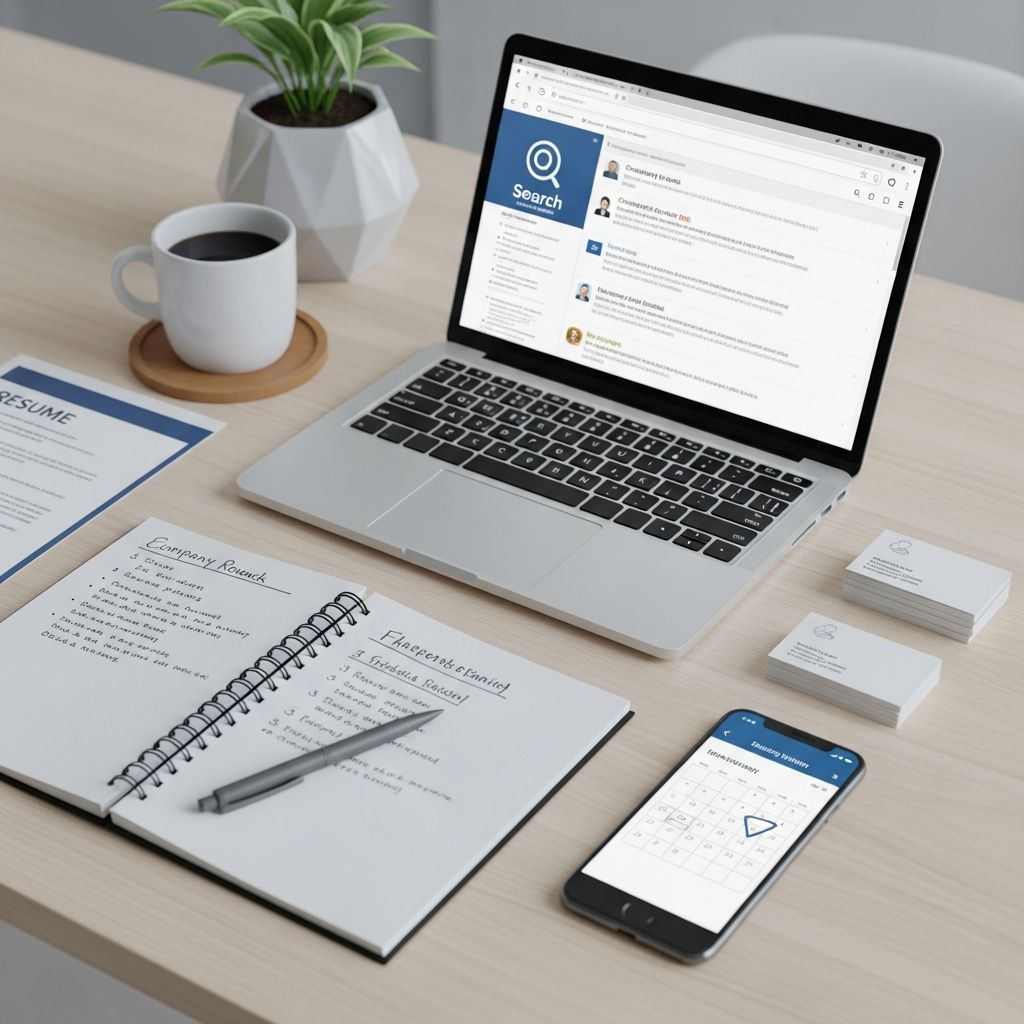
Landing an interview is a win. Turning that interview into an offer requires deliberate preparation, not guesswork. This guide walks you through a complete, practical system for getting ready—so you show up informed, confident, and ready to make the decision easy for the hiring team.
1. Clarify the Role and What Success Looks Like
Effective preparation starts with a clear picture of the job itself. Many candidates skim the posting; strong candidates treat it as a roadmap.
- Study the job description line by line. List out required skills, tools, and responsibilities in one column.
- Match each requirement to your experience. Add a second column where you jot down specific projects, courses, or achievements that show you can do that task.
- Spot the themes. Look for repeated words and phrases (e.g., “cross-functional,” “client-facing,” “data-driven”)—these signal what the employer values most.
- Define success in the first 6–12 months. Ask yourself: If I were the manager, what outcomes would I want this person to achieve?
This exercise gives you a list of talking points you can weave into your answers to prove you are aligned with the actual work, not just the title.
2. Research the Employer Beyond the Homepage
Interviewers expect you to understand not only the job, but also the organization and its environment. Research helps you tailor your stories and questions, and it signals genuine interest.
- Understand the organization’s core business. Identify their primary products or services, main customers, and revenue model.
- Review recent news. Look for press releases, major announcements, funding rounds, or leadership changes that could affect the team you are joining.
- Learn the mission and values. Check official pages that describe the organization’s mission, vision, and culture. See where your own values intersect.
- Scan leadership bios. If you know who is interviewing you, read their public profile and background to anticipate their perspective.
Bring your findings into the conversation by connecting your experience to what the organization is trying to accomplish right now.
3. Map Out the Interview Format and Logistics
Even strong answers fall flat if basic logistics go wrong. Plan the practical details well ahead of time.
- Confirm the format. Is it phone, video, in-person, or a panel? Will there be technical tasks, case questions, or presentations?
- Test your technology. For virtual interviews, verify your internet connection, audio, camera, and any required software the day before.
- Plan your route. For on-site interviews, check commute time, parking options, building security, and check-in procedures.
- Prepare materials. Bring extra copies of your resume, a list of references if appropriate, a notebook, and a pen. Keep a version of your resume open or printed for virtual conversations.
When logistics are handled, you free up mental bandwidth for listening, thinking, and building rapport.
4. Build Your Core Story Library (Using STAR)
Most modern interviews rely heavily on behavioral questions like “Tell me about a time you led a project” or “Describe a situation where you had to adapt quickly.” These questions aim to predict your future performance based on your past actions.
A proven way to answer them clearly is the STAR method:
- S – Situation: Set the context and background.
- T – Task: Explain what you needed to accomplish.
- A – Action: Describe what you specifically did.
- R – Result: Share the outcomes, including any metrics.
Create a small “story bank” of 5–8 experiences you can adapt to many questions:
- A challenging project with a tight deadline
- A time you resolved a conflict or worked with a difficult teammate
- A situation where you showed leadership without a formal title
- An instance where you made a mistake and recovered
- A moment where you improved a process or solved a complex problem
Outline each story in bullet form using STAR. Avoid memorizing word-for-word scripts; focus on the key beats so you can stay natural and adapt as needed.
5. Practice High-Impact Interview Questions
While you cannot predict every question, several themes appear in most interviews. Prepare clear, concise responses to questions like:
- “Tell me about yourself.”
- “Why are you interested in this role and our organization?”
- “What are your strengths?”
- “What’s a weakness you’re working on?”
- “Tell me about a time you worked on a team.”
- “Describe a time you dealt with a setback or failure.”
For each question type:
- Keep it structured. For “Tell me about yourself,” build a 2–3 minute professional overview: past experience, present role or focus, and future goals aligned with the job.
- Be specific. Use evidence and examples rather than vague claims.
- Stay relevant. Emphasize experiences that directly support the role’s key responsibilities.
Practice out loud. If possible, record yourself or schedule a mock interview with a career center, mentor, or trusted colleague to receive feedback on clarity, pacing, and body language.
6. Align Your Professional Brand: Resume, Online Profiles, and Message
Interviewers often review your resume and online presence before they meet you. Alignment across all channels makes you appear focused and intentional.
- Ensure consistency. Your resume, LinkedIn (or equivalent), and cover letter should tell the same story about your skills, accomplishments, and direction.
- Highlight relevant achievements. Draw attention to projects, metrics, and results that match the job description.
- Prepare a cohesive narrative. Be ready to explain career changes, gaps, or unconventional paths in a positive, forward-looking way.
Think of your interview as the live version of what your documents and profiles already suggest about you.
7. Plan Your Questions for the Interviewer
Thoughtful questions show that you are evaluating the opportunity, not just trying to be chosen. They also help you understand if the role and environment truly fit you.
Consider asking about:
- Success criteria: “What does success look like in this role in the first six months?”
- Team dynamics: “How does this team typically collaborate across departments?”
- Current priorities: “What are the most urgent projects this role will tackle?”
- Management style: “How do you prefer to support and communicate with your team?”
- Next steps: “What are the next stages in the hiring process?”
Skip questions that you could have answered easily from the organization’s website, and avoid asking about salary or benefits in very first-round screens unless the interviewer raises the topic.
8. Present Yourself Professionally: Appearance and Communication
First impressions form quickly. Professionalism in appearance and communication can reinforce your credibility before you say much.
| Area | What to Aim For | What to Avoid |
|---|---|---|
| Dress | Clean, well-fitting attire slightly more formal than the everyday dress code. | Overly casual clothes, distracting patterns, or anything uncomfortable. |
| Body Language | Open posture, eye contact, relaxed but attentive expression. | Crossed arms, fidgeting, looking away constantly. |
| Voice | Steady pace, clear articulation, varied tone. | Rushing, mumbling, or speaking in a monotone. |
| Technology (Virtual) | Neutral background, good lighting, minimal noise. | Backlighting, cluttered background, interruptions. |
Remember that professional communication also includes punctuality, courtesy to support staff, and prompt responses to emails or messages.
9. Manage Nerves and Perform Under Pressure
Nervousness is normal; preparation helps you keep it in the manageable range. Research on interview and test performance suggests that moderate anxiety can actually sharpen focus, whereas overwhelming stress harms performance.
- Rehearse under realistic conditions. Practice answers while standing or sitting upright, looking into a camera or mirror.
- Use brief calming techniques. Deep breathing, grounding exercises, or short walks can reduce physical symptoms of anxiety.
- Reframe the situation. Treat the interview as a two-way conversation about fit, not a one-sided interrogation.
- Prepare a “reset” strategy. If you blank on a question, it is acceptable to pause, ask the interviewer to repeat or clarify, or say, “Let me think about a strong example,” and then respond.
The goal is not to eliminate nerves, but to stay composed enough that your preparation and personality can show through.
10. Execute During the Interview: Listen, Clarify, Connect
On interview day, your job is to build a clear picture in the interviewer’s mind of how you think, work, and collaborate.
- Listen fully to each question. Resist the urge to jump in as soon as you recognize a key word. This lowers the risk of answering a question that was not asked.
- Clarify when needed. If a question is broad or vague, ask, “Would you like an example from a recent role, or from my academic experience?”
- Structure your responses. Use STAR for behavioral questions, and simple logical structures (“three key reasons,” “two main steps”) for others.
- Connect back to the role. After describing an example, add a brief sentence linking it to the position: “This experience is relevant here because…”
Throughout, keep your answers honest. Interviewers are experienced at spotting exaggerated claims or inconsistent stories.
11. Close Strong and Follow Up Professionally
The final minutes of the interview and what you do afterward can reinforce a positive impression.
- Summarize your fit. If given a chance, briefly restate how your skills and goals align with the role and what excites you about the opportunity.
- Clarify next steps. Ask when you might expect to hear back and whether there is anything else you can provide.
- Send a thank-you message. Within 24 hours, send a concise note to each interviewer highlighting one or two specific points from your conversation and reiterating your interest.
Professional follow-up keeps you on the hiring team’s radar and demonstrates reliability and respect for their time.
Frequently Asked Questions (FAQs)
How far in advance should I start preparing for an interview?
Begin structured preparation as soon as you receive the invitation. For many candidates, 3–5 days is enough to research the organization, review the job description, and rehearse key stories and answers. More technical or multi-stage processes may require one to two weeks of targeted practice.
How long should my answers be?
Most behavioral answers land best in about 1–2 minutes, using the STAR method to stay concise but complete. Shorter factual questions can often be answered in 20–40 seconds, while complex case or technical questions may take longer if you explain your reasoning clearly.
What if I do not have direct experience in the field?
Focus on transferable skills such as communication, problem-solving, learning new tools quickly, and collaborating with diverse teams. Use examples from academics, volunteer work, part-time jobs, or personal projects that mirror the challenges of the role.
Is it acceptable to bring notes into an interview?
In most cases, it is fine to bring a small notebook with a few bullet points and questions, especially for in-person interviews. For video interviews, you can keep a brief outline near your screen, but avoid reading verbatim; your attention should stay on the conversation.
How many questions should I ask the interviewer?
Prepare at least 5–7 thoughtful questions, understanding that some may be answered during the conversation. Aim to ask 2–4 strong questions at the end that focus on the role, expectations, team, and success metrics.
References
- How to Prepare for an Interview — Indeed Editorial Team. 2023-08-11. https://www.indeed.com/career-advice/interviewing/how-to-prepare-for-an-interview
- Comprehensive Guide to Interviewing: Preparation, Execution & Follow-Up — California State University, Los Angeles (CBE Placement Services). 2019-01-01. https://www.calstatela.edu/sites/default/files/interviewing_guide_-_cbe_placement.pdf
- Interview Questions and How to Prepare — UC Davis Internship and Career Center. 2022-04-01. https://careercenter.ucdavis.edu/interviews-and-offers/questions-and-prep
- Interview Guide — Princeton University Center for Career Development. 2021-01-01. https://careerdevelopment.princeton.edu/sites/g/files/toruqf1041/files/media/interview_guide_5.pdf
- Using the STAR Method for Your Next Behavioral Interview — MIT Career Advising & Professional Development. 2020-09-15. https://capd.mit.edu/resources/the-star-method-for-behavioral-interviews/
- Stand Out in a Job Interview — Harvard Business Review (Video, Amy Gallo). 2021-02-18. https://www.youtube.com/watch?v=ZU9x1vFx5lI

Medha Deb is an editor with a master's degree in Applied Linguistics from the University of Hyderabad. She believes that her qualification has helped her develop a deep understanding of language and its application in various contexts. Medha specializes in the areas of beauty, health, sports, and wellness and is committed to ensuring that the content on the website is…