
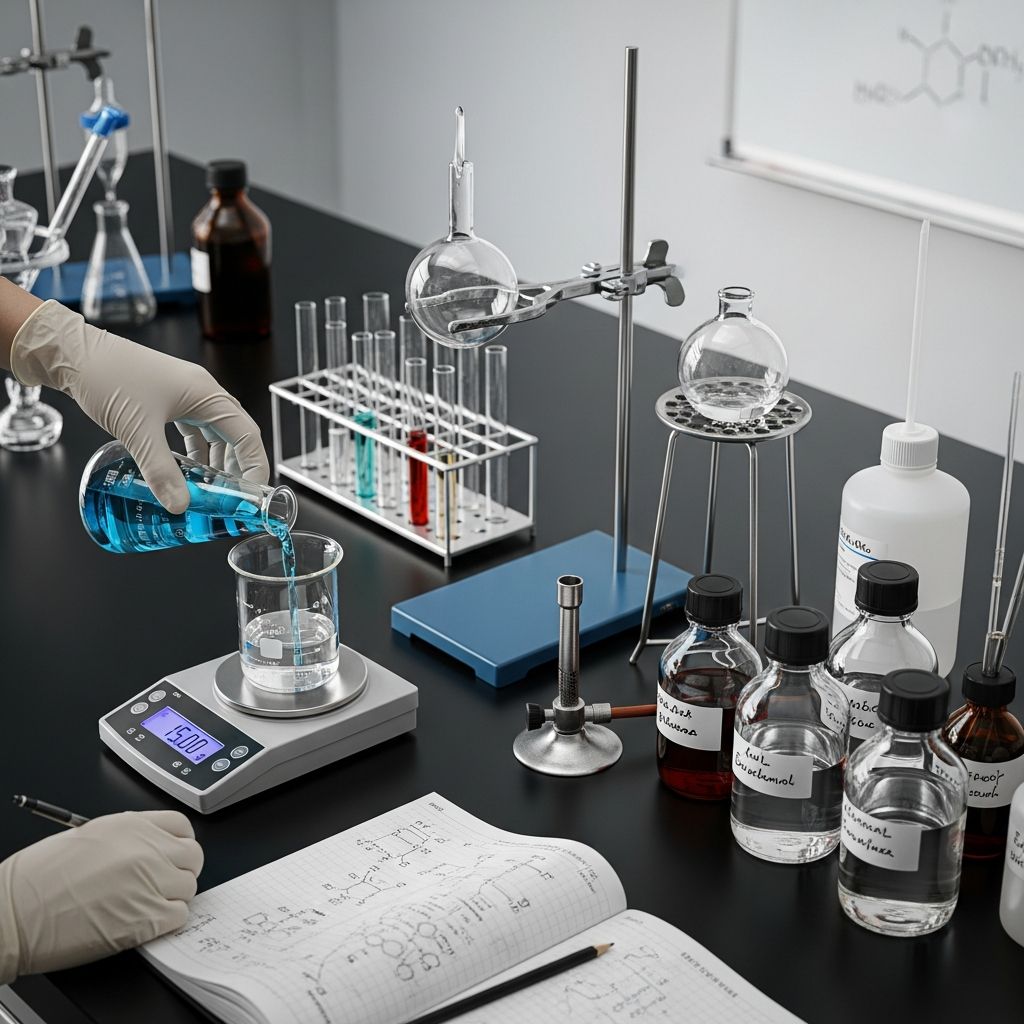
Success in chemistry laboratories demands thorough preparation, blending knowledge, safety awareness, and practical skills. This guide equips students with proven strategies to navigate labs confidently, drawing from educational best practices to enhance learning outcomes and experimental precision.
Building a Strong Foundation Before Entering the Lab
The cornerstone of effective lab work lies in pre-lab readiness. Begin by thoroughly reviewing the experiment’s objectives, required materials, and procedural steps. This foresight prevents errors and fosters a deeper understanding of chemical principles at play.
Consult your course syllabus or instructor communications for specific requirements. Identify the experiment’s goals—whether testing reaction rates or verifying stoichiometry—and connect them to lecture concepts. Reviewing background theory, such as relevant equations or reaction mechanisms, solidifies conceptual grasp.
- Read procedures multiple times: Anticipate challenges like timing-sensitive steps or potential side reactions.
- Gather preliminary data: Note expected outcomes, like color changes or gas evolution, to benchmark results.
- Practice calculations: Compute molarities, dilutions, or yields in advance to streamline in-lab math.
Institutions like the University of California San Diego emphasize that pre-lab familiarity reduces anxiety and boosts productivity, allowing focus on critical analysis rather than basic recall.
Prioritizing Safety: Your Non-Negotiable First Step
Safety protocols form the bedrock of lab preparation. Personal protective equipment (PPE) is mandatory: safety goggles, lab coats, closed-toe shoes, long pants, and gloves suited to the chemicals involved. Verify university policies, as some provide gear while others require personal purchase.
Familiarize yourself with hazard symbols, material safety data sheets (MSDS), and emergency procedures. Know locations of eyewash stations, fire extinguishers, and spill kits. For instance, handling acids or flammables demands specific ventilation and storage practices.
| Hazard Type | Precautions | PPE Required |
|---|---|---|
| Corrosives (e.g., HCl) | Use fume hood; neutralize spills | Goggles, gloves, apron |
| Flammables (e.g., ethanol) | No open flames; secure storage | Lab coat, goggles |
| Toxics (e.g., heavy metals) | Minimize skin contact; proper disposal | Nitrile gloves, respirator if needed |
Label all containers clearly with contents, concentrations, dates, and your initials to prevent mix-ups. Test equipment like Bunsen burners beforehand to avoid disruptions.
Acquiring and Maintaining Essential Lab Equipment
Inventory your assigned lab drawer early. Common items include beakers, flasks, pipettes, burettes, funnels, and thermometers. Learn their uses: graduated cylinders for volume precision, Erlenmeyer flasks for mixing.
Practice basic techniques via videos or demos, such as pipetting (hold at eye level for accuracy) or using a burette (rinse with titrant first). For new instruments like spectrophotometers, study operation manuals and calibration steps.
- Clean glassware properly: Rinse with deionized water; avoid scratches that harbor contaminants.
- Organize workspace: Designate areas for chemicals, waste, and clean tools to minimize cross-contamination.
- Check functionality: Ensure stopcocks work, joints fit snugly, and sensors calibrate correctly.
Grouping materials into pre-packed kits per experiment saves time and ensures completeness, a tactic recommended for efficient setups.
Developing Precision in Observation and Record-Keeping
Neat, detailed notes are invaluable for analysis and reports. Use a bound lab notebook with numbered pages; record everything in real-time with dates, times, and conditions (e.g., temperature, humidity).
Employ tables for data logging:
| Time (min) | Volume Added (mL) | pH | Observations |
|---|---|---|---|
| 0 | 0 | 7.0 | Clear solution |
| 1 | 5.0 | 4.2 | Faint cloudiness |
Capture qualitative details: odors, textures, precipitates. Photograph setups if permitted, noting scales. Balance objectivity with sketches for clarity.
Executing Procedures with Accuracy and Focus
Follow instructions sequentially, but think critically—question anomalies like unexpected colors. Stay engaged: divide tasks in groups, communicate clearly, and clean incrementally to avoid end-rush.
Practice skills like titration: swirl gently, add dropwise near equivalence. For microscale experiments, use smaller volumes to reduce waste and enhance safety.
- Minimize distractions: Silence phones; focus on one step.
- Verify measurements: Use balances to 0.001g precision.
- Handle waste responsibly: Segregate solids, liquids, and hazmat per guidelines.
Crafting Insightful Lab Reports
Post-lab, synthesize findings into structured reports: abstract, introduction, methods, results (with graphs), discussion, and conclusion. Highlight percent yields, error analysis, and theoretical ties.
Common pitfalls: vague discussions or ignoring errors. Use statistics like standard deviation for rigor. Proofread for clarity and units consistency.
Advanced Strategies for Lab Efficiency
For repeated labs, create reusable kits with sealed reagents. Color-code for multi-step processes. Delegate in teams: one preps glassware, another calibrates instruments.
Incorporate digital tools: apps for stoichiometry or sensors for real-time data. Reflect post-lab on improvements to build expertise over time.
Frequently Asked Questions
What should I wear to chemistry lab?
Wear closed-toe shoes, long pants, lab coat, and safety goggles. Avoid loose clothing or jewelry.
How do I handle chemical spills?
Alert others, evacuate if necessary, use spill kits, and notify instructors. Never mix cleaners.
What’s the best way to take lab notes?
Use a dedicated notebook, record in ink, include raw data, observations, and calculations immediately.
Do I need to memorize procedures?
No—understand them deeply through pre-reading to adapt to variations confidently.
How can I improve calculation speed?
Practice unit conversions, sig figs, and formulas daily outside lab.
Overcoming Common Challenges
Mistakes like contamination or misreading scales are learning opportunities. Review peers’ methods, seek TA feedback, and iterate. Persistence sharpens skills essential for research careers.
By integrating these preparations, students transform labs from daunting tasks into engaging scientific pursuits, paving the way for mastery in chemistry.
References
- 8 Must-Know Tips for Chemistry Lab Success — Stemly Tutoring. 2023-05-15. https://www.stemlytutoring.com/blog/top-8-chemistry-lab-tips
- Five Tips for Success in the Chemistry Lab — inChemistry (American Chemical Society). 2022-09-12. https://inchemistry.acs.org/college-life/five-tips-for-success-in-the-chemistry-lab.html
- Lab Prep Tips — Chemical Education Xchange. 2023-11-08. https://www.chemedx.org/blog/lab-prep-tips
- How to Prepare for your FIRST Chemistry Lab! — MyChemHelp (YouTube, University-affiliated channel). 2022-08-20. https://www.youtube.com/watch?v=DSLZbgZYqRM

Medha Deb is an editor with a master's degree in Applied Linguistics from the University of Hyderabad. She believes that her qualification has helped her develop a deep understanding of language and its application in various contexts. Medha specializes in the areas of beauty, health, sports, and wellness and is committed to ensuring that the content on the website is…