
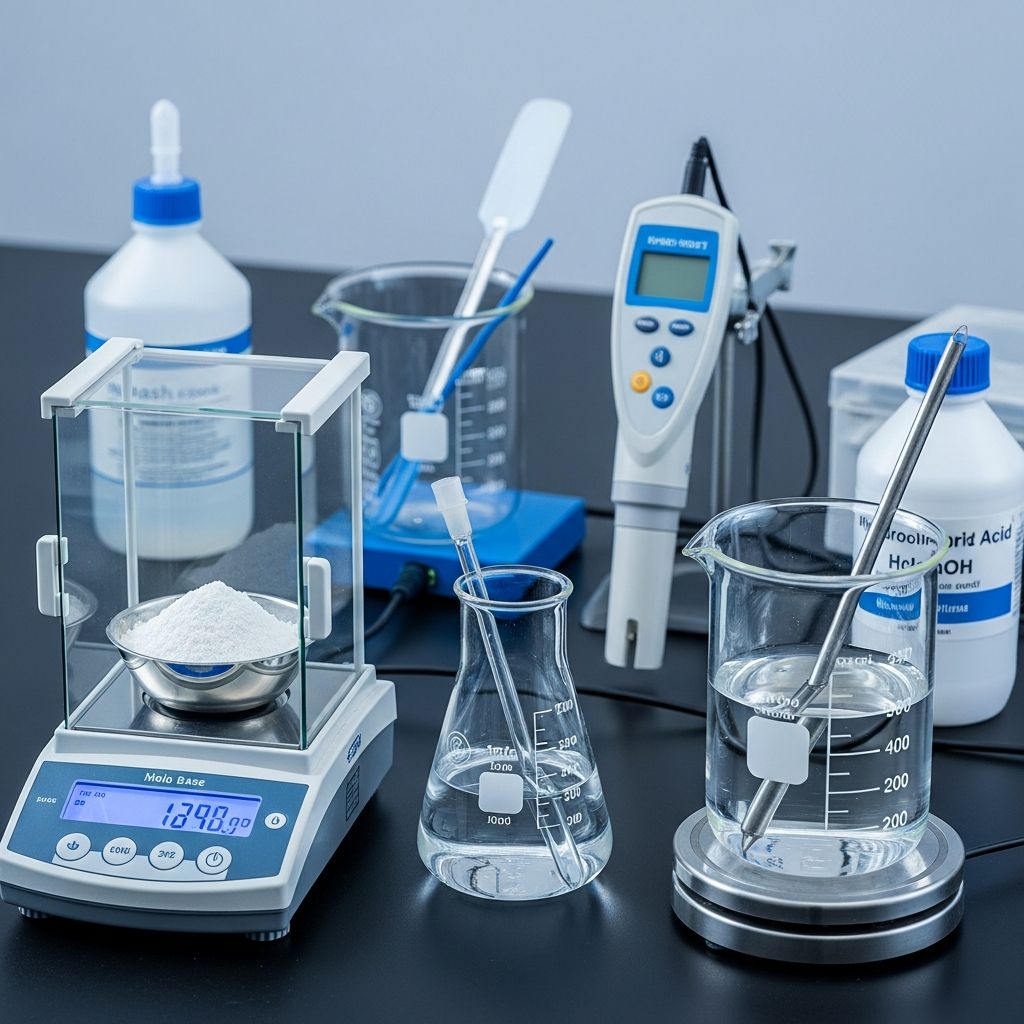
Tris buffer, known chemically as tris(hydroxymethyl)aminomethane, serves as a cornerstone in biochemical and molecular biology laboratories. This versatile buffering agent maintains stable pH levels in experimental setups, crucial for enzyme reactions, electrophoresis, and nucleic acid work. Understanding its preparation ensures reproducible results and experimental accuracy.
Fundamentals of Buffer Systems in Laboratory Research
Buffers resist pH changes upon addition of small amounts of acid or base, vital for biological processes sensitive to pH fluctuations. Tris, with a pKa of approximately 8.08 at 25°C, excels in the pH range of 7.2 to 9.0, ideal for many physiological simulations.
The Henderson-Hasselbalch equation governs buffer efficacy: pH = pKa + log([base]/[acid]). For Tris, the base form predominates above pKa, adjusted by adding HCl to form the conjugate acid, Tris-HCl.
Tris buffers exhibit temperature sensitivity, with pH decreasing about 0.028 units per 1°C rise. Always calibrate pH at the intended use temperature.
Essential Materials and Equipment
Accurate preparation demands high-purity reagents and calibrated tools:
- Tris base (molecular weight 121.14 g/mol, ≥99% purity)
- Concentrated hydrochloric acid (HCl, 6-12 M)
- Distilled or deionized water (nuclease-free for nucleic acid work)
- Analytical balance (precision ±0.01 g)
- pH meter with calibrated electrode
- Magnetic stirrer and stir bar
- Volumetric flasks (1 L class A preferred)
- 0.22 µm sterile filters for final sterilization
- Graduated cylinders and pipettes
Store Tris base in a cool, dry place to prevent moisture absorption, which can alter weighing accuracy.
Standard Recipes for Common Concentrations
Tris buffers are typically prepared as 1 M stocks, then diluted. Below are validated protocols from reliable sources.
1 M Tris-HCl, pH 7.2 (General Use)
This recipe yields 1 liter.
- Weigh 121.14 g Tris base.
- Dissolve in 800 mL distilled water in a beaker with stir bar.
- Stir until fully dissolved (solution turns clear).
- Adjust pH to 7.2 with concentrated HCl (add slowly; ~60-70 mL typical).
- Allow cooling to room temperature before final pH check.
- Bring to 1 L with distilled water.
| Component | Amount | Final Concentration |
|---|---|---|
| Tris base | 121.14 g | 1 M |
| HCl (conc.) | ~60-70 mL | Adjusts pH |
| Water | To 1 L | – |
1 M Tris-HCl, pH 7.4 (Nucleic Acid Resuspension)
Suitable for RNA/DNA work.
- Dissolve 12.1 g Tris base in 80 mL nuclease-free water (scales to 100 mL stock).
- Add ~6-7 mL conc. HCl slowly while stirring.
- Cool and fine-tune pH to 7.4.
- Adjust to 100 mL.
- Filter sterilize.
- Dilute 1:100 for 10 mM working buffer.
0.5 M Tris, pH 7.8 (Small Volume Example)
For 250 mL preparation.
- Add 210 mL water to beaker.
- Weigh 15.14 g Tris base (±0.02 g).
- Stir to dissolve fully.
- pH starts ~8.8-9.0; add HCl drops until pH 7.8.
- Transfer to cylinder, adjust to 250 mL.
- Verify pH post-dilution.
Step-by-Step Preparation Process
Follow this universal workflow for consistency.
- Water Setup: Measure ~80% final volume (e.g., 800 mL for 1 L).
- Tris Addition: Tare weigh boat, add Tris powder gradually while stirring to avoid clumps.
- Dissolution: Stir 10-15 min until clear. Heat gently if needed (<37°C).
- pH Adjustment: Calibrate pH meter with buffers (pH 4, 7, 10). Immerse probe, avoid stir bar contact. Add HCl dropwise, wait for stabilization (30-60 sec per addition). Temperature fluctuations affect reading—cool solution first.
- Final Volume: Transfer to volumetric flask, dilute to mark.
- Verification: Recheck pH. Filter if required.
- Labeling: Include concentration, pH, temp, date, preparer initials.
Pro Tip: HCl addition is exothermic; monitor temperature to prevent over-acidification.
Advanced pH Adjustment Techniques
For precision, use Method B from Fisher Scientific: Prepare 0.1 M Tris base (12.1 g/L), then add pre-calculated 0.1 M HCl volumes based on temperature-pH charts.
| pH at 25°C | mL 0.1 M HCl per 100 mL 0.1 M Tris |
|---|---|
| 7.7 | 73.2 |
| 8.3 | 39.8 |
| 8.9 | 14.0 |
This minimizes iterative adjustments. For automation, consider peristaltic pumps for HCl delivery.
Storage, Stability, and Sterilization
Store at 4°C in tightly sealed bottles; stable 6-12 months. Autoclave (121°C, 15 min) for sterility, but recheck pH post-cooling as it may shift slightly. Aliquot to avoid contamination.
Freeze-thaw cycles degrade buffers; use single-use aliquots for sensitive apps. Discard if precipitation or off-odor appears.
Practical Applications in Modern Labs
Tris buffers feature prominently in:
- Electrophoresis: SDS-PAGE running buffers (Tris-glycine).
- PCR and Enzymology: Maintains optimal pH for polymerases.
- Protein Purification: Equilibration/wash buffers in chromatography.
- Cell Culture: Component in lysis buffers.
- Nucleic Acid Work: Resuspension to protect against pH shifts.
In CRISPR workflows, 10 mM Tris-HCl pH 7.4 resuspends crRNA/tracrRNA, preventing degradation during freeze-thaw.
Troubleshooting Common Issues
| Problem | Cause | Solution |
|---|---|---|
| pH drifts post-adjustment | Temperature change or incomplete mixing | Recheck at use temp; remix thoroughly |
| Cloudy solution | Impure Tris or microbial growth | Use fresh reagents; filter sterilize |
| pH won’t stabilize | Uncalibrated meter or CO2 absorption | Recalibrate meter; work in draft-free area |
| Too acidic/basic | Overshot HCl addition | Prepare new batch; small increments next time |
Safety Protocols and Best Practices
Tris is mildly toxic (irritant); wear gloves, goggles. HCl is corrosive—use fume hood, add acid to water slowly. Dispose per lab waste guidelines.
Best Practices:
- Standardize procedures across lab.
- Validate with known standards.
- Document deviations.
- Train personnel on temperature effects.
Frequently Asked Questions (FAQs)
What is the effective pH range for Tris buffers?
Tris is effective from pH 7.2 to 9.0 due to its pKa of 8.08. Outside this, buffering capacity drops significantly.
Why does Tris pH change with temperature?
Tris ionization is temperature-dependent; pH decreases ~0.028 units/°C. Adjust at working temperature.
Can I autoclave Tris buffer?
Yes, but verify pH afterward as minor shifts occur. Filter sterilization suits nucleic acid apps.
How do I make lower concentrations?
Dilute 1 M stock (e.g., 1:10 for 100 mM). Recheck pH post-dilution.
Is nuclease-free water necessary?
Only for nucleic acid work; regular distilled suffices otherwise.
Scaling Recipes for Lab Needs
For small batches, scale proportionally but verify pH meticulously—errors amplify in tiny volumes. Example: 100 mL 1 M Tris requires 12.114 g base, ~6-7 mL HCl.
Expand this guide’s protocols to meet diverse experimental demands, ensuring reliability in research outcomes.
References
- Tris Buffer (1 M, pH 7.2) Preparation and Recipe — AAT Bioquest. Accessed 2026. https://www.aatbio.com/resources/buffer-preparations-and-recipes/tris-buffer
- Preparing Tris Buffer — BioNetwork (YouTube Transcript). Accessed 2026. https://www.youtube.com/watch?v=S6bgIeM5wSQ
- 10 mM Tris-HCl buffer pH 7.4 Protocol — Horizon Discovery. Accessed 2026. https://horizondiscovery.com/-/media/Files/Horizon/resources/Protocols/crrna-tracrrna-resuspension-buffer-protocol.pdf?sc_lang=en
- Preparation of Tris Stock Solutions — Fisher Scientific. Accessed 2026. https://www.fishersci.co.uk/webfiles/uk/web-docs/PAGE744.PDF
- Protocol II: 1 M Tris-HCl Buffer Stock Solution — New England Biolabs (NEB). Accessed 2026. https://www.neb.com/en/protocols/protocol-ii-1-m-tris-hcl-buffer-stock-solution-1-liter

- Integrated M.A. in Applied Linguistics, University of Hyderabad
- 5+ years in editorial, instructional, SEO, and research-based writing
Sneha is a relationships and lifestyle writer with a strong foundation in applied linguistics and certified training in relationship coaching. She brings over five years of writing experience to theskillvault, crafting thoughtful, research-driven content that empowers readers to build healthier relationships, boost emotional well-being, and embrace holistic living. Her writing and insights reflect the belief that beauty, happiness, and wellness…