
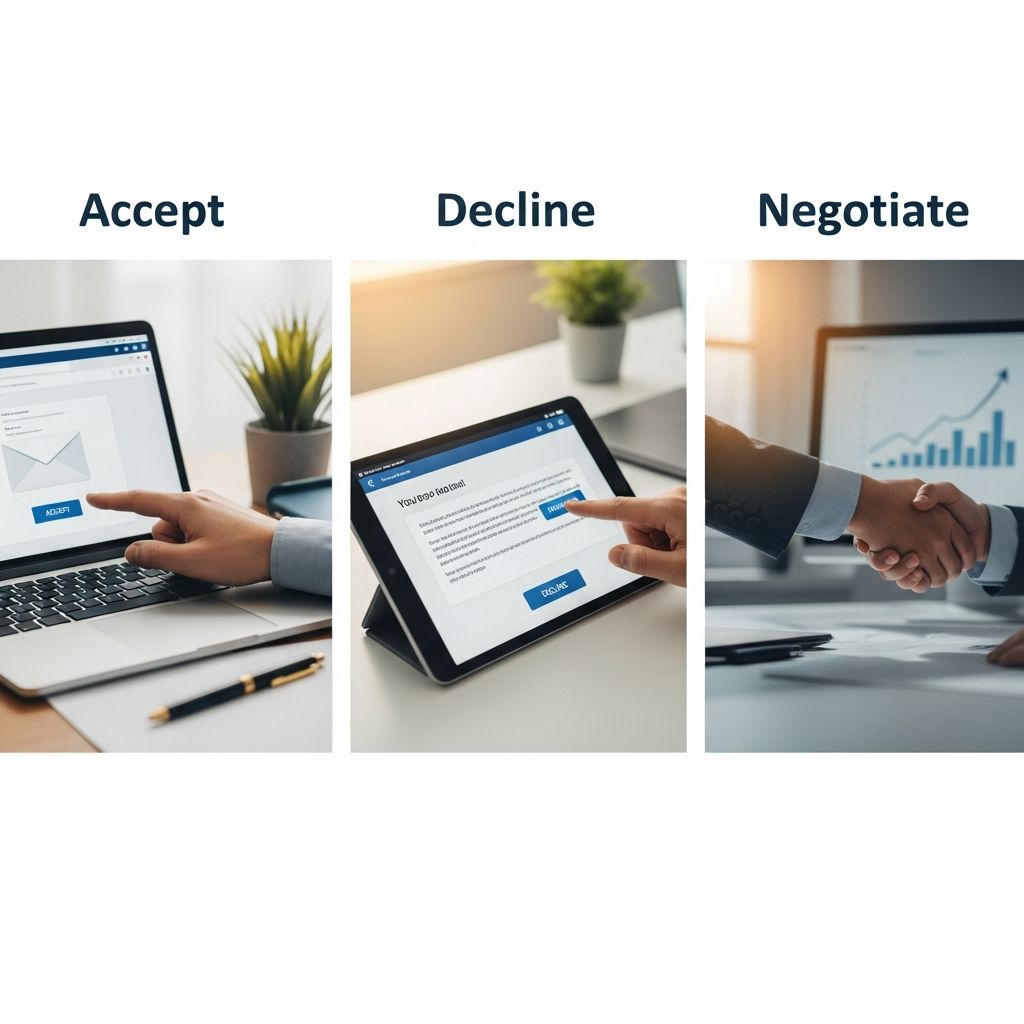
Getting a job offer in your inbox can be exciting, nerve-racking, or both. Whether you want to enthusiastically say yes, politely decline, or open a conversation about salary and benefits, your email response shapes how the employer sees you and can even affect your future negotiations.
This guide walks you through how to respond to a job offer by email in a clear, confident, and professional way. You will learn what to include, common mistakes to avoid, and sample wording you can adapt to your own situation.
Why Your Job Offer Email Response Matters
Your reply to a job offer is more than a formality. It is part of the employer’s written record and can influence both your relationship with the organization and your compensation.
- Professionalism: A clear, courteous email shows that you communicate well and respect others’ time.
- Clarity: Written communication helps prevent misunderstandings about salary, title, start date, and other terms of employment.
- Negotiation leverage: Email lets you organize your questions and requests thoughtfully instead of reacting under pressure in a call.
- Documentation: A written record of agreed terms is helpful if questions arise later about pay, responsibilities, or working arrangements.
Key Decisions Before You Hit “Reply”
Before drafting your email, be clear about what you want to achieve with your response. In most cases, you are doing one of four things:
- Accepting the offer as-is.
- Requesting more information or time to decide.
- Negotiating salary, benefits, or other terms.
- Declining the offer.
Knowing your goal will help you choose the right tone, level of detail, and structure for your message.
Essential Elements of Any Job Offer Email Response
Regardless of whether you are accepting, negotiating, or declining, almost every response should contain a few core components.
| Element | Why It Matters | Typical Placement |
|---|---|---|
| Subject line | Signals the purpose of your message and helps HR track the thread. | Email header |
| Greeting | Sets a polite, professional tone. | Opening line |
| Thank-you | Shows appreciation for the offer and the employer’s time. | First paragraph |
| Clear statement of intent | Makes it obvious whether you are accepting, declining, or requesting changes. | Early in the body |
| Key details | Confirms job title, start date, salary, or the specific terms you are discussing. | Middle of the email |
| Next steps | Clarifies what should happen after your email (signing a contract, scheduling a call, etc.). | Final paragraph |
| Professional sign-off | Closes the message on a courteous note and includes your contact info. | End of email |
How to Accept a Job Offer by Email
When you are ready to say yes, your main goals are to confirm the terms, express enthusiasm, and set a clear path toward your start date.
Checklist for an Acceptance Email
- Use a direct subject line, such as “Offer Acceptance – [Your Name]”.
- Address the correct person (usually the hiring manager or recruiter).
- Thank them for the offer and the opportunity.
- Clearly state that you accept the role.
- Confirm the job title and, if known, your start date.
- Reference the offer letter or agreed terms (e.g., salary or remote-work arrangement).
- Ask about any paperwork, onboarding details, or pre-employment steps.
- Close with a professional sign-off and your full name.
Clarity at this stage reduces the risk of confusion later about the nature of the role, the level of responsibility, or the expected schedule.
How to Ask for More Time or Information
If you are not ready to decide, it is reasonable to ask for clarification or additional time—especially for complex roles or when you are balancing more than one opportunity.
When to Request More Time
- You are waiting to hear back from another employer.
- You need to review the full benefits package or contract in detail.
- You want to discuss the offer with family or a mentor.
- You need clarity on responsibilities, reporting structure, or working hours.
Be honest without oversharing. Employers are familiar with candidates needing a few days to decide, and some career centers even recommend carefully reviewing offers rather than accepting on the spot.
What to Include in a “More Time” Email
- A warm thank-you and expression of interest in the role.
- A clear statement that you are still considering the offer.
- A specific date by which you can give a final answer.
- Any key questions that affect your decision (for example, benefits, remote options, or relocation support).
How to Negotiate a Job Offer via Email
Email is often an appropriate place to start a negotiation, though many employers will move detailed conversations to a call or video meeting. Research on negotiation suggests that preparing your arguments and focusing on objective information (such as market salary data and role responsibilities) can improve outcomes.
Steps to Prepare Before Negotiating
- Research the market: Look up typical salaries for your role, level of experience, and location using reliable compensation data sources.
- Review the entire package: Consider base pay, bonuses, benefits, paid time off, flexibility, and professional development, not just salary.
- Set your priorities: Decide which 1–3 items matter most (for example, salary, remote work days, or a signing bonus).
- Plan your rationale: Link your request to your skills, the responsibilities of the role, and relevant market data.
Structure of a Negotiation Email
- Begin by thanking the employer and stating that you are excited about the role.
- Signal that you would like to discuss specific terms (for example, base salary or vacation time).
- Briefly explain why you are requesting a change, using neutral, professional language.
- Make a clear, realistic counterproposal or range rather than saying you “want more” in general.
- Invite a conversation by suggesting a call or providing times when you are available.
Keeping the tone collaborative rather than confrontational encourages the employer to see you as a partner instead of an adversary, which is consistent with best practices in negotiation research.
How to Politely Decline a Job Offer
Turning down an offer can feel awkward, but a thoughtful, respectful email helps preserve the relationship and leaves the door open for future opportunities.
Principles for Declining Gracefully
- Respond as soon as you are sure you will not accept.
- Express genuine appreciation for the offer and any time spent interviewing you.
- Give a brief, honest reason without criticizing the company (for example, another opportunity, role mismatch, or personal circumstances).
- Wish them well and, if appropriate, show interest in staying in touch.
Career professionals often note that industries can be smaller than they appear, and handling rejections professionally can protect your reputation over the long term.
Common Mistakes to Avoid in Job Offer Emails
Even a strong candidate can leave a negative impression with a poorly written response. Avoid these frequent errors:
- Being vague: Failing to state clearly whether you accept, decline, or need more time creates confusion for HR and hiring managers.
- Using overly casual language: Treat your email as business correspondence, not a text message.
- Leaving out key details: Not confirming the role or start date can lead to misunderstandings later.
- Missing deadlines: Ignoring a response date without communicating can lead employers to withdraw the offer.
- Writing while emotional: If you feel frustrated or disappointed, step away and respond later with a calm tone.
- Skipping a final proofread: Simple spelling or formatting errors can distract from your message and appear careless.
Quick Subject Line Ideas
Your subject line should be short, descriptive, and easy for the employer to recognize in a crowded inbox.
- If you are accepting:
- “Offer Acceptance – [Your Name]”
- “Accepting [Role Title] Offer”
- If you are negotiating or asking questions:
- “Offer for [Role Title] – Follow-up Questions”
- “[Role Title] Offer – Details and Next Steps”
- If you are declining:
- “Regarding Offer for [Role Title] – [Your Name]”
Practical Email Building Blocks You Can Reuse
Use the phrasing below as modular pieces you can adapt to your own email for different situations.
Openers That Work in Most Situations
- “Thank you for offering me the position of [Role Title] at [Company Name].”
- “I appreciate the time you and the team spent speaking with me about this opportunity.”
- “I was excited to receive your email about the offer for [Role Title].”
Phrases for Accepting
- “I am pleased to formally accept this offer.”
- “I look forward to joining the team on [Start Date].”
- “As outlined in the offer letter, I understand that the starting salary will be [Amount].”
Phrases for Requesting More Time or Information
- “I am very interested in this opportunity and would like to review the full details before making a final decision.”
- “Would it be possible to confirm [specific detail], such as benefits coverage or working hours?”
- “Could I let you know my final decision by [Date]?”
Phrases for Negotiating
- “I am excited about the role and would like to discuss the base salary component of the offer.”
- “Based on my experience in [relevant area] and current market ranges, I was expecting a salary closer to [Target Amount].”
- “Would you be open to a brief call this week to talk through compensation and benefits?”
Phrases for Declining
- “After careful consideration, I have decided to pursue a different opportunity.”
- “This was a difficult decision, as I enjoyed learning more about the team and the work you are doing.”
- “I truly appreciate the offer and hope our paths may cross again in the future.”
Frequently Asked Questions About Job Offer Emails
Q: How quickly should I respond to a job offer email?
You should acknowledge the offer within 24 hours, even if you are not ready to decide. A brief note thanking them and stating when you will provide a final answer shows professionalism and respect for their timeline.
Q: Is email always the right way to respond to a job offer?
Email is widely accepted as a formal response method, especially when the offer itself arrived electronically. However, some organizations may request a phone call or an online system confirmation in addition to email, so follow any instructions in the offer letter or message.
Q: Can I negotiate after verbally accepting an offer?
It is much easier and more ethical to negotiate before you accept. Once you have clearly accepted the offer, employers may see later attempts to renegotiate as backing out of an agreement. If you realize you misunderstood a major term, contact them immediately and explain the situation honestly.
Q: What if I am waiting on another company’s decision?
You do not need to name the other employer, but you can say that you are still in the process of making a decision and respectfully ask for a short extension. Many career advisors recommend being transparent about your need for time while still expressing sincere interest in the role you have been offered.
Q: Should I mention salary research or competing offers directly in my email?
You can reference market data briefly when you negotiate, especially if you focus on the value you bring to the role rather than threats to go elsewhere. If you mention another offer, do so factually and respectfully, not as an ultimatum.
Q: Is it unprofessional to decline by email?
In many cases, declining by email is acceptable, particularly if communication has already been primarily written. For senior roles or where you developed a strong relationship with the interviewer, you may choose to call first and then follow up with a short email so there is a written record.
References
- Accepting a Job Offer via E-Mail (With Sample Responses) — Indeed Editorial Team. 2023-05-18. https://ca.indeed.com/career-advice/starting-new-job/how-to-accept-a-job-offer-via-email
- How to Write an Accept Job Offer Email (10 Examples) — MailTracker Blog. 2023-08-10. https://www.getmailtracker.com/blog/accept-job-offer-email
- Offer Letter Acceptance Reply Sample Templates & Examples — NEO. 2024-02-06. https://www.neo.space/blog/accept-job-offer-email
- How To Accept A Job Offer – Examples & Templates — Give A Grad A Go. 2023-03-02. https://giveagradago.com/resources/blog/how-to-accept-a-job-offer/
- 12 Follow-up Email Templates for Every Work Situation — Hardin-Simmons University Career Services. 2024-12-03. https://careerservices.hsutx.edu/blog/2024/12/03/12-follow-up-email-templates-for-every-work-situation/
- Negotiating Job Offers — Harvard Law School Program on Negotiation. 2022-11-14. https://www.pon.harvard.edu/daily/salary-negotiations/negotiating-job-offers/

- Integrated M.A. in Applied Linguistics, University of Hyderabad
- 5+ years in editorial, instructional, SEO, and research-based writing
Sneha is a relationships and lifestyle writer with a strong foundation in applied linguistics and certified training in relationship coaching. She brings over five years of writing experience to theskillvault, crafting thoughtful, research-driven content that empowers readers to build healthier relationships, boost emotional well-being, and embrace holistic living. Her writing and insights reflect the belief that beauty, happiness, and wellness…