
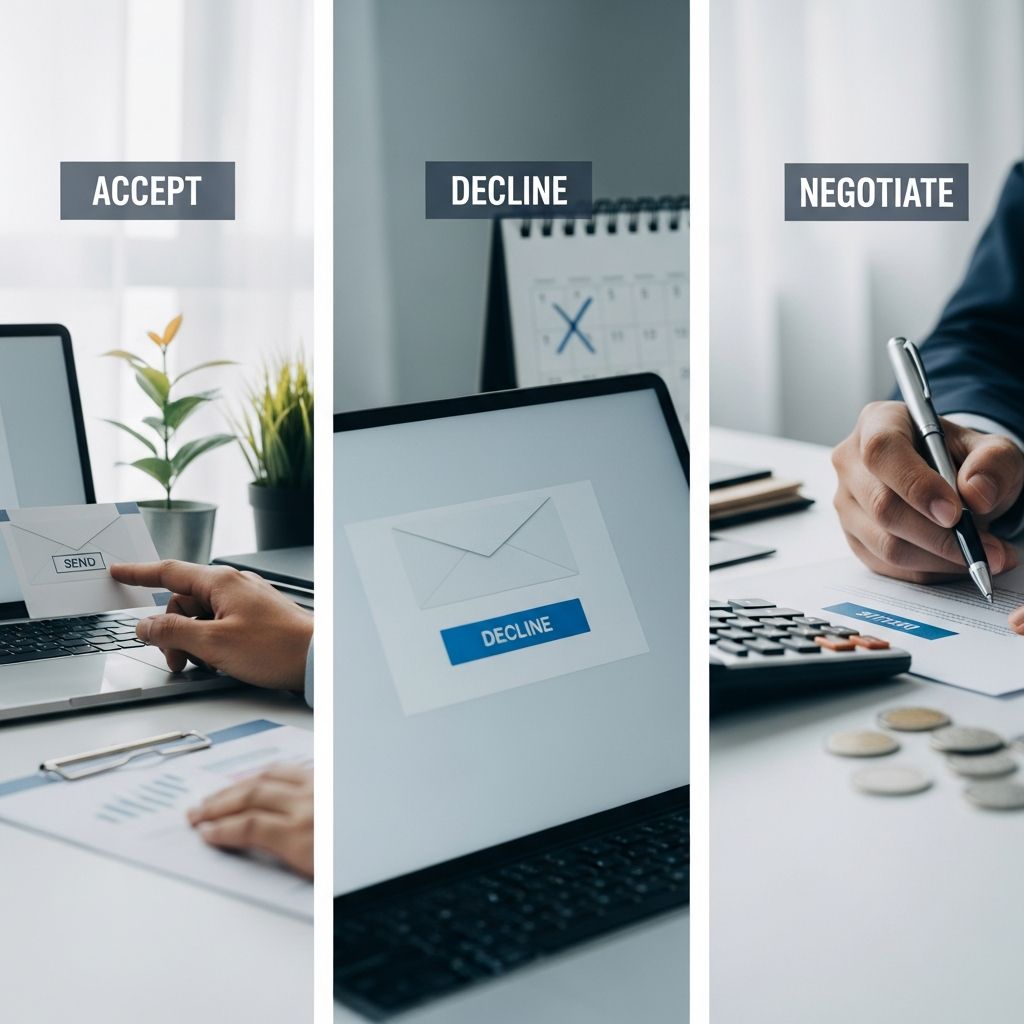
Receiving a job offer by email is exciting—but it can also feel intimidating if you are not sure how to respond. A clear, well-structured reply helps you make a strong impression, protect your interests, and keep the door open for future opportunities.
This guide walks you through how to respond to a job offer email in four common situations: accepting, asking questions, negotiating, and declining. You will learn what to include, what to avoid, and how to adapt sample structures to your own circumstances.
Core Principles for Any Job Offer Email
Regardless of whether you say yes, no, or “not yet,” every response should follow a few core professional principles.
- Be prompt: Most employers expect a reply within a few days, or sooner if they gave a specific deadline.
- Be clear: State your decision or request directly so the employer knows how to proceed.
- Be courteous: Thank the employer for the offer and for their time, even if you decide not to accept.
- Be accurate: Restate key terms (role, salary, start date) only when you understand them correctly.
- Be honest: If you need more time or information to decide, say so instead of going silent.
Career guidance sites and university career centers consistently emphasize timely, polite, and unambiguous communication when responding to offers, especially in writing.
Before You Hit Reply: Quick Pre-Email Checklist
Take a brief pause before you respond. Use this checklist to avoid missteps.
- Have you read the full offer letter (including attachments and benefits information)?
- Do you understand the job title, reporting line, and primary responsibilities?
- Are the salary, bonuses, and benefits clearly described?
- Do you know the proposed start date and work location or hybrid policy?
- Is the reply deadline clear, or do you need to ask for one?
If anything is missing or unclear, your first email should acknowledge the offer and request clarification rather than giving a final yes or no.
Recommended Email Structure
Most job offer responses can follow the same basic structure, with small adjustments depending on your goal.
| Section | Purpose | Works For |
|---|---|---|
| Subject line | Signals that your message concerns the offer. | All scenarios |
| Greeting | Address the correct person respectfully by name. | All scenarios |
| Appreciation | Thank them for the offer and their time. | Accepting, negotiating, asking for time, declining |
| Main message | State your decision or request clearly. | All scenarios |
| Clarifications or conditions | Ask questions, confirm terms, or outline negotiation points. | Questions, negotiations |
| Next steps | Ask about contracts, onboarding, or a call. | Mostly accepting and negotiating |
| Closing | End on a professional and positive note. | All scenarios |
How to Accept a Job Offer by Email
When you are ready to say yes, your acceptance email should do three things: express gratitude, clearly accept the offer, and confirm essential details like the role and start date.
Key elements of an acceptance email
- Subject line: For example: “Job Offer Acceptance – [Your Name]”
- Thank you: A brief sentence thanking them for the opportunity.
- Explicit acceptance: A clear statement that you accept the offer.
- Role and company: State the exact job title and employer name to avoid ambiguity.
- Start date: Confirm the agreed date or propose one if it is still flexible.
- Next steps: Ask if there is any paperwork, background check, or onboarding information you should complete.
- Professional sign-off: Close with a polite sign-off and your full name.
Example structure: acceptance email
Use this structure as a guide and adapt the wording to your voice:
- Opening: “Thank you for offering me the [job title] position at [company].”
- Acceptance: “I am pleased to accept and look forward to joining the team.”
- Confirmation: “As outlined, the role will begin on [start date].”
- Optional detail: “I appreciate the clarity around the salary of [amount] and the benefits package.”
- Next steps: “Please let me know if there are any documents I should review or sign before my first day.”
- Closing: “Thank you again for this opportunity.”
Some organizations treat a written acceptance email as a binding confirmation, so be sure your decision is final before you send it.
How to Ask Questions or Request More Information
It is reasonable—and often wise—to ask follow-up questions before you decide. Employment experts emphasize that understanding duties, compensation, and work conditions is essential to making an informed decision.
Common reasons to request more details
- You want to clarify job responsibilities or reporting lines.
- You need more information about benefits, bonuses, or overtime.
- You are unsure about remote work expectations or travel requirements.
- You would like to speak with future teammates or a supervisor.
Structure for an information-seeking email
- Open with thanks and enthusiasm about the offer.
- State that you are seriously considering the role.
- List your questions in a concise, organized way (bullets can help).
- Request a brief call or confirm that email responses are fine.
- Reiterate that you want to make a thoughtful and informed choice.
For example, after a positive but brief offer conversation, you might write that you are excited about the role but would appreciate clarification on specific areas before giving a final answer.
How to Ask for More Time to Decide
If you need more time to compare opportunities, relocate, or consider personal commitments, you can request an extension. Research on job search behavior suggests candidates often juggle multiple steps at once—applications, interviews, and offers—so asking for a little extra time is common when done respectfully.
Tips for requesting extra time
- Check the deadline: If the employer already gave you a date, reference it directly.
- Be specific: Propose a concrete date by which you can respond.
- Show genuine interest: Make clear that you are carefully considering the offer, not ignoring it.
- Keep it brief: You do not need to explain every detail of what you are weighing.
Example structure: extension request
- Opening: Thank them and note that you are excited about the opportunity.
- Reference: Mention the current response deadline if one exists.
- Request: Ask if it would be possible to respond by a specific later date.
- Reassurance: Emphasize that you want to give the offer the serious consideration it deserves.
- Closing: Express appreciation for their flexibility.
How to Negotiate a Job Offer via Email
When the role is a great fit but some terms are not, negotiation is appropriate. Many employers expect candidates to negotiate, especially on salary and sometimes on benefits or start date. Academic and career resources note that polite, well-prepared negotiation can improve outcomes without harming the relationship when framed collaboratively.
What you might negotiate
- Base salary
- Signing bonus or relocation support
- Flexible work arrangements or hybrid schedule
- Additional vacation days or professional development budget
- Job title adjustments that better match responsibilities
Best practices for salary and terms negotiation
- Do your research: Use reliable salary data (for example, government labor statistics or reputable salary surveys) to understand typical pay ranges for your role and location.
- Focus on value: Explain the skills, experience, or achievements you bring that justify your request.
- Be specific and realistic: Propose a clear number or range rather than “more,” and keep it within a reasonable band.
- Stay positive: Frame your request as a mutual fit discussion, not an ultimatum.
- Consider the full package: If salary is fixed, ask whether other aspects (vacation, training, hybrid work) might be flexible.
Structure for a negotiation email
- Start with appreciation for the offer and excitement about the role.
- State that you would like to discuss one or two specific terms of the offer.
- Briefly share context: your research, competing market rates, or added responsibilities.
- Make a clear, reasonable request with a number or proposal.
- Invite a conversation, often by suggesting a short call.
- Reiterate that you are enthusiastic and hope to reach an agreement.
For example, you might write that, based on market data for similar roles and your years of experience, you were expecting compensation in a slightly higher range and ask whether the employer can move closer to that figure.
How to Decline a Job Offer Gracefully
Declining an offer can feel uncomfortable, but it is better to respond clearly and courteously than to delay or avoid answering. Professional career resources emphasize that a respectful rejection helps you preserve the relationship and your reputation for future opportunities.
Reasons you might decline
- You accepted another offer that is a better match.
- The responsibilities or culture are not aligned with your goals.
- The salary or benefits are significantly below your needs and cannot be adjusted.
- Life circumstances changed (relocation, caregiving, further study, etc.).
Structure for a decline email
- Open with thanks for the offer and the time invested in you as a candidate.
- State clearly that you have decided not to accept the position.
- Optionally, briefly mention a high-level reason (without criticizing the employer).
- Express appreciation for meeting the team or learning about the organization.
- End by wishing them success and, if appropriate, suggesting you would like to stay in touch.
You do not need to disclose personal details or compare offers line by line. A concise, sincere note is enough.
Common Mistakes to Avoid in Job Offer Emails
Even a strong candidate can weaken their standing with a poorly written reply. Avoid these common pitfalls:
- Taking too long to respond: Silence can lead employers to assume disinterest.
- Being vague: Phrases like “I think I will accept” can create confusion—be definite.
- Using overly casual language: Treat this as a formal business communication, not a text message.
- Accepting before reading the full offer: Always confirm that the terms match what was discussed.
- Making demands: Negotiation should be polite and collaborative, not confrontational.
- Forgetting to proofread: A quick review for typos and names shows attention to detail.
Quick Reference: Example Subject Lines
- Accepting an offer: “Job Offer Acceptance – [Your Name]”
- Negotiating: “Job Offer – Follow-Up and Questions”
- Requesting more time: “Job Offer – Timeline Question”
- Declining: “Regarding Job Offer for [Job Title]”
Frequently Asked Questions (FAQs)
How fast should I respond to a job offer email?
Ideally, acknowledge the offer within 24 hours, even if you need more time to decide. In your first reply, thank them and either accept, decline, ask questions, or request a specific extension. Many employers are willing to give a few days if you communicate clearly.
Is an email response legally binding?
In many regions, a written acceptance of an offer can be considered an agreement, especially if the terms were clearly laid out in writing. Labor and contract law vary by jurisdiction, so if you have concerns, consult official employment resources or a legal professional before confirming.
Should I negotiate by email or phone?
You can initiate negotiation by email because it lets you organize your points and avoid reacting under pressure. However, many candidates then move the discussion to a short call to talk through details in a more conversational way.
Can I change my mind after accepting?
Withdrawing after acceptance should be a last resort, as it may affect your professional reputation. If your situation changes dramatically, notify the employer as soon as possible, apologize for the inconvenience, and keep your explanation straightforward.
What if I never received a written offer letter?
If you received only a verbal offer, you can respond with appreciation and ask for a formal written document outlining the terms before you accept. This helps both you and the employer avoid misunderstandings about pay, duties, or start date.
References
- Accepting a Job Offer via E-Mail (With Sample Responses) — Indeed Career Guide. 2022-05-11. https://ca.indeed.com/career-advice/starting-new-job/how-to-accept-a-job-offer-via-email
- How to Write an Accept Job Offer Email (10 Examples) — MailTracker Blog. 2023-08-01. https://www.getmailtracker.com/blog/accept-job-offer-email
- Offer Letter Acceptance Reply Sample Templates & Examples — NEO Blog. 2023-04-15. https://www.neo.space/blog/accept-job-offer-email
- Exactly How to Respond to a Job Offer via Email (With Examples) — Tufts University Career Center. 2024-01-15. https://careers.nutrition.tufts.edu/blog/2024/01/15/exactly-how-to-respond-to-a-job-offer-via-email-with-examples/
- How to Accept a Job Offer — Give a Grad a Go Career Advice. 2023-06-06. https://givegradago.com/resources/blog/how-to-accept-a-job-offer/
- Occupational Employment and Wage Statistics — U.S. Bureau of Labor Statistics. 2024-04-03. https://www.bls.gov/oes/
- Free Salary Negotiation Email Template — Michael Page Australia Career Advice. 2023-09-10. https://www.michaelpage.com.au/advice/career-advice/salary-negotiation/free-salary-negotiation-email-template

Medha Deb is an editor with a master's degree in Applied Linguistics from the University of Hyderabad. She believes that her qualification has helped her develop a deep understanding of language and its application in various contexts. Medha specializes in the areas of beauty, health, sports, and wellness and is committed to ensuring that the content on the website is…