
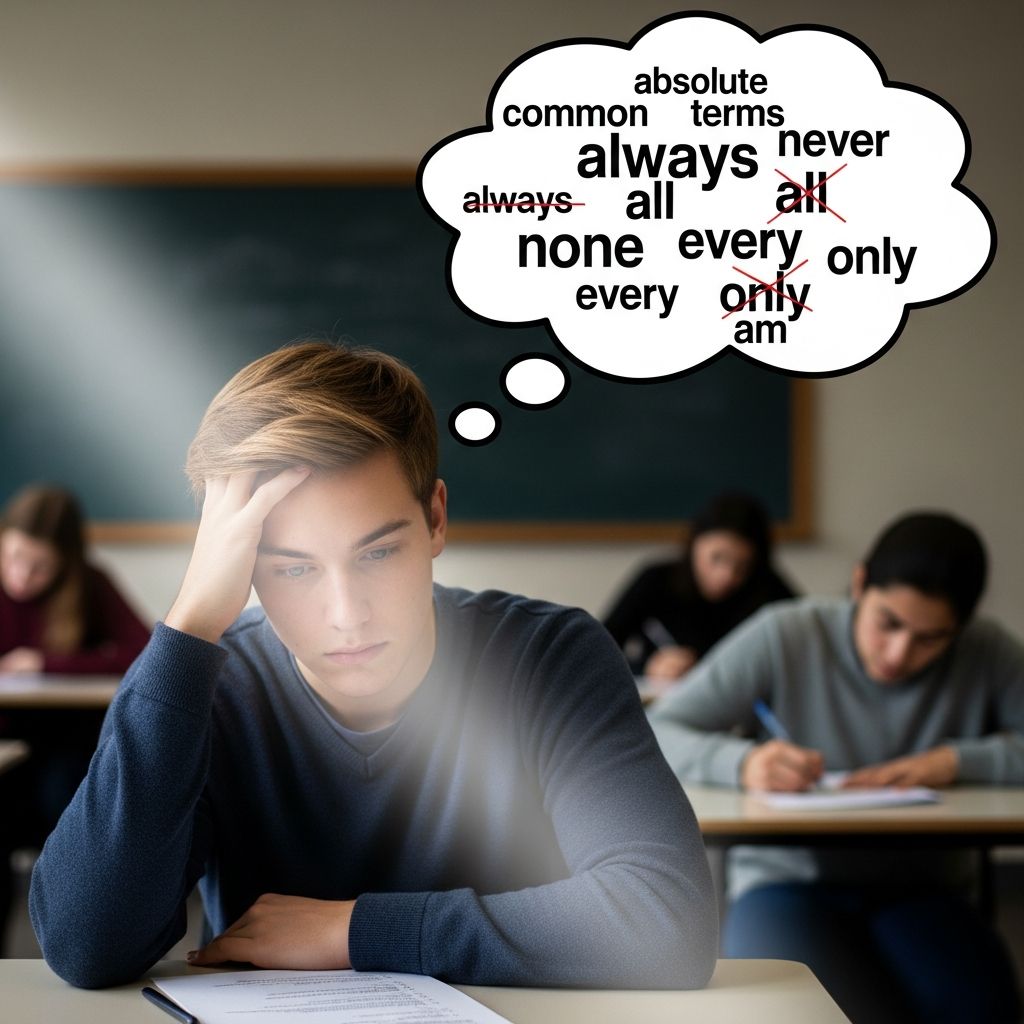
Absolute language on the SAT often appears in reading comprehension and writing sections, using words like “always,” “never,” “all,” “none,” and “every” to create tricky answer choices. Recognizing these terms helps students eliminate overly extreme options and select more nuanced, accurate responses supported by the passage.
Why Absolutes Trip Up Test-Takers
Absolute terms promise certainty but rarely align with the subtle realities described in SAT passages. Passages typically present qualified viewpoints from authors, historians, or scientists, avoiding black-and-white statements. When an answer choice introduces an absolute, it exaggerates the text, making it incorrect. For instance, a passage might discuss a historical event’s “frequent” occurrences, but an answer claiming it happened “always” distorts the evidence.
This pattern stems from SAT design by the College Board, which tests critical reading by rewarding precise interpretation over sweeping generalizations. Students who overlook absolutes fall into traps, assuming strong language matches the passage’s tone. Instead, correct answers use qualifiers like “often,” “sometimes,” or “likely,” mirroring the text’s measured language.
Common Absolute Words to Flag
Train your eye to spot these frequent offenders immediately:
- Always: Implies unbroken consistency, rare in complex topics.
- Never: Suggests total absence, almost never accurate in passages.
- All or Every: Claims universality without exceptions.
- None or No: Denies any instance, overly restrictive.
- Definitely or Certainly: Presents unproven absolutes as fact.
These words create “extreme” choices that sound confident but contradict the passage’s nuance. In vocabulary-in-context questions, absolutes misdefine words like “acute,” which means “sharp” or “keen,” not “absolute” in every case.
Spotting Absolutes in Reading Passages
In SAT Reading, absolutes dominate wrong answers for main idea, detail, and inference questions. Consider a passage on environmental changes: If it states “many species adapt to climate shifts,” an absolute like “all species survive unchanged” is wrong. Practice by underlining absolutes in answer choices first—they’re often eliminators.
Table of Absolute Trap Examples:
| Passage Nuance | Absolute Wrong Answer | Correct Qualified Answer |
|---|---|---|
| Researchers observed frequent but not universal patterns. | Patterns occur always. | Patterns occur frequently. |
| Historical figures sometimes influenced policy. | Figures never failed to act. | Figures often shaped outcomes. |
| Most artifacts show cultural evolution. | All artifacts prove decline. | Many artifacts indicate change. |
This table illustrates how absolutes invert the passage’s meaning. Official practice tests reinforce this: In one, a choice with “had reached” fails tense agreement and absolute implication.
Strategies for Reading Section Success
- Pre-Scan Choices: Read questions, then skim answers for absolutes. Cross them out if the passage lacks matching strength.
- Match Passage Tone: Note the author’s qualifiers (e.g., “may,” “tend to”) and favor similar answers.
- Test Extremes: Ask, “Does the text support 100%?” Rarely yes.
- Practice with Vocab: Words like “adamant” (unyielding) might tempt absolutes, but context shows nuance.
Applying these raises accuracy. PrepScholar analysis of hard questions shows 80% of traps use absolutes in complex sentences.
Absolute Language in Writing and Language
SAT Writing tests grammar, punctuation, and style, where absolutes hide in faulty sentences. Questions on verb agreement or conciseness often pair with extreme phrasing. For example, “The team always wins” implies no losses, illogical without evidence. Correct choices use conditionals or qualifiers.
Tense tables help: Absolutes clash with progressive forms emphasizing duration, not permanence.
| Tense Type | Example Without Absolute | Absolute Pitfall |
|---|---|---|
| Present Perfect | She has completed assignments. | She always completes (overgeneralizes). |
| Future Perfect | They will have finished by noon. | They will always finish (unwarranted certainty). |
| Past Perfect Progressive | He had been working all day. | He never stopped working (ignores breaks). |
From College Board tests, choices like “create” vs. “are creating” hinge on avoiding absolute implications in context.
Building Precision in Expression
Beyond elimination, craft responses mirroring passage precision. In rhetoric questions, absolutes weaken arguments. A claim like “Science proves all theories” ignores debate; better: “Science supports many theories.” Practice rewriting absolutes: Change “never fails” to “rarely disappoints.”
Vocabulary mastery aids: Terms like “coherent” (logically consistent) contrast absolutes’ rigidity. Digital SAT emphasizes Standard English Conventions, where absolutes disrupt flow.
Practice Drills to Sharpen Skills
Simulate test conditions with targeted exercises:
- Drill 1: Read a passage snippet, list absolutes in foils.
- Drill 2: Rewrite five sentences, replacing absolutes with qualifiers.
- Drill 3: Time yourself eliminating 10 choices with absolutes.
Example Drill: Passage: “Agile animals often evade predators, though some do not.” Question: Main idea? A) All agile animals escape. B) Agile animals frequently evade. (B correct.)
Consistent practice builds instinct. YouTube breakdowns of SAT tests highlight absolute errors in 70% of misses.
Advanced Tactics for High Scorers
Top performers predict absolutes before reading choices. In paired passages, contrast views: One says “most historians agree,” so “all” is wrong. For command-of-evidence, absolutes ignore partial support.
Track errors: Log absolute misses in a journal, noting passage type (science, history). Over time, recognition speeds up, targeting 150+ scores.
FAQs
What if the passage uses an absolute?
Rare, but possible in quotes. Verify exact match; otherwise, it’s a trap.
Are absolutes more common in digital SAT?
Yes, in concise Writing modules, testing precision under time pressure.
How many questions involve absolutes?
Estimate 10-15 per Reading/Writing section, per official practices.
Can vocab lists help?
Yes, words like “apocryphal” (false) teach nuance over absolutes.
Practice resources?
College Board PDFs, PrepScholar hard questions.
Mastering absolutes transforms SAT performance, turning pitfalls into points. Integrate daily review for peak results.
References
- The 1000 Most Common SAT Words — SparkNotes. N/A. https://img.sparknotes.com/content/testprep/pdf/sat.vocab.pdf
- SAT Practice Test 10 – Reading-Writing — Focus on Learning Center. 2018-10-01. https://focusonlearningcenter.com/wp-content/uploads/2020/07/October-2018-SAT-Test-Practice-Test-10-Reading-Writing-and-Language-Version.pdf
- The 12 Hardest SAT Writing Questions Ever — PrepScholar Blog. N/A. https://blog.prepscholar.com/the-12-hardest-sat-writing-questions-ever
- A Guide to Digital SAT Grammar and Punctuation — Test Innovators. N/A. https://testinnovators.com/blog/standard-english-conventions-guide-digital-sat/
- SAT Practice Test #6 — College Board SAT Suite. N/A. https://satsuite.collegeboard.org/media/pdf/sat-practice-test-6-digital.pdf

- Integrated M.A. in Applied Linguistics, University of Hyderabad
- 5+ years in editorial, instructional, SEO, and research-based writing
Sneha is a relationships and lifestyle writer with a strong foundation in applied linguistics and certified training in relationship coaching. She brings over five years of writing experience to theskillvault, crafting thoughtful, research-driven content that empowers readers to build healthier relationships, boost emotional well-being, and embrace holistic living. Her writing and insights reflect the belief that beauty, happiness, and wellness…