
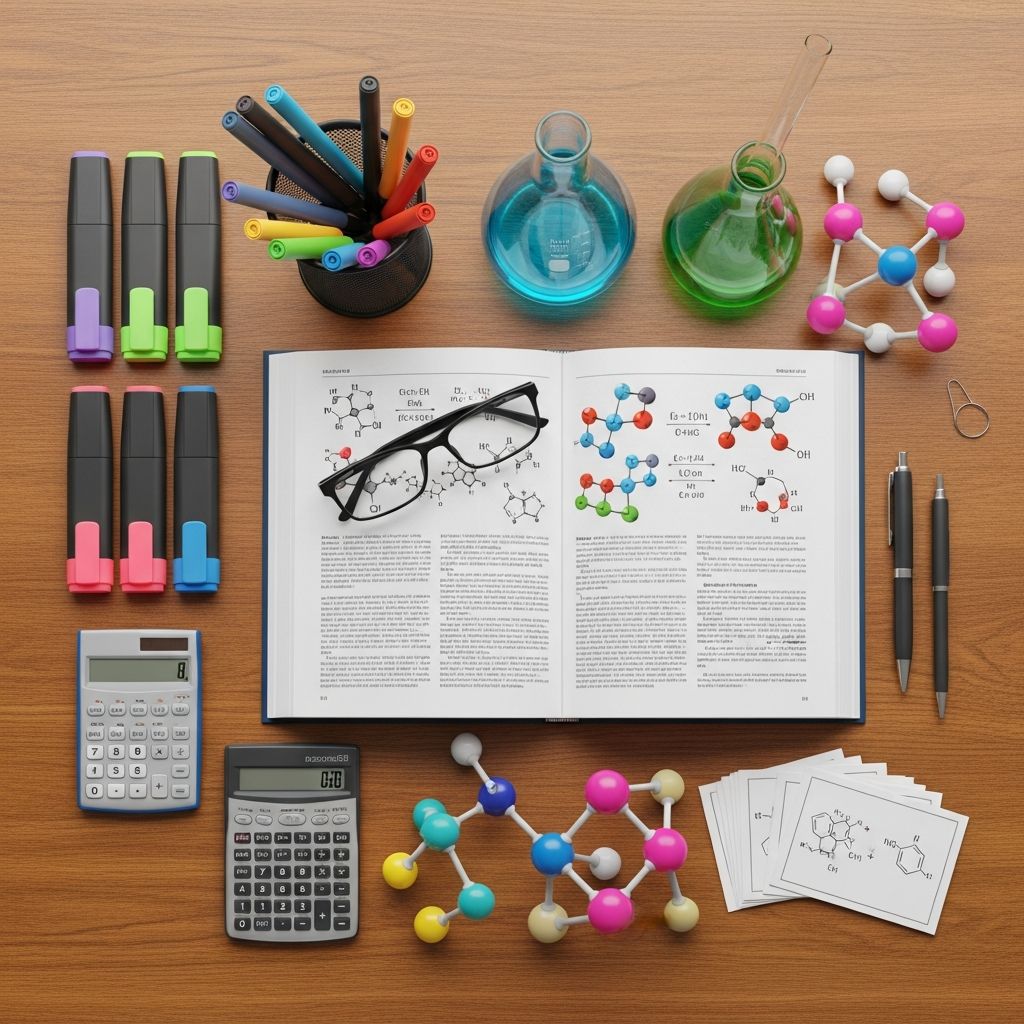
Chemistry demands a blend of conceptual grasp, mathematical precision, and consistent practice. High-performing students treat it as a skill to build systematically rather than a subject to cram. This guide outlines actionable methods to enhance comprehension, speed, and confidence across all chemistry levels.
Building a Solid Daily Routine for Chemistry Success
Consistency trumps intensity in chemistry learning. Dedicate time each day—ideally one hour minimum—to engage with material actively. Start early in the semester to avoid backlog buildup. Use short sessions during transitions like commutes for quick reviews of formulas or definitions.
Break study into focused blocks: 45-50 minutes of work followed by 10-minute breaks. This Pomodoro-style approach sustains attention and aids memory consolidation. Prioritize active tasks over passive reading, limiting the latter to 20% of your time.
- Scan readings before lectures to prime your brain for key ideas.
- Review notes immediately after class to fill gaps.
- End each day with 10-15 minutes recapping the session’s core concepts.
Active Recall: The Core of Effective Learning
Active recall strengthens neural pathways far beyond passive review. Close your book and write definitions, laws, or mechanisms from memory—then verify accuracy. For instance, jot Le Chatelier’s principle or the ideal gas law without peeking.
Track progress in a simple table: one column for concepts, another for your recall attempt, and a third for correctness. Repeat until three consecutive successes, then shift to weekly review. Research confirms this boosts long-term retention by 34%.
| Concept | Your Recall | Correct? | Streak |
|---|---|---|---|
| Electronegativity | Atom’s pull on electrons | Yes | 3 |
| Boyle’s Law | P1V1=P2V2 | Yes | 2 |
| Stoichiometry | Mole ratios | No | 0 |
Mastering Calculations Through Targeted Drills
Calculation fluency separates average from top performers. Allocate 20-30 minutes daily to one skill: mole conversions, dilutions, or balancing equations. Time yourself to simulate exam pressure, aiming to halve solution times within two weeks.
Show every step explicitly, even obvious ones. This builds partial credit potential and reveals error patterns like unit mismatches or arithmetic slips. Analyze misses: categorize as conceptual, procedural, or careless to direct future drills.
For stoichiometry, practice mixed sets blending combustion, limiting reagents, and percent yield. Speed gains free mental bandwidth for complex reasoning.
Visual Mapping for Conceptual Connections
Chemistry thrives on relationships between ideas. Ditch linear notes for diagrams linking variables. Sketch how temperature shifts equilibrium, rate, and energy in one view. Map organic pathways with electron arrows and intermediates.
Dual coding—pairing visuals with words—enhances recall via multiple brain channels. On tests, these mental images trigger faster than rote text. For redox, flowchart oxidation states step-by-step.
Pre-Lecture Preparation and Post-Lecture Synthesis
Approach lectures as reinforcement, not introduction. Preview assigned chapters: read opening pages and section intros for context. During class, note main points and unanswered questions.
Post-lecture, expand notes with textbook details. Solve embedded examples fully, writing solutions even for familiar ones. Discuss ambiguities in groups to solidify understanding.
Problem-Solving: Quantity and Quality Matter
Work every assigned problem, plus extras from varied sources. Quantity builds pattern recognition; quality ensures depth. Without notes initially, then check—mimic exam isolation.
Mix problem types weekly to prevent siloed knowledge. In organic chemistry, prioritize mechanisms over memorization: ask ‘why’ electrons move that way. Think molecularly: track bonds and charges.
Collaborative Learning and Teaching Others
Small study groups amplify insights. Assign roles: one explains a reaction, another quizzes, others critique. Teaching exposes weaknesses and reinforces your grasp.
Buddy up for problem walkthroughs, verbalizing logic. Groups exchange tricks for tough topics like nomenclature or spectroscopy. Limit to 3-4 peers for focused sessions.
Organic Chemistry: Beyond Memorization
Organic demands mechanistic insight. Visualize reactions as electron dances, not isolated facts. Flashcards for essentials, but prioritize ‘why’ pathways form.
Create reaction summaries: reactants to products with conditions and key intermediates. Practice retrosynthesis by working backward from targets.
Time Management and Avoiding Common Pitfalls
Plan weekly: allocate slots for new material, review, and mocks. Shun all-nighters; spaced repetition outperforms cramming.
Pitfalls: over-relying on homework (exams mix unpredictably), skipping basics, or ignoring labs. Labs cement theory—review procedures pre-session.
Flashcards and Summary Tools
Curate flashcards for high-yield facts: polyatomic ions, solubility rules, periodic trends. Use spaced repetition apps for efficiency.
Condense chapters into one-page summaries post-unit. Include visuals, equations, and exceptions.
Exam Simulation and Review
Weekly timed mocks under realistic conditions. Grade harshly, dissect errors for targeted fixes. Build endurance gradually.
Final review: cycle through weakness maps, visuals, and mixed problems. Sleep well—consolidation happens overnight.
Frequently Asked Questions
How much daily time for chemistry?
At least one hour, every day. Short, daily exposure builds mastery over sporadic marathons.
Best for organic chemistry?
Focus mechanisms, draw electron movements, and practice reactions actively rather than rote learning.
Struggling with calculations?
Drill one type daily, time yourself, show all steps, and categorize errors.
Group study effective?
Yes, for explaining concepts and quizzing—but keep groups small and structured.
Pre-lecture reading necessary?
Essential: skim for context to maximize lecture absorption.
Advanced Techniques for High Achievers
Tackle derivations: prove gas laws from postulates. Apply concepts cross-contexts, like kinetics in biology. Create original problems to test depth.
Integrate tech: simulations for molecular views, apps for quizzing. Track metrics like accuracy rates over weeks.
Succeeding in chemistry rewires thinking for all STEM. These strategies, rooted in cognitive science, transform struggle into strength. Commit to the process—results follow.
References
- 7 Ways to Study Chemistry and Improve Exam Scores in 14 Days — Numerous.ai. 2023. https://numerous.ai/blog/how-to-study-chemistry
- Study Strategies for Chemistry — Rhodes College Academic and Learning Resources. Accessed 2026. https://sites.rhodes.edu/academic-and-learning-resources/learning-tips/study-strategies-chemistry
- Chemistry Study Tips — GCC.edu. Accessed 2026. https://www.gcc.edu/Portals/0/Chemistry_Study_Tips.pdf
- 10 Awesome Study Skills and Strategies for Chemistry — CUNY SPS OpenLab. 2024-03. https://openlab.sps.cuny.edu/knowledge-bank/wp-content/uploads/sites/110/2024/03/10-awesome-study-skills-and-Strategies-for-Chemistry-GS.pdf
- Keys to Success in Chemistry — American University. Accessed 2026. https://www.american.edu/provost/academic-access/upload/keys-to-success-in-chemistry.pdf

- Integrated M.A. in Applied Linguistics, University of Hyderabad
- 5+ years in editorial, instructional, SEO, and research-based writing
Sneha is a relationships and lifestyle writer with a strong foundation in applied linguistics and certified training in relationship coaching. She brings over five years of writing experience to theskillvault, crafting thoughtful, research-driven content that empowers readers to build healthier relationships, boost emotional well-being, and embrace holistic living. Her writing and insights reflect the belief that beauty, happiness, and wellness…