
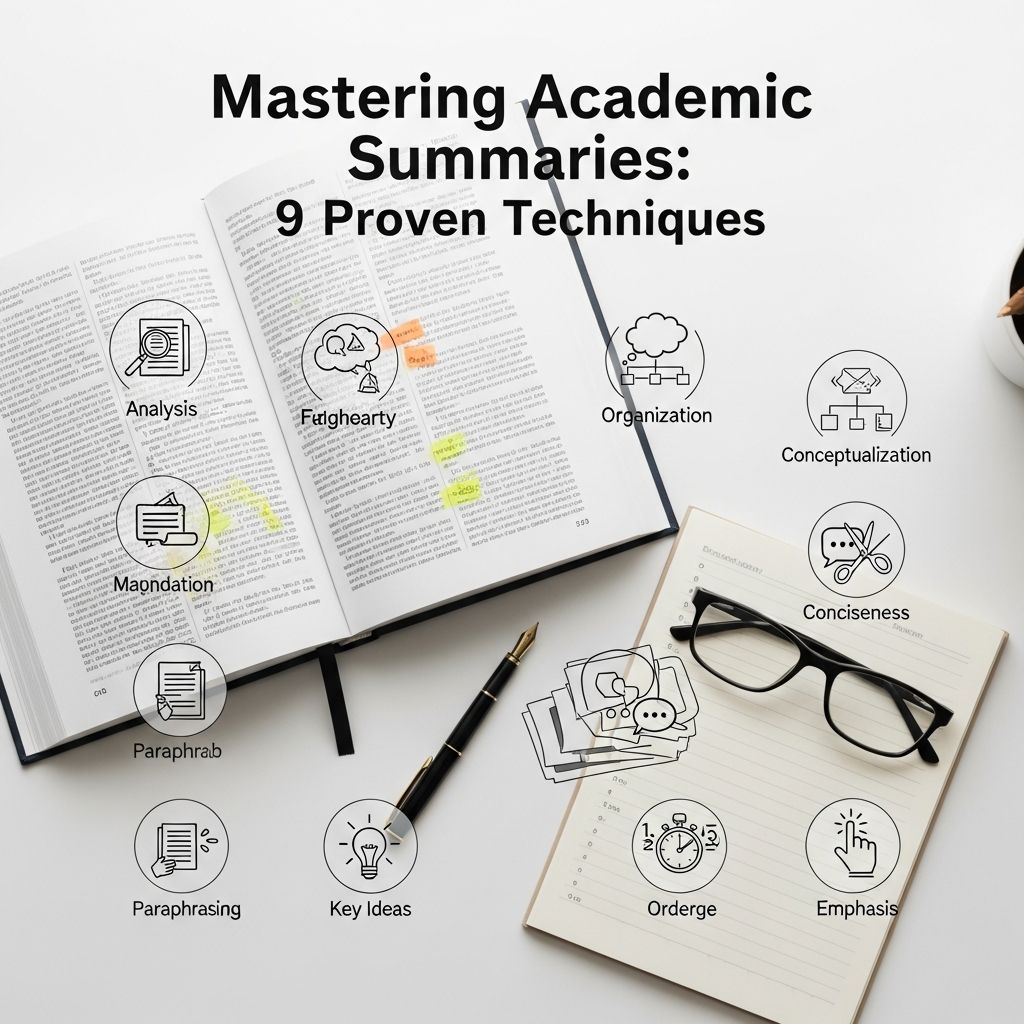
Summarizing academic articles and research papers is a fundamental skill for students, researchers, and professionals. It sharpens your ability to distill complex information into clear, concise forms, aiding in literature reviews, essays, and presentations. This guide presents nine original, actionable techniques drawn from established academic practices to help you create summaries that faithfully represent the source while highlighting critical elements.
Understanding the Essence of Effective Summarization
At its core, summarization involves capturing the main ideas, arguments, methods, findings, and implications of a scholarly work without injecting personal bias. Effective summaries are objective, brief, and structured, typically comprising 10-30% of the original length depending on the context—such as coursework or publication needs. They demonstrate deep comprehension and analytical prowess, enabling you to engage with vast bodies of literature efficiently.
Before diving into techniques, clarify your purpose: Are you summarizing for note-taking, a review paper, or class discussion? This focus guides the depth and structure, ensuring relevance. Academic papers follow standard formats—abstract, introduction, methods, results, discussion, and references—which provide a natural blueprint for your summary.
Technique 1: Conduct Thorough Initial Readings
Begin with multiple readings to build a solid foundation. First, skim the abstract, introduction, headings, and conclusion to grasp the overall scope and key claims. Then, read deeply at least twice: once for general understanding and again interactively, questioning the logic and evidence.
- Highlight the central research question or thesis in the introduction.
- Note methodology details without getting lost in minutiae.
- Identify pivotal results and their interpretations in the discussion.
This layered approach prevents misinterpretation and ensures you capture nuances.
Technique 2: Leverage Structured Annotations
Active annotation transforms passive reading into dynamic analysis. Use margins or digital tools to jot key elements: thesis, hypotheses, methods, major findings, limitations, and implications. Color-code for efficiency—yellow for arguments, blue for data, red for gaps.
For empirical papers, underline sentences addressing ‘how the study design tackles research questions’ and ‘result credibility’. This creates a roadmap, making summarization straightforward. Annotations also facilitate quick reviews, saving time during literature synthesis.
Technique 3: Pinpoint the Core Research Objectives
Every summary must start with the paper’s purpose. Articulate the primary goal, research questions, and hypotheses clearly. Ask: What problem does this study solve? Who or what was examined (demographics, variables)? This sets the summary’s foundation, mirroring the abstract’s role.
Example structure: “Smith et al. (2023) investigated [topic] to determine [hypothesis], focusing on [population].” This precision orients readers immediately.
Technique 4: Outline Methodologies Succinctly
Describe how the research was conducted without exhaustive details. Cover design type (experimental, survey), sample size, tools, and procedures. Use phrases like “Data were collected via [method] from [N] participants” to convey rigor concisely.
Avoid jargon overload; prioritize elements directly tied to outcomes. This section bridges purpose and results, maintaining logical flow.
Technique 5: Highlight Key Findings Objectively
Report results factually, using present tense and third-person: “The study found significant differences in [variable] (p < 0.05)”. Include tables or figures’ highlights if transformative, but paraphrase. Distinguish raw data from interpretations to uphold neutrality.
| Element | Example Summary Phrasing |
|---|---|
| Main Result | “Group A outperformed Group B by 25%.” |
| Statistical Note | “Supported by ANOVA (F(1,50)=12.3, p=0.001).” |
| Unexpected Finding | “Contrary to predictions, no effect on [variable].” |
Technique 6: Interpret Conclusions and Implications
Summarize the discussion’s takeaways: how findings answer questions, limitations, and broader impacts. Note suggestions for future work, e.g., “Authors recommend longitudinal studies to address [gap]”. This elevates your summary from descriptive to insightful.
Link back to the thesis: “These results confirm/reject the hypothesis, implying [real-world application].” Stay faithful—do not extrapolate.
Technique 7: Prioritize Clarity and Brevity in Drafting
Craft in paragraph form without subheadings for seamless flow. Use simple language, active voice where appropriate, and transitions (e.g., “subsequently,” “conversely”). Eliminate fillers: cut “it is clear that” to “results show”. Aim for an intelligent yet accessible tone.
- Combine sentences: “The method involved surveys. Surveys targeted 200 users.” → “Surveys of 200 users assessed…”
- Paraphrase rigorously to avoid plagiarism.
Technique 8: Revise Ruthlessly for Precision
Post-draft, compare against the original: Does it omit key points? Misrepresent intent? Revise for conciseness—target 1/5th original length. Tools like Hemingway App aid readability. Vary attributions: “According to Jones…” or “Jones posits…”.
Proofread for errors; ensure citations follow style guides (APA, MLA). Solicit peer feedback for objectivity.
Technique 9: Integrate Proper Attribution and Ethics
Always cite: Include bibliographic details upfront. Paraphrase over quoting; if quoting, limit to under 40 words. Common pitfalls: injecting opinions, over-detailing, or poor structure—sidestep by sticking to source fidelity.
Ethical summaries build credibility, preventing plagiarism accusations.
Practical Applications Across Disciplines
These techniques adapt universally—from STEM’s empirical focus to humanities’ argumentative summaries. In lit reviews, chain multiple summaries thematically. For presentations, use bullet-point variants. Practice on diverse papers to refine.
Benefits include faster research, improved retention (active recall via notes), and enhanced writing. Studies from university writing centers affirm summarization boosts critical thinking.
Frequently Asked Questions (FAQs)
What is the ideal length for an academic summary?
Typically 10-30% of the original, adjusted for purpose—shorter for notes, longer for reviews.
Should summaries include my analysis?
No; reserve analysis for separate sections. Summaries must remain objective.
How do I handle conflicting findings?
Report neutrally: “Results were mixed, with [specifics]”.
Is the abstract sufficient for summarizing?
No; it condenses info—verify with full text for accuracy.
What if the paper lacks a clear structure?
Infer from content: identify thesis, evidence, conclusions.
Mastering these nine techniques equips you to navigate scholarly literature confidently. Regular practice yields proficiency, streamlining your academic journey.
References
- Academic Writing Tips on How To Summarize a Journal Article — Proof-Reading-Service.com. 2023. https://www.proof-reading-service.com/blogs/academic-publishing/academic-writing-tips-on-how-to-summarize-a-journal-article
- How To Summarize Any Research Article Better: Proven Tips Outlined — Rev.com. 2023. https://www.rev.com/blog/how-to-summarize-a-research-article
- Summarizing: How to effectively summarize the work of others — Simon Fraser University Library (lib.sfu.ca). 2023. https://www.lib.sfu.ca/about/branches-depts/slc/writing/sources/summarizing
- Tips on Summarizing – Bruin Success with Less Stress — UCLA Library (guides.library.ucla.edu). 2023. https://guides.library.ucla.edu/bruin-success/3-10
- How to Summarize a Research Article — UConn Writing Center (writingcenter.uconn.edu). 2014-06-01. https://writingcenter.uconn.edu/wp-content/uploads/sites/593/2014/06/How_to_Summarize_a_Research_Article1.pdf

- Integrated M.A. in Applied Linguistics, University of Hyderabad
- 5+ years in editorial, instructional, SEO, and research-based writing
Sneha is a relationships and lifestyle writer with a strong foundation in applied linguistics and certified training in relationship coaching. She brings over five years of writing experience to theskillvault, crafting thoughtful, research-driven content that empowers readers to build healthier relationships, boost emotional well-being, and embrace holistic living. Her writing and insights reflect the belief that beauty, happiness, and wellness…